Identifying Core Sections of Your Portfolio
A well-structured portfolio is like a neatly organized exhibit of your professional journey. It gives potential employers or clients a clear view of your skills, accomplishments, and personality.
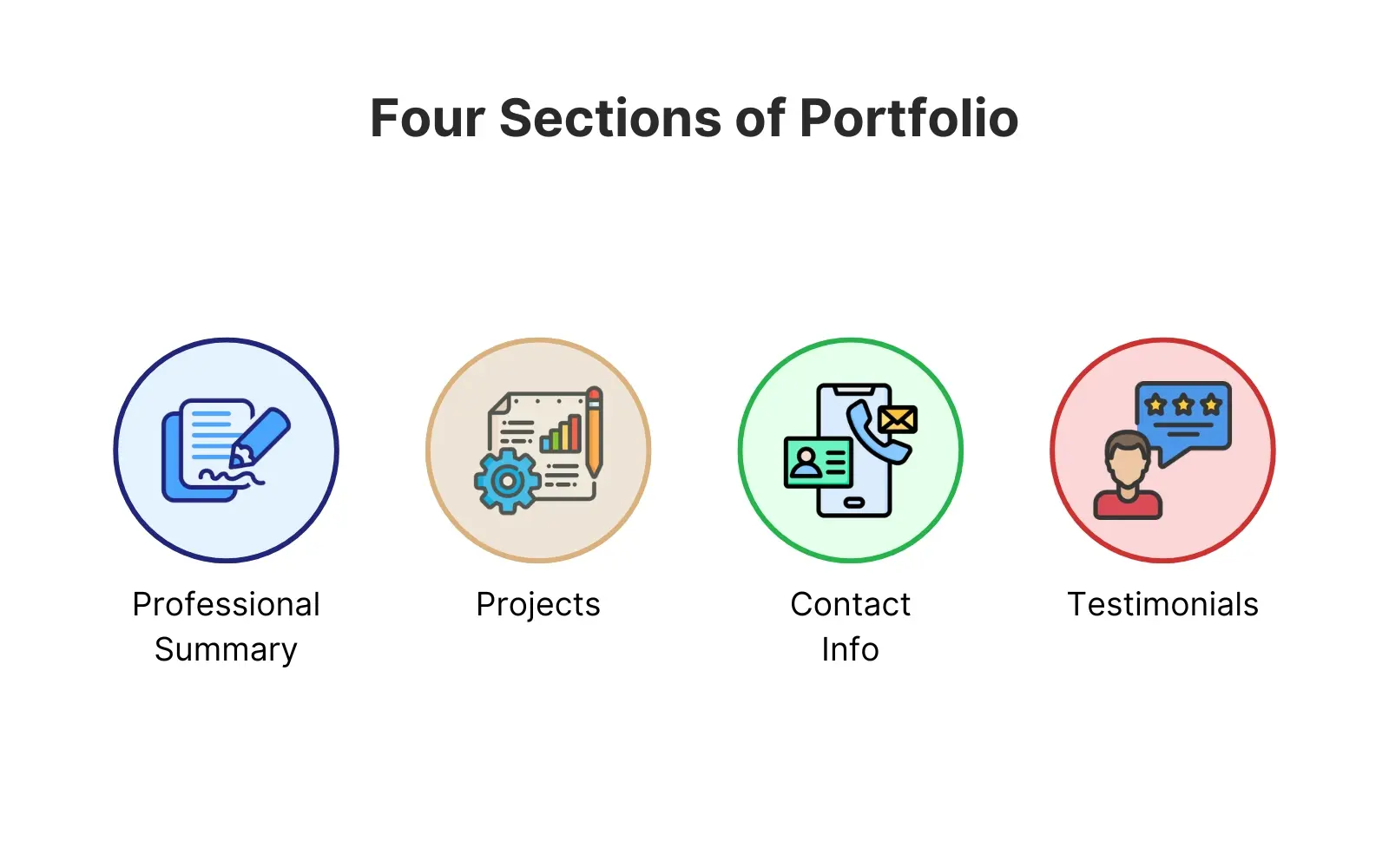
Four key sections—Professional Summary, Projects, Testimonials, and Contact Info—form the backbone of a compelling portfolio.
Let’s explore why each one matters and how to craft them effectively.
1. Professional Summary
This is a concise snapshot of your career story. It should briefly explain who you are, what you do, and what sets you apart.
- Key Elements
-
Role and Expertise: State your job title or core skill set (e.g., “Front-End Developer,” “Data Analyst,” “UX Designer”).
-
Unique Selling Point: Highlight a standout trait or focus area (e.g., “specializing in responsive design” or “experienced in machine learning for healthcare”).
-
Tone and Length: Keep it professional but personable, typically no longer than two or three sentences.
-
Example Prompt
“Summarize my background as a junior data analyst skilled in Python and SQL, focusing on healthcare projects. Keep it under 50 words.”
2. Projects
Your projects show what you can actually do.
Think of them as case studies that highlight your technical abilities, creativity, and problem-solving skills.
- Key Elements
-
Project Name & Context: Give each project a clear title and a short description of what it’s about.
-
Your Role: Explain your specific contributions. Did you design the interface, handle the backend, or manage a team?
-
Results & Metrics: Whenever possible, mention quantifiable outcomes (e.g., “Reduced load time by 40%,” “Increased user engagement by 25%”).
-
Tools Used: List any relevant languages, frameworks, or software.
-
Example Prompt
“Write a concise, bullet-point overview of my e-commerce redesign project where I improved user flow and boosted sales by 30%.”
3. Testimonials
Testimonials provide social proof of your abilities. These can be quotes from satisfied clients, colleagues, or mentors who can vouch for your work.
- Key Elements
-
Source: Include the name, role, or company of the person giving the testimonial (with their permission).
-
Highlight Strengths: Encourage them to focus on your skills, professionalism, or results.
-
Short and Impactful: Aim for one or two sentences that capture their endorsement clearly.
-
Example Prompt
“Create a two-sentence testimonial quote that highlights my commitment to deadlines and innovative approach, attributed to my former project manager at XYZ Corp.”
4. Contact Info
Finally, make it easy for people to get in touch. This section ensures that anyone interested in your work knows how to reach you quickly.
- Key Elements
-
Professional Email: Use a straightforward email address (e.g., yourname@domain.com).
-
Social Profiles: If relevant, link to your LinkedIn, GitHub, or other professional platforms.
-
Optional Channels: Include a website link or scheduling tool if you use one for appointments.
-
Example Prompt
“Generate a short concluding section with my professional email and a LinkedIn link, inviting readers to connect or ask for more details.”
Bringing It All Together
When you combine these four sections—Professional Summary, Projects, Testimonials, and Contact Info—you create a portfolio that’s both comprehensive and easy to navigate. Each part supports the others, forming a clear narrative that shows who you are, what you’ve done, and how interested parties can learn more.
With these essentials in place, you’re well on your way to crafting a portfolio that leaves a lasting impression.
🤖 Don't fully get this? Learn it with Claude
Stuck on Identifying Core Sections of Your Portfolio? Open Claude, copy a block below, and it'll teach you this exact concept — visually and interactively.
Build the mental picture, not memorization.
I just read a lesson on **Identifying Core Sections of Your Portfolio** (Career & Job Search) and want to truly understand it. Explain Identifying Core Sections of Your Portfolio from first principles using ONE vivid real-world analogy and a visual mental model — draw it as ASCII art or a clear step-by-step diagram — with a concrete example using real numbers. Then ask me one question to check I got the mental picture, and wait for my reply. If you're unsure or a claim isn't standard, say so and reason from first principles instead of guessing.
Socratic — adapts to where you're stuck.
Teach me **Identifying Core Sections of Your Portfolio** interactively. Ask me ONE guiding question at a time, wait for my answer, and adapt to my confusion — build the idea with me step by step instead of explaining it all at once. If you're unsure or a claim isn't standard, say so and reason from first principles instead of guessing.
Active recall exposes what you missed.
Quiz me on **Identifying Core Sections of Your Portfolio** with 5 questions, easy to tricky, ONE at a time. Tell me if each answer is right; at the end, explain clearly what I got wrong and why. If you're unsure or a claim isn't standard, say so and reason from first principles instead of guessing.
Intuition + hook + flashcards for long-term memory.
Help me remember **Identifying Core Sections of Your Portfolio** for the long term: give the one-sentence intuition, a memorable hook/mnemonic, a tiny worked example, and 3 active-recall flashcards (Q -> A). If you're unsure or a claim isn't standard, say so and reason from first principles instead of guessing.