Adjusting SEO in Your Portfolio
Search Engine Optimization (SEO) isn’t just for websites and blogs; it can also make your online portfolio more visible to potential employers and clients.
You can dramatically improve your chances of appearing in relevant searches by identifying key terms related to your field and using prompt engineering to refine your keyword strategy.
Below, we’ll discuss how to define relevant SEO keywords and how ChatGPT can help discover high-value terms for your portfolio content.
1. Defining SEO Keywords Relevant to Your Industry or Role
Employers and recruiters often search for candidates by using specific job titles, skills, or industry-related terms. If your portfolio includes those terms in a natural, readable way, you’re more likely to pop up in their search results.
How to Do It
-
Identify Core Skills and Terms
-
Make a list of what you do (e.g., “Full-Stack Development,” “Data Analysis,” “UX/UI Design”) and any tools or languages you commonly use (e.g., “React,” “Python,” “Figma”).
-
Consider soft skills or broader areas like “Project Management,” “Team Leadership,” or “Client Communication.”
-
-
Look at Industry Trends
-
Stay aware of buzzwords or hot topics in your field by reading articles, job listings, and LinkedIn posts.
-
Keep an eye out for specific certifications or niche skills that might set you apart.
-
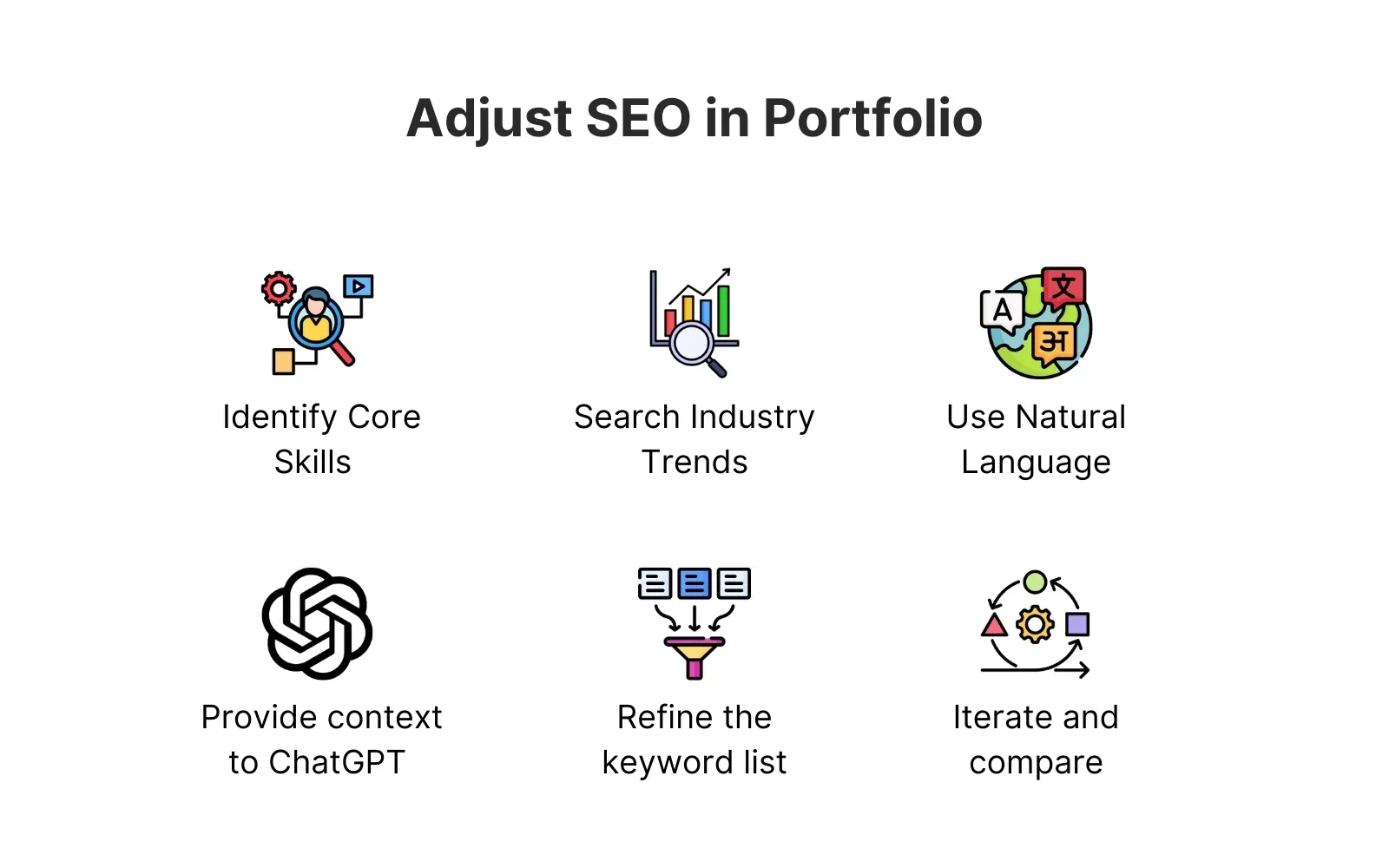
- Use Natural Language
-
Incorporate these keywords into your project descriptions, About section, and resume, but avoid keyword stuffing.
-
Example: “I leveraged React and Node.js to build a responsive e-commerce platform, reducing load times by 40%.”
-
2. Prompt Engineering to Discover High-Value Keywords for Your Content
Even if you have an idea of which keywords are important, ChatGPT can help refine your list and uncover potential terms you might not have considered.
This fine-tuned approach ensures you stay on the cutting edge of what employers and recruiters are actively looking for.
How to Do It
-
Provide Context to ChatGPT
-
Give details about your industry, role, and the kind of work you do.
-
Prompt Example:
“List 10 high-impact keywords for a front-end developer who specializes in React, TypeScript, and user-focused design. Focus on phrases recruiters might use when searching on LinkedIn.”
-
-
Refine the Keyword List
-
If the initial output is too broad or generic, narrow it down by specifying your target audience or skill level.
-
Prompt Example:
“Now narrow these keywords to focus on mid-level developers with 3–5 years of experience in Agile environments.”
-
-
Iterate and Compare
-
Request multiple versions of keyword lists to see which terms consistently appear, and combine the best of each.
-
Prompt Example:
“Based on these lists, suggest the top 5 keywords that would most likely catch a hiring manager’s attention for a role in SaaS product development.”
-
Best Practices for Integrating Keywords
-
Use Keywords in High-Value Sections
- Place your most important keywords in titles, headings, or the first few sentences of your project descriptions.
-
Maintain Readability
- Your content should still read naturally. Overloading your portfolio with repetitive terms can alienate human readers and may even harm your search visibility.
-
Update Regularly
- Keyword trends change over time. Therefore, revisit your portfolio every few months to ensure your content aligns with current industry language.
Let's Test AI
Now, it's your turn!
Try ChatGPT to see what skills it suggests by entering your job role.
You can tweak the prompt a bit or rewrite according to your own requirements.
🤖 Don't fully get this? Learn it with Claude
Stuck on Adjusting SEO in Your Portfolio? Open Claude, copy a block below, and it'll teach you this exact concept — visually and interactively.
Build the mental picture, not memorization.
I just read a lesson on **Adjusting SEO in Your Portfolio** (Career & Job Search) and want to truly understand it. Explain Adjusting SEO in Your Portfolio from first principles using ONE vivid real-world analogy and a visual mental model — draw it as ASCII art or a clear step-by-step diagram — with a concrete example using real numbers. Then ask me one question to check I got the mental picture, and wait for my reply. If you're unsure or a claim isn't standard, say so and reason from first principles instead of guessing.
Socratic — adapts to where you're stuck.
Teach me **Adjusting SEO in Your Portfolio** interactively. Ask me ONE guiding question at a time, wait for my answer, and adapt to my confusion — build the idea with me step by step instead of explaining it all at once. If you're unsure or a claim isn't standard, say so and reason from first principles instead of guessing.
Active recall exposes what you missed.
Quiz me on **Adjusting SEO in Your Portfolio** with 5 questions, easy to tricky, ONE at a time. Tell me if each answer is right; at the end, explain clearly what I got wrong and why. If you're unsure or a claim isn't standard, say so and reason from first principles instead of guessing.
Intuition + hook + flashcards for long-term memory.
Help me remember **Adjusting SEO in Your Portfolio** for the long term: give the one-sentence intuition, a memorable hook/mnemonic, a tiny worked example, and 3 active-recall flashcards (Q -> A). If you're unsure or a claim isn't standard, say so and reason from first principles instead of guessing.