Compare-And-Swap (CAS) & the ABA Problem
Compare-and-swap is a single CPU instruction that reads a memory word, checks it still equals a value you expected, and writes a new value — all as one indivisible step that no other core can interleave. On x86 this is LOCK CMPXCHG: the LOCK prefix makes the core acquire exclusive ownership of the target cache line (MESI 'M/E' state) for the read-compare-write, so any competing core's write either happened strictly before or strictly after — never in the middle. On ARM/POWER the same effect is built from a load-linked / store-conditional pair (LDXR/STXR): the store succeeds only if nobody touched the line since the load. Either way the hardware gives you an atomic conditional write, and that one primitive is the foundation every lock-free data structure is built on.
Why it matters
A mutex serializes threads: only one runs the critical section, the rest block, and if the holder is preempted (or crashes) everyone waits. CAS lets many threads race optimistically — each computes its update against a snapshot and commits only if nothing changed underneath it. There is no lock to hold, so a thread that stalls mid-operation cannot freeze the others (lock-freedom: system-wide progress is guaranteed). This is how AtomicLong.incrementAndGet, Java's ConcurrentHashMap bucket updates, and Go's runtime scheduler counters avoid a global lock on the hot path. The cost: you must be able to express the update as 'read → compute → conditionally commit → retry on failure,' and you inherit a subtle correctness trap — the ABA problem.
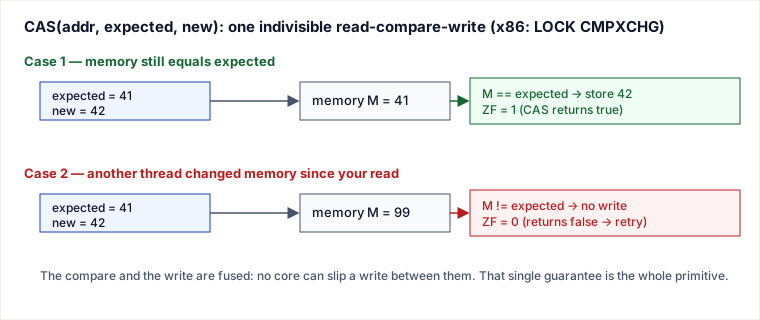
The optimistic retry loop
Because CAS can fail (someone else committed first), you wrap it in a loop: snapshot the current value, compute the new value from that snapshot, attempt to commit, and retry from a fresh snapshot on failure. A failed CAS is not an error — it is the signal 'the world moved; recompute.'
Trace a concurrent counter at start value 41 with threads T1 and T2 both incrementing:
| step | T1 | T2 | counter |
|---|---|---|---|
| 1 | read cur=41, next=42 | read cur=41, next=42 | 41 |
| 2 | CAS(41→42) ✓ true | — | 42 |
| 3 | — | CAS(41→42) ✗ false (M is 42) | 42 |
| 4 | — | retry: read cur=42, next=43 | 42 |
| 5 | — | CAS(42→43) ✓ true | 43 |
No update was lost — T2's stale CAS failed and it recomputed against the new value. Java and Go express the identical loop:
// Java — java.util.concurrent.atomic
final AtomicLong counter = new AtomicLong(41);

long incrementAndGet() {
    long cur, next;
    do {
        cur  = counter.get();      // snapshot
        next = cur + 1;            // compute off the snapshot
    } while (!counter.compareAndSet(cur, next)); // commit or retry
    return next;
}
// Go — sync/atomic
var counter int64 = 41
func incrementAndGet() int64 {
for {
cur := atomic.LoadInt64(&counter)
next := cur + 1
if atomic.CompareAndSwapInt64(&counter, cur, next) {
return next
}
}
}Runtime note: the JVM lowers compareAndSet to a hardware CAS intrinsic (via Unsafe/VarHandle) — no JNI, no lock. Go's atomic.CompareAndSwapInt64 is an assembly intrinsic likewise. Both give sequentially-consistent ordering for the atomic itself, so the loop is also a memory fence.
The ABA problem
CAS compares values (or pointer bits), not history. It cannot tell 'unchanged the whole time' apart from 'changed to B and back to A.' If the word held A when you read it and holds A again when you CAS, the swap succeeds — even though the world you assumed is gone. For a plain counter this is harmless (42 is 42). For a pointer it is a real bug, because the address may have been freed and recycled to a different logical node.
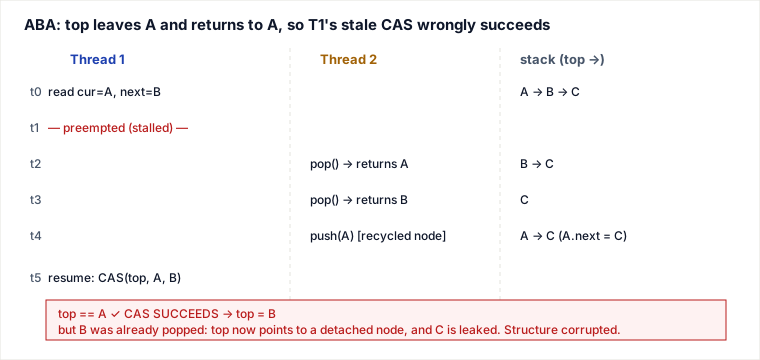
Trace a lock-free Treiber stack holding A → B → C (top = A). T1 starts a pop:
- T1 reads
cur = A, computesnext = A.next = B. It is about toCAS(top, A, B)— then the scheduler preempts it. - T2 runs freely:
pop()returns A (top → B),pop()returns B (top → C). - T2 reuses node A (from a free list / object pool) and
pushes it: top → A, andA.next = C. Stack is nowA → C. - T1 resumes and executes
CAS(top, A, B). top is A (same address / same reference), so CAS succeeds and sets top = B.
Disaster: B was already popped. top now points at a detached, possibly-freed node; C is leaked out of the stack. The structure is silently corrupted by a CAS that 'succeeded.' The read and the CAS both saw A — ABA slipped between them.
The fixes: version the word, not just the value
All fixes make the word carry identity over time so a round-trip A→B→A is detectable:
- Tagged / versioned pointer (stamp). Pair the pointer with a monotonically increasing counter and CAS the pair. Even if the pointer returns to A, the stamp advanced, so the CAS on
(A, stamp)fails. This is the standard fix. - Double-width CAS (DWCAS). Steal a hardware instruction that swaps two adjacent words atomically — x86-64
LOCK CMPXCHG16B(128-bit: 64-bit pointer + 64-bit tag). C++ exposes it via a named struct:struct TaggedPtr { Node* ptr; uint64_t tag; }; std::atomic<TaggedPtr> top; top.compare_exchange_strong(expected, desired);— the type has to be named because you cannot pass an anonymous struct as a template argument. A 64-bit tag effectively never wraps, so ABA is eliminated in practice. - Pointer tag bits. When alignment leaves low/high pointer bits free, pack a small counter into them and use ordinary single-word CAS. Cheap but the tag is tiny, so it can wrap — a risk on very hot structures.
- Safe reclamation (hazard pointers, epoch-based reclamation, RCU): don't reuse a node's memory while any thread might still hold it, which removes the recycling that makes ABA harmful. This is what production allocators/GCs lean on.
Java packages the versioned-pointer fix as AtomicStampedReference<V> — a reference plus an int stamp, CAS'd together:
// Java — ABA-safe Treiber pop using AtomicStampedReference
static final class Node<E> { final E item; Node<E> next; Node(E i){item=i;} }
final AtomicStampedReference<Node<E>> top =
        new AtomicStampedReference<>(null, 0);

E pop() {
    int[] stampHolder = new int[1];
    Node<E> cur, next;
    do {
        cur = top.get(stampHolder);        // read ref + its stamp
        if (cur == null) return null;
        next = cur.next;
    } while (!top.compareAndSet(
                cur, next,                 // expected ref, new ref
                stampHolder[0], stampHolder[0] + 1)); // expected stamp, new stamp
    return cur.item;
}
Now the T1/T2 trace fails safely: after T2's pop/pop/push the stamp is 3, but T1 still expects stamp 0, so compareAndSet(A, B, 0, 1) returns false and T1 harmlessly retries. Go has no built-in stamped reference; you build the same thing with atomic.Uint64 packing (pointer index + version) or atomic.Pointer[T] plus epoch-based reclamation.
Pitfalls a working engineer hits
- 'GC means no ABA' is false. A tracing GC stops a node from being freed while reachable, which prevents the classic use-after-free ABA. But the moment you recycle nodes yourself — object pools, free lists, reused array slots — the same reference reappears and ABA returns. Node pooling is common precisely on the hot lock-free paths that most need CAS.
- ABA only bites pointers/handles, not scalars. Don't reach for a stamped reference on a plain counter; the added CAS width and allocation are pure overhead there.
AtomicStampedReferenceboxes. Each instance wraps ref+stamp in an internalPairobject allocated on every successful update — real allocation churn under contention. If you can spare pointer bits, tag-in-pointer avoids the box.- Livelock, not deadlock. Lock-free CAS loops never deadlock, but under heavy contention threads can spin retrying repeatedly (progress is guaranteed for some thread, not fairness for a given one). Watch CPU burn on the retry loop; consider backoff.
- Spurious LL/SC failures. On ARM/POWER,
STXRcan fail even with no real conflict (context switch, cache eviction). Correct code already retries, but a tight loop with a function call between LL and SC may never make progress — keep the CAS window minimal. - ABA can hide behind 'it worked in testing.' The window is a preemption between your read and CAS; it surfaces only under real contention and recycling, often first in production. Reason about it, don't test for it.
Trade-offs & when to use CAS vs a mutex
The named alternative is a blocking lock (ReentrantLock / synchronized in Java, sync.Mutex in Go).
| CAS / lock-free | Mutex (blocking lock) | |
|---|---|---|
| Progress | Lock-free: a stalled thread never blocks others | Holder stall/crash blocks everyone |
| Contention behavior | Optimistic; wasted work + retries as contention rises | Pessimistic; parks waiters (no wasted CPU spinning) |
| Critical section | Must fit one word (or a small tuple via DWCAS) | Arbitrary multi-word invariants, freely |
| Correctness cost | ABA, memory ordering, reclamation — subtle | Simple to reason about |
Use CAS when the update is a single word or pointer, contention is low-to-moderate, and you cannot tolerate one thread blocking the rest (hot counters, single-linked lock-free stacks/queues, flags, futures resolving once). Use a mutex when the invariant spans multiple fields (transfer between two accounts, resize-then-rehash), when contention is high enough that spinning wastes more than parking, or simply when clarity matters more than the last ounce of throughput. A senior default: reach for Atomic* for a single value; reach for a lock the moment two fields must change together — don't contort several CAS'd words to fake a multi-word transaction.
Takeaways
- CAS is one atomic read-compare-write (
LOCK CMPXCHG/ LL-SC); it is the single primitive under all lock-free code, always used inside a snapshot-compute-commit-retry loop where a failed CAS just means 'retry.' - CAS compares values, not history — so A→B→A looks unchanged. That's the ABA problem, and it corrupts pointer-based structures (freed/recycled nodes), not scalar counters.
- Fix ABA by versioning the word: a stamp (Java
AtomicStampedReference), double-width CAS (CMPXCHG16B), pointer tag bits, or safe reclamation (hazard pointers / epochs / RCU). - Choose CAS for single-word, progress-critical hot paths; choose a mutex the moment an invariant spans multiple fields.
Recall
A lock-free stack uses a plain AtomicReference<Node> and a per-thread free list that recycles popped nodes. Under a GC that never frees a reachable node, can ABA still corrupt the stack — and if so, exactly when? (Answer: yes. GC prevents use-after-free, but the free list re-pushes the same node object, so its reference reappears at top; a thread that read the old top and stalled will have its CAS(top, A, oldNext) succeed against a node whose next now points elsewhere — detaching live nodes. The stamp/version is what closes the window.)
L0 · CAS is one atomic read-compare-write; it can't distinguish "unchanged" from "changed and changed back," which is the ABA problem.
L1 · ① Concurrency — "Two threads both read counter=41 and both attempt CAS(41→42) — what happens to the loser?"
Trap: "Both succeed, since they both read the same value 41."
Bar: The LOCK prefix (or LL/SC pair) gives exclusive ownership of the cache line for the compare-and-write as one fused step, so only one core's CAS can observe M==expected at any instant; the loser's memory has already moved, its CAS returns false, and it must reread and recompute — the retry loop, not application logic, is what prevents the lost update. connects-to: atomics & CAS foundations
L2 · ② Failure — "T1 is preempted right before CAS(top, A, B) on a Treiber stack, then resumes later — is the eventual success safe?"
Trap: "The address still matches A, so CAS succeeding means nothing changed underneath it."
Bar: A successful CAS only proves the bit-pattern at top equals A right now — it can't tell that A was popped, freed, recycled, and re-pushed while T1 stalled; the fix is CAS-ing a (pointer, monotonic stamp) pair so a round-trip A→B→A still advances the stamp and the stale CAS is rejected even though the pointer matches. connects-to: Treiber stack / Michael-Scott queue
L3 · ④ Time/Lifecycle — "Does a tracing garbage collector eliminate ABA?"
Trap: "Yes — GC never frees a reachable node, so the recycled-address bug can't happen."
Bar: GC only prevents use-after-free ABA; the moment you run your own free list or object pool, the node stays reachable (GC is satisfied) but its identity is deliberately reused, so the same reference reappears at the head and a stale CAS still succeeds wrongly — the fix has to live in the algorithm (stamped reference, hazard pointer, epoch reclamation), not in the allocator. connects-to: hazard pointers / epochs / RCU
L4 · ⑤ Adversary/Edge — "On ARM, STXR fails even though nothing touched your data — does that break your CAS-based algorithm?"
Trap: "That's a hardware bug, or my algorithm has a race."
Bar: Spurious LL/SC failure is architecturally permitted — an interrupt, a cache-line eviction, or even an unrelated write to the same line (false sharing under MESI) can drop the reservation with no logical conflict; correct code treats every CAS failure identically (retry from a fresh read), so spurious failures only cost throughput, never correctness — the real danger is a tight loop with a function call between LL and SC that never lets the store land. connects-to: MESI cache coherence & false sharing
L5 · ⑥ Cost/Simplicity — "At 64 threads hammering one CAS'd counter, is lock-free still the right call?"
Trap: "Lock-free is always faster than a mutex — that's the whole point of avoiding locks."
Bar: Past a contention threshold, every winning write invalidates the cache line for all other cores, so losers reread, recompute, and CAS again against a line that's already stale by the time they retry — throughput collapses into wasted spinning worse than a mutex, which just parks waiters instead of burning CPU; lock-free wins are proven for a single word under low-to-moderate contention, not universally. connects-to: memory ordering & happens-before
The floor keeps dropping: lock-free is not wait-free — under adversarial scheduling one specific thread can be perpetually out-raced and retry forever even while the system as a whole keeps making progress; and try designing an ABA-safe stack with zero spare pointer bits and no double-width CAS available — the only remaining lever is safe reclamation, not versioning.
Self-locate: died at L1 → mid-level; L4+ → staff signal.
Facing any new concept? Hit it with the six: concurrent? failing? at 100×? over time? adversarial? worth the cost? — that's the interviewer's whole playbook.
Sources: Herlihy & Shavit, The Art of Multiprocessor Programming (CAS, Treiber stack, ABA, LL/SC); Goetz et al., Java Concurrency in Practice (atomics, nonblocking algorithms); Michael & Scott, Simple, Fast, and Practical Non-Blocking and Blocking Concurrent Queue Algorithms (PODC 1996); Maged Michael, Hazard Pointers (IEEE TPDS 2004); Intel 64 & IA-32 SDM Vol.2 (CMPXCHG/CMPXCHG16B, LOCK); JDK javadocs for AtomicReference / AtomicStampedReference; Go sync/atomic docs. Re-authored/Deepened for this guide.
🤖 Don't fully get this? Learn it with Claude
Stuck on Compare-And-Swap (CAS) & the ABA Problem? Open Claude, copy a block below, and it'll teach you this exact concept — visually and interactively.
Build the mental picture, not memorization.
I just read a lesson on **Compare-And-Swap (CAS) & the ABA Problem** (Concurrency) and want to truly understand it. Explain Compare-And-Swap (CAS) & the ABA Problem from first principles using ONE vivid real-world analogy and a visual mental model — draw it as ASCII art or a clear step-by-step diagram — with a concrete example using real numbers. Then ask me one question to check I got the mental picture, and wait for my reply. If you're unsure or a claim isn't standard, say so and reason from first principles instead of guessing.
Socratic — adapts to where you're stuck.
Teach me **Compare-And-Swap (CAS) & the ABA Problem** interactively. Ask me ONE guiding question at a time, wait for my answer, and adapt to my confusion — build the idea with me step by step instead of explaining it all at once. If you're unsure or a claim isn't standard, say so and reason from first principles instead of guessing.
Active recall exposes what you missed.
Quiz me on **Compare-And-Swap (CAS) & the ABA Problem** with 5 questions, easy to tricky, ONE at a time. Tell me if each answer is right; at the end, explain clearly what I got wrong and why. If you're unsure or a claim isn't standard, say so and reason from first principles instead of guessing.
Intuition + hook + flashcards for long-term memory.
Help me remember **Compare-And-Swap (CAS) & the ABA Problem** for the long term: give the one-sentence intuition, a memorable hook/mnemonic, a tiny worked example, and 3 active-recall flashcards (Q -> A). If you're unsure or a claim isn't standard, say so and reason from first principles instead of guessing.