Before the Advent of Database
Traditional File System
Before databases became the backbone of data storage and retrieval, the traditional file system was the primary way organizations stored data. This system involved storing data in files and directories on physical media such as hard drives. Each application had its own set of files, often organized in a hierarchical or sequential manner. Data was managed through a combination of file formats and custom software programs to read and write information.
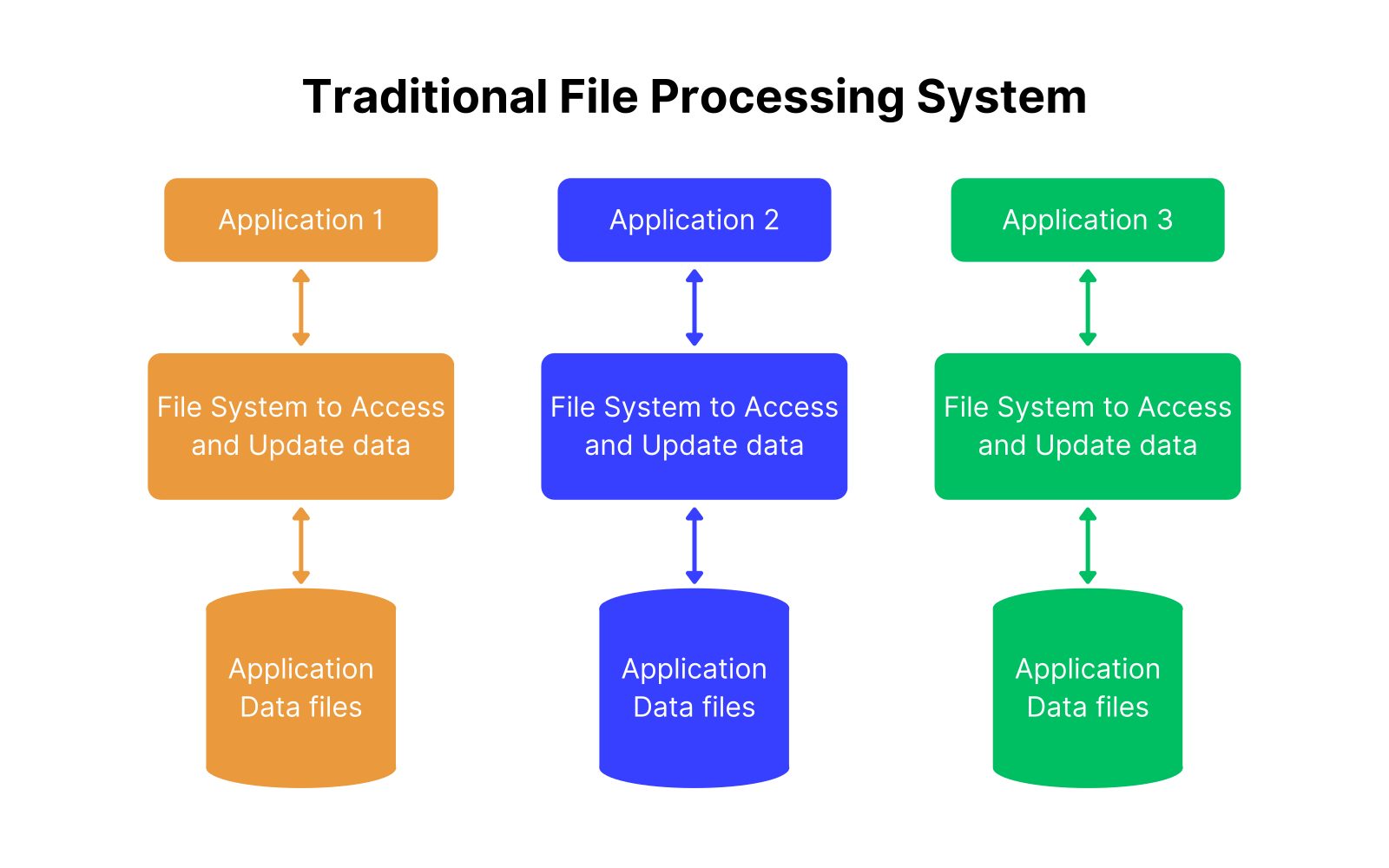
- Structure: Files were structured in formats like text files, CSVs, and binary files.
- Access: Data access was typically sequential or indexed for improved retrieval in some systems.
- Management: Each department or application maintained its own files independently.
Disadvantages of the File System
While the traditional file system worked for basic data storage needs, it presented significant limitations as data complexity and usage increased:
-
Data Redundancy and Inconsistency:
- Redundant Storage: Multiple copies of the same data are stored in different files, leading to unnecessary storage consumption.
- Inconsistency (Data Drift): Updates in one file are not automatically propagated to others, causing discrepancies.
Worked Example — Student Registrar vs. Billing Files:
Imagine a school department using two separate flat CSV files:Enrollment.csv(Registrar):[student_id: 101, name: "Asha Kumar", address: "12 Main St", course: "CS101"]Billing.csv(Finance):[student_id: 101, name: "Asha Kumar", address: "12 Main St", balance: 1500]
Enrollment.csvis updated. The Billing address remains "12 Main St". This leads to inconsistency (data drift) because there is no single source of truth or shared transaction manager. -
Data Isolation:
- Lack of Integration: Data scattered across various files and formats made it difficult to integrate and retrieve related information.
- Complex Access: Retrieving related data often required complex and manual programming.
-
Difficulty in Data Access:
- Programming Dependency: Accessing data required significant programming effort, limiting quick data retrieval.
- Sequential Access Limitations: Searching large files was slow and inefficient, especially when data was stored sequentially.
-
Lack of Security:
- No Centralized Control: File systems did not have a unified way to enforce security or control data access.
- Vulnerability: Data was often exposed to unauthorized access without proper access control mechanisms.
-
Limited Data Integrity and Reliability:
- Error-Prone: Maintaining data integrity required manual programming, which was error-prone and unreliable.
- Data Corruption: Files were more susceptible to corruption, especially if data was accessed concurrently by multiple programs.
-
Challenges with Data Scalability:
- Hard to Scale: The file system was not designed to handle large-scale data effectively.
- Manual Management: Growth in data volume made file management cumbersome and complex.
Why the Database Was Invented
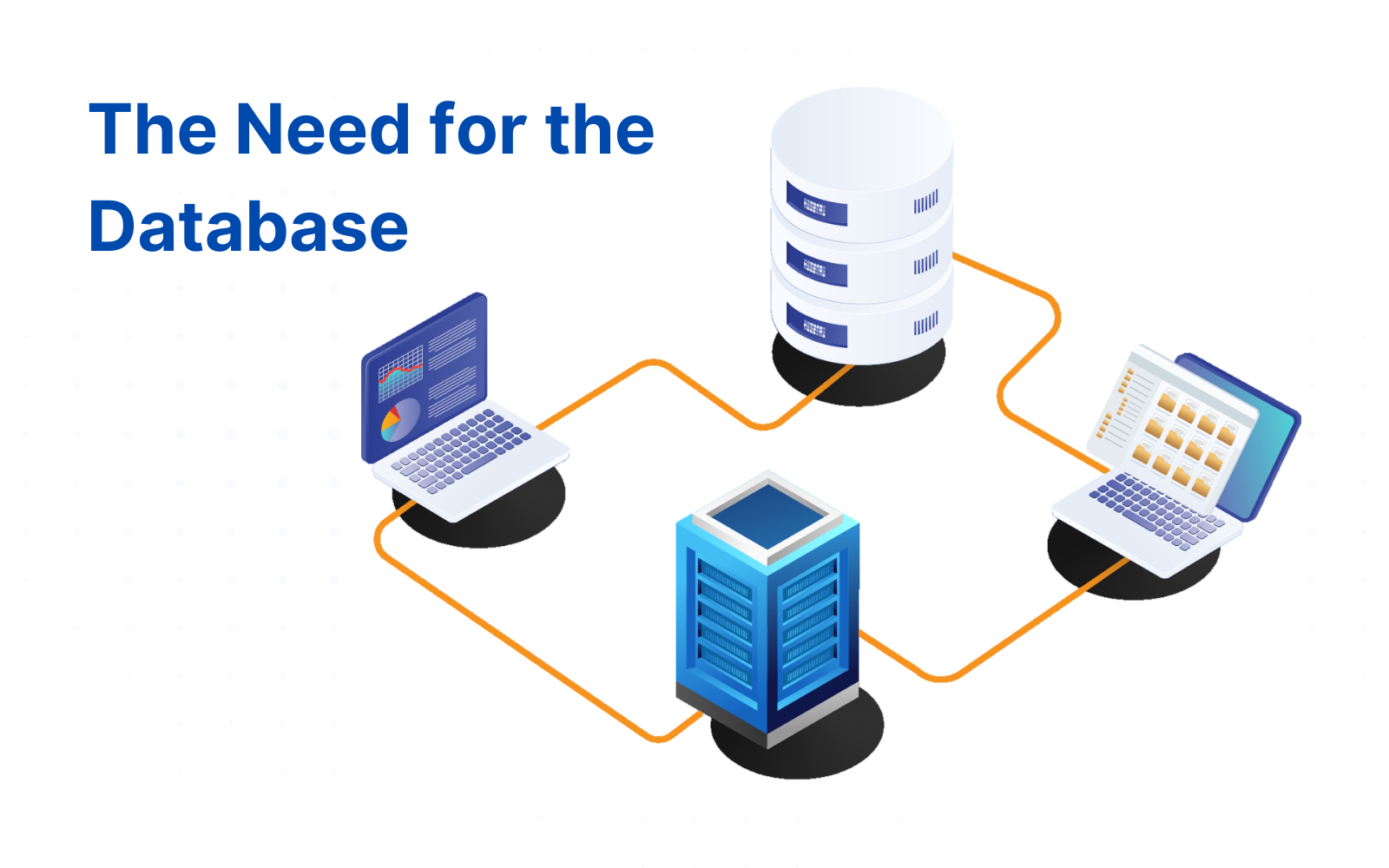
The limitations of traditional file systems paved the way for the invention of database systems. As data grew in volume, complexity, and importance, a more organized, reliable, and efficient system was required.
Databases were developed to:
- Reduce Data Redundancy: Centralize data storage to ensure that the same piece of data is not duplicated across multiple locations.
- Improve Data Consistency: Establish a single source of truth so that data changes are reflected across all systems using it.
- Enhance Data Access: Provide more flexible, faster, and structured query methods through languages like SQL.
- Support Concurrent Access: Allow multiple users and applications to access and modify data simultaneously without data integrity issues.
- Strengthen Security and Authorization: Offer robust mechanisms for securing data and controlling access based on user roles.
- Ensure Data Integrity and Reliability: Maintain data accuracy through constraints, relationships, and checks automatically enforced by the database system.
When a File System Is Actually Preferred
Despite their disadvantages, traditional file systems are not obsolete. They are the optimal choice over databases in several major engineering scenarios:
- Sequential Log Appends: Writing application access logs (like Nginx/Apache logs) or append-only event streams (like Kafka broker partition segments) is significantly faster when written directly to flat files on the filesystem. Doing so avoids the CPU, parsing, and locking overhead of database query processors.
- Static Configuration Files: Small, read-only configuration blocks (JSON, YAML, INI) are loaded into RAM once at application startup. Spinning up or querying a DBMS to fetch them adds unnecessary network latency and operational complexity.
- Raw Media and Large Object Storage: Storing high-resolution images, videos, or PDFs inside a database (using BLOB/Bytea columns) bloats the database page cache, index trees, and backup recovery times. High-performance architectures store raw files in a hierarchical filesystem (or cloud object storage) and store only their metadata paths in the database.
🎯 STRICT STANDOUT: Why / mental model / when-not / worked / failure / hostile panel — Before the Advent of Database
Why this concept exists (judgment layer)
File-per-app storage is the default before a shared DBMS: it explains why databases were invented (single source of truth, concurrent writers, constraints) and why the file system still wins for logs, config, and blobs.
Mental model (install this intuition)
Redundancy → drift. If the same fact (address) is copied into two files with no shared transaction, the second writer is always wrong after the first update. A DBMS centralizes that fact; a file system is fine when one writer owns the file and readers tolerate eventual copies.
Worked example with numbers or traced steps
Enrollment.csv: student 101 → address '12 Main St'
Billing.csv:    student 101 → address '12 Main St'
Registrar updates Enrollment → '88 Oak Rd'
Billing still '12 Main St'  → invoice mailed to old address
Cost: 1 silent inconsistency; no constraint, no cascade, no audit row
DB fix: Student(address) once; both apps read same row under isolation
When NOT to use / named alternative
Prefer flat files / object storage for append-only logs (nginx, Kafka segments), static config loaded once at boot (YAML/JSON), and large media blobs (store path in DB, bytes on disk/S3). Do not force a DBMS under every byte of IO.
Failure mode & ops fingerprint
Ops fingerprint: two CSVs disagree on customer fields after a 'simple' address change; support tickets about wrong ship-to; no foreign keys so orphan invoice rows survive deleted customers. Detect with nightly hash-diff of natural keys across silos.
Hostile-panel drills (defend the decision)
Q1. Why is redundancy the root cause of registrar/billing drift, not 'bad process'?
Model answer: Two independent writers of the same fact have no atomic multi-file update; process cannot guarantee both files commit together without a transaction manager.
Q2. When would you deliberately keep student photos out of the RDBMS?
Model answer: Large BLOBs bloat page cache, indexes, and backup RTO; store in object storage and keep only metadata/path in the relational row.
Q3. Name one integrity property files do not enforce that an RDBMS does by default.
Model answer: Referential integrity (FK), CHECK/UNIQUE constraints, or multi-row atomicity under concurrent writers.
🤖 Don't fully get this? Learn it with Claude
Stuck on Before the Advent of Database? Open Claude, copy a block below, and it'll teach you this exact concept — visually and interactively.
Build the mental picture, not memorization.
I just read a lesson on **Before the Advent of Database** (Databases) and want to truly understand it. Explain Before the Advent of Database from first principles using ONE vivid real-world analogy and a visual mental model — draw it as ASCII art or a clear step-by-step diagram — with a concrete example using real numbers. Then ask me one question to check I got the mental picture, and wait for my reply. If you're unsure or a claim isn't standard, say so and reason from first principles instead of guessing.
Socratic — adapts to where you're stuck.
Teach me **Before the Advent of Database** interactively. Ask me ONE guiding question at a time, wait for my answer, and adapt to my confusion — build the idea with me step by step instead of explaining it all at once. If you're unsure or a claim isn't standard, say so and reason from first principles instead of guessing.
Active recall exposes what you missed.
Quiz me on **Before the Advent of Database** with 5 questions, easy to tricky, ONE at a time. Tell me if each answer is right; at the end, explain clearly what I got wrong and why. If you're unsure or a claim isn't standard, say so and reason from first principles instead of guessing.
Intuition + hook + flashcards for long-term memory.
Help me remember **Before the Advent of Database** for the long term: give the one-sentence intuition, a memorable hook/mnemonic, a tiny worked example, and 3 active-recall flashcards (Q -> A). If you're unsure or a claim isn't standard, say so and reason from first principles instead of guessing.