Introduction to Functional Dependency
What a functional dependency actually says
A functional dependency X → Y ("X functionally determines Y") holds in a table when, for
any two rows, if they agree on X they must also agree on Y. Formally: for tuples
t1, t2, if t₁[X] = t₂[X] then t₁[Y] = t₂[Y].
Read it as: the value of X pins down the value of Y.
The common misstatement to avoid: an FD does not require X to be unique, nor Y. It is perfectly normal for X to repeat across many rows — the FD only forbids the same X from being paired with two different Y values.
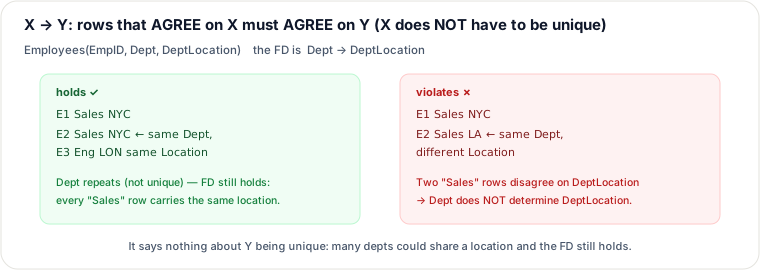
Traced on real rows
In Employees(EmpID, Dept, DeptLocation):
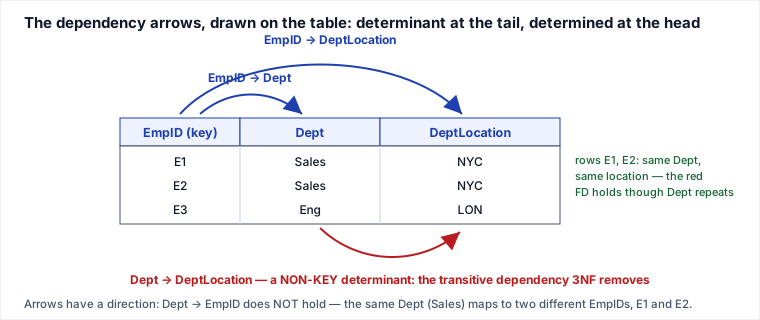
EmpID → Dept,EmpID → DeptLocation— the key determines everything.Dept → DeptLocation— every employee in "Sales" sits in the same office. NoteDeptis not unique (dozens of people are in Sales) yet the FD holds.Dept → EmpIDdoes not hold — one department has many employees, so the sameDeptmaps to differentEmpIDs.
Here are those dependencies drawn as arrows on the table itself — determinant at the tail, determined column at the head. The blue arrows out of EmpID are just "it is the key"; the red arrow is the interesting one:
Consider a table mapping client addresses:
| Address_ID (PK) | Street | ZipCode | City |
|---|---|---|---|
| 1 | 120 Main St | 90210 | Beverly Hills |
| 2 | 450 Oak Ave | 90210 | Beverly Hills |
| 3 | 789 Pine Rd | 10001 | New York |
| 4 | 12 Wall St | 10001 | New York |
ZipCode → City holds because:
- Row 1 and Row 2 share the same ZipCode (
90210) and agree on the same City (Beverly Hills). - Row 3 and Row 4 share the same ZipCode (
10001) and agree on the same City (New York).
ZipCode functionally determines City. However, ZipCode is not a primary key (it repeats across multiple rows). The FD simply dictates that the same ZipCode can never be mapped to two different cities in this table.
That last non-dependency (Dept → DeptLocation holds but the table's key is EmpID) is
exactly a transitive dependency — a non-key column determining another non-key column — and it is the
thing 3NF exists to remove. The entire normalization track is built on this definition, which is why getting it right
matters.
Pitfalls
- "X → Y means X is unique" — false.
Dept → DeptLocationwith a repeating Dept is the canonical counterexample. - FDs are a statement about all allowed states of the table (the business rule), not about one snapshot. A single snapshot can't prove an FD, but it can disprove one.
Takeaways
X → Y: rows agreeing on X must agree on Y — X determines Y.- Neither X nor Y need be unique; only "same X, different Y" is forbidden.
- A non-key → non-key FD is a transitive dependency — the target of 3NF.
Re-authored for correctness for this guide (the prior version defined an FD as requiring unique values). Definition per Silberschatz, "Database System Concepts" & Codd. See also: Closure of Attribute Sets, Normalization (3NF), Keys.
🎯 STRICT STANDOUT: Why / worked / when-not / failure / drills — Introduction to Functional Dependency
Why this concept exists (judgment chain)
An FD X→Y is a constraint on all legal states: same X forces same Y. It does not require X unique. Normalization is just systematic removal of bad FDs (partial, transitive) that cause anomalies — so a wrong FD definition poisons every later NF decision.
Worked example with numbers or traced steps
Employees: E1 Sales NYC; E2 Sales NYC; E3 Eng LON.
Dept → DeptLocation HOLDS (Sales always NYC) even though Dept repeats.
Dept → EmpID FAILS (Sales maps to E1 and E2).
Zip table: 90210→Beverly Hills twice, 10001→New York twice → Zip→City holds;
Zip is not a key.
Violation test: one snapshot can disprove (two same-X different-Y rows);
proving holds requires the business rule / all allowed states.
When NOT to use / named alternative
Do not invent FDs from one CSV sample (“looks unique”). Do not treat candidate keys as the only determinants — non-key determinants are exactly what 3NF/BCNF hunt. Skip FD modeling only for throwaway staging dumps with no integrity needs.
Failure / ops fingerprint
Fingerprint: “Dept determines location so Dept must be unique” confusion; schemas that store DeptLocation on every employee and suffer update anomalies. Ops: encode FDs as UNIQUE constraints or separate tables; document business FDs in schema review.
Hostile-panel drills (defend the decision)
Q1. Does X→Y imply X is unique?
Model answer: No. Many rows may share X; they must share Y. Uniqueness of X is a key property, a special FD X→all attributes.
Q2. Give a transitive dependency from the employee example.
Model answer: EmpID→Dept and Dept→DeptLocation imply EmpID→DeptLocation; Dept→DeptLocation is non-key→non-key — 3NF target.
Q3. How do you disprove an FD on data?
Model answer: Exhibit two tuples equal on X and unequal on Y. Absence of counterexample in one dump does not prove the FD.
🤖 Don't fully get this? Learn it with Claude
Stuck on Introduction to Functional Dependency? Open Claude, copy a block below, and it'll teach you this exact concept — visually and interactively.
Build the mental picture, not memorization.
I just read a lesson on **Introduction to Functional Dependency** (Databases) and want to truly understand it. Explain Introduction to Functional Dependency from first principles using ONE vivid real-world analogy and a visual mental model — draw it as ASCII art or a clear step-by-step diagram — with a concrete example using real numbers. Then ask me one question to check I got the mental picture, and wait for my reply. If you're unsure or a claim isn't standard, say so and reason from first principles instead of guessing.
Socratic — adapts to where you're stuck.
Teach me **Introduction to Functional Dependency** interactively. Ask me ONE guiding question at a time, wait for my answer, and adapt to my confusion — build the idea with me step by step instead of explaining it all at once. If you're unsure or a claim isn't standard, say so and reason from first principles instead of guessing.
Active recall exposes what you missed.
Quiz me on **Introduction to Functional Dependency** with 5 questions, easy to tricky, ONE at a time. Tell me if each answer is right; at the end, explain clearly what I got wrong and why. If you're unsure or a claim isn't standard, say so and reason from first principles instead of guessing.
Intuition + hook + flashcards for long-term memory.
Help me remember **Introduction to Functional Dependency** for the long term: give the one-sentence intuition, a memorable hook/mnemonic, a tiny worked example, and 3 active-recall flashcards (Q -> A). If you're unsure or a claim isn't standard, say so and reason from first principles instead of guessing.