Transactions & ACID — Atomicity and the Write-Ahead Log
All-or-nothing, even when the server dies
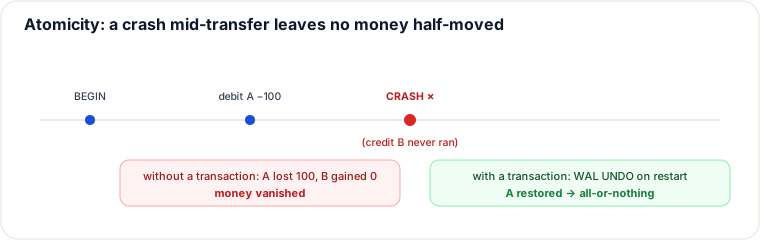
Transfer $100 from A to B: debit A, then credit B. If the database crashes between those two steps, $100 has vanished. A transaction bundles statements so they either all commit or none do — the property called atomicity.
ACID, letter by letter (and who owns each letter)
- Atomicity (engine) — all statements commit or all roll back. The transfer above is the canonical example. Delivered by the WAL + recovery (REDO/UNDO), not by "hoping both UPDATEs run."
- Consistency (mostly application + declared constraints) — a transaction leaves the database in a state that satisfies every invariant the engine was told about (PK/UNIQUE/FK/CHECK) and every business invariant the app encoded in the transaction (inventory never negative, double-entry balances). The engine cannot invent "A+B money conserved" unless you write both legs in one transaction and declare the constraints. A/I/D are engine properties; C is shared: constraints are engine-enforced, business rules are app-authored. "ACID means the database keeps my app correct" is the slogan failure mode of this page.
- Isolation (engine, but level-dependent) — concurrent transactions do not see each other's intermediate states beyond what the isolation level permits. "Don't corrupt each other" is not a single guarantee — it is a menu of anomalies (next section).
- Durability (engine) — once
COMMITreturns, the committed effects survive process crash and power loss (WAL fsync / equivalent). Note: durability to the primary does not automatically mean durability on every replica.
BEGIN;
UPDATE accounts SET balance = balance - 100 WHERE id = 'A';
UPDATE accounts SET balance = balance + 100 WHERE id = 'B';
COMMIT;   -- both or neither; on error -> ROLLBACK
Isolation is not a slogan: anomalies and defaults
Without naming anomalies, "I" is marketing. Four classic read anomalies (full traces live on the Isolation Levels page; you need the names now):
| Anomaly | What goes wrong | Closed by (typical) |
|---|---|---|
| Dirty read | You read another txn's uncommitted write; it may roll back | Read Committed and above |
| Non-repeatable read | Same row, read twice in one txn, two different committed values | Repeatable Read / Snapshot Isolation |
| Phantom | Same predicate, re-run SELECT, different set of rows (insert/delete in range) | SI snapshot freezes classic phantom reads; lock engines use gap locks; true serializability needs SERIALIZABLE |
| Write skew / lost update | Two txns read overlapping state, each writes a different row; both commit; invariant broken | SELECT FOR UPDATE, atomic UPDATE, or SERIALIZABLE (SSI) |
Defaults matter — "ACID" does not mean "serializable by default":
- PostgreSQL default:
READ COMMITTED— each statement gets a fresh snapshot; non-repeatable reads and write skew are possible across statements in one transaction. - MySQL InnoDB default:
REPEATABLE READ— stronger than Postgres's default name, but InnoDB RR is not identical to Postgres RR (gap locks vs pure SI). Still not full serializability. - Oracle default:
READ COMMITTED(statement-level SI). - SQL Server default:
READ COMMITTED(locking RC unless RCSI is on).
So an app that "uses transactions" on Postgres still runs at RC unless you raise the level. Multi-statement money, inventory, or capacity checks need an explicit level (or SELECT … FOR UPDATE / single atomic UPDATE) — not faith in the word ACID.
How the database delivers atomicity + durability: the WAL
Before changing a data page, the DB appends the change to a write-ahead log and
fsyncs that first. On COMMIT it only needs the log durable (sequential write =
fast). On crash recovery it replays the log: REDO committed transactions, UNDO
uncommitted ones — restoring exactly the all-or-nothing boundary.
Why both REDO and UNDO exist: STEAL / NO-FORCE
Recovery is not an arbitrary design — it is forced by two buffer-manager policy answers:
- STEAL = yes: a dirty page holding an uncommitted change may be evicted to disk before that transaction commits. Without STEAL, a long transaction pins every page it dirtied in the buffer pool. With STEAL, disk can already contain uncommitted data after a crash → recovery must UNDO losers.
- FORCE = no (NO-FORCE): commit does not flush every touched data page to disk; only the WAL is forced. Commit stays a sequential log write. After a crash, committed changes may exist only in the WAL → recovery must REDO winners.
Real engines (Postgres, InnoDB, ARIES-style systems) choose STEAL + NO-FORCE for throughput. That single choice is why both REDO and UNDO appear on restart. FORCE would make REDO optional but slow every commit to random page I/O; NO-STEAL would make UNDO optional but starve the buffer pool under long writers. (Full ARIES trace and 2×2 matrix: the Transactions deep-dive recovery page.)
Pitfalls
- Autocommit: many drivers commit each statement unless you
BEGIN— your "transaction" was three separate ones; the A→B transfer is not atomic. - Long transactions hold locks and (under MVCC) hold back vacuum/undo cleanup — keep them short.
- Doing multi-step money/inventory logic without a transaction is the classic data-loss bug.
- "We use ACID so we're safe" — without knowing default isolation, you may still allow non-repeatable reads, phantoms (depending on engine), and write skew. Name the level.
- Assuming C is free — missing FKs/CHECKs and multi-statement invariants not wrapped in one transaction are app bugs the engine will not invent for you.
Interview drills
- L1: Name A, C, I, D in one sentence each. Which are purely engine properties?
Answer: A all-or-nothing, C valid state transition, I concurrent anomaly control, D commit survives crash. A/I/D engine; C shared (constraints + app). - L2: Why does recovery need both REDO and UNDO?
Answer: STEAL ⇒ uncommitted pages may be on disk ⇒ UNDO; NO-FORCE ⇒ committed pages may not be on disk ⇒ REDO. - L3: Postgres defaults to READ COMMITTED. Can two statements in one transaction see different committed values of the same row?
Answer: Yes — non-repeatable read is allowed at RC. Raise to REPEATABLE READ / SERIALIZABLE or use FOR UPDATE for critical rows. - L4: Client got COMMIT success, then the primary's disk failed before a replica applied the change. Is durability violated?
Answer: Single-node durability held if WAL was fsynced on the primary; cross-replica durability is a separate replication/sync-commit guarantee.
Takeaways
- A transaction = atomic, isolated (at a named level), durable bundle; wrap any multi-statement invariant in one.
- The WAL + STEAL/NO-FORCE buffer policy give durability and force both REDO and UNDO on recovery.
- C is not "the database is always right" — it is constraints plus application transaction logic.
- I is anomaly-shaped; know dirty / non-repeatable / phantom / write skew and your engine's default level.
- Watch autocommit; keep transactions short; never treat "ACID" as "serializable."
Re-authored for this guide; crash/atomicity diagram hand-authored as SVG. Follows Designing Data-Intensive Applications ch. 7, the ARIES recovery rationale (STEAL/NO-FORCE), and the PostgreSQL / InnoDB isolation defaults. See also: Isolation Levels & Anomalies, MVCC & Locking, Transactions deep dive (recovery/SSI).
🎯 STRICT STANDOUT: Why / mental model / when-not / worked / failure / hostile panel — Transactions & ACID — Atomicity and the Write-Ahead Log
Why this concept exists (judgment layer)
Entry page for transactions: A/I/D are engine mechanisms; C is shared; I is anomaly menu + default levels — not the slogan 'ACID means safe.' STEAL/NO-FORCE explains REDO+UNDO.
Mental model (install this intuition)
Atomicity = commit record all-or-nothing. Durability = WAL fsync. Isolation = level-selected anomaly control. Consistency = declared constraints + app invariants in one txn. Defaults: PG RC, MySQL InnoDB RR — neither is full serializable.
Worked example with numbers or traced steps
BEGIN; A-=100; crash; B+=100 never runs
Without txn: money gone. With WAL: UNDO debit on recovery
STEAL: dirty uncommitted pages may hit disk → need UNDO
NO-FORCE: commit does not flush all data pages → need REDO
PG RC: two SELECTs in one txn can see different committed values of same row
When NOT to use / named alternative
Do not wrap every read in long SERIALIZABLE transactions (lock/SSI abort cost). Do not assume multi-statement safety under autocommit. Single-row atomic UPDATE may beat multi-statement txn for simple counters.
Failure mode & ops fingerprint
Fingerprint: transfer as three autocommit statements; 'we use Postgres so we're serializable'; fsync off; long txn holds vacuum; write skew on two doctors on-call both going off duty under SI.
Hostile-panel drills (defend the decision)
Q1. Which ACID letters are purely engine?
Model answer: A, I (mechanism), D. C is shared: engine constraints + application transaction logic.
Q2. Why both REDO and UNDO?
Model answer: STEAL ⇒ uncommitted data may be on disk ⇒ UNDO losers. NO-FORCE ⇒ committed data may only be in WAL ⇒ REDO winners.
Q3. Postgres default and non-repeatable read?
Model answer: READ COMMITTED — yes, two statements can see different committed values; raise level or FOR UPDATE for critical sections.
Production judgment
Production reading of ACID: Atomicity is not “try/catch.” It is “all durable effects of this business action appear or none do” under crash. Durability is not “we wrote to Postgres.” It is “after commit returns, a power loss still leaves the effects.” Isolation is which concurrent histories you allow — and money systems that ignore write skew / lost update invent free inventory.
Tie to private labs: Ledger (balanced legs in one txn) · Idempotent payment (atomic claim) · WAL (durability mechanism) · Job queue (lease state durable).
Staff drill: Name one anomaly your isolation level still allows, and whether a payment checkout can hit it.
🤖 Don't fully get this? Learn it with Claude
Stuck on Transactions & ACID — Atomicity and the Write-Ahead Log? Open Claude, copy a block below, and it'll teach you this exact concept — visually and interactively.
Build the mental picture, not memorization.
I just read a lesson on **Transactions & ACID — Atomicity and the Write-Ahead Log** (Databases) and want to truly understand it. Explain Transactions & ACID — Atomicity and the Write-Ahead Log from first principles using ONE vivid real-world analogy and a visual mental model — draw it as ASCII art or a clear step-by-step diagram — with a concrete example using real numbers. Then ask me one question to check I got the mental picture, and wait for my reply. If you're unsure or a claim isn't standard, say so and reason from first principles instead of guessing.
Socratic — adapts to where you're stuck.
Teach me **Transactions & ACID — Atomicity and the Write-Ahead Log** interactively. Ask me ONE guiding question at a time, wait for my answer, and adapt to my confusion — build the idea with me step by step instead of explaining it all at once. If you're unsure or a claim isn't standard, say so and reason from first principles instead of guessing.
Active recall exposes what you missed.
Quiz me on **Transactions & ACID — Atomicity and the Write-Ahead Log** with 5 questions, easy to tricky, ONE at a time. Tell me if each answer is right; at the end, explain clearly what I got wrong and why. If you're unsure or a claim isn't standard, say so and reason from first principles instead of guessing.
Intuition + hook + flashcards for long-term memory.
Help me remember **Transactions & ACID — Atomicity and the Write-Ahead Log** for the long term: give the one-sentence intuition, a memorable hook/mnemonic, a tiny worked example, and 3 active-recall flashcards (Q -> A). If you're unsure or a claim isn't standard, say so and reason from first principles instead of guessing.