hard Palindromic Partitioning
Problem Statement
Given a string, we want to cut it into pieces such that each piece is a palindrome. Write a function to return the minimum number of cuts needed.
Example 1:
Input: "abdbca"
Output: 3
Explanation: Palindrome pieces are "a", "bdb", "c", "a".
Example 2:
Input: = "cddpd"
Output: 2
Explanation: Palindrome pieces are "c", "d", "dpd".
Example 3:
Input: = "pqr"
Output: 2
Explanation: Palindrome pieces are "p", "q", "r".
Example 4:
Input: = "pp"
Output: 0
Explanation: We do not need to cut, as "pp" is a palindrome.
Constraints:
1 <= st.length <= 16scontains only lowercase English letters.
Try it yourself
Try solving this question here:
✅ Solution Palindromic Partitioning
Problem Statement
Given a string, we want to cut it into pieces such that each piece is a palindrome. Write a function to return the minimum number of cuts needed.
Example 1:
Input: "abdbca"
Output: 3
Explanation: Palindrome pieces are "a", "bdb", "c", "a".
Example 2:
Input: = "cddpd"
Output: 2
Explanation: Palindrome pieces are "c", "d", "dpd".
Example 3:
Input: = "pqr"
Output: 2
Explanation: Palindrome pieces are "p", "q", "r".
Example 4:
Input: = "pp"
Output: 0
Explanation: We do not need to cut, as "pp" is a palindrome.
Constraints:
1 <= st.length <= 16scontains only lowercase English letters.
Basic Solution
This problem follows the "Longest Palindromic Subsequence" pattern and shares a similar approach as that of the "Longest Palindromic Substring".
The brute-force solution will be to try all the substring combinations of the given string. We can start processing from the beginning of the string and keep adding one character at a time. At any step, if we get a palindrome, we take it as one piece and recursively process the remaining length of the string to find the minimum cuts needed.
Here is the code:
class Solution {

  public int findMPPCuts(String st) {
    return this.findMPPCutsRecursive(st, 0, st.length() - 1);
  }

  private int findMPPCutsRecursive(String st, int startIndex, int endIndex) {
    // we don't need to cut the string if it is a palindrome
    if (
      startIndex >= endIndex || isPalindrome(st, startIndex, endIndex)
    ) return 0;

    // at max, we need to cut the string into its 'length-1' pieces
    int minimumCuts = endIndex - startIndex;
    for (int i = startIndex; i <= endIndex; i++) {
      if (isPalindrome(st, startIndex, i)) {
        // we can cut here as we have a palindrome from 'startIndex' to 'i'
        minimumCuts = Math.min(
          minimumCuts,
          1 + findMPPCutsRecursive(st, i + 1, endIndex)
        );
      }
    }
    return minimumCuts;
  }

  private boolean isPalindrome(String st, int x, int y) {
    while (x < y) {
      if (st.charAt(x++) != st.charAt(y--)) return false;
    }
    return true;
  }

  public static void main(String[] args) {
    Solution mpp = new Solution();
    System.out.println(mpp.findMPPCuts("abdbca"));
    System.out.println(mpp.findMPPCuts("cdpdd"));
    System.out.println(mpp.findMPPCuts("pqr"));
    System.out.println(mpp.findMPPCuts("pp"));
  }
}
The time complexity of the above algorithm is exponential
Top-down Dynamic Programming with Memoization
We can memoize both functions findMPPCutsRecursive() and isPalindrome(). The two changing values in both these functions are the two indexes; therefore, we can store the results of all the subproblems in a two-dimensional array. (alternatively, we can use a hash-table).
Here is the code:
class Solution {

  public int findMPPCuts(String st) {
    Integer dp[][] = new Integer[st.length()][st.length()];
    Boolean dpIsPalindrome[][] = new Boolean[st.length()][st.length()];
    return this.findMPPCutsRecursive(dp, dpIsPalindrome, st, 0, st.length()-1);
  }

  private int findMPPCutsRecursive(Integer dp[][], Boolean dpIsPalindrome[][],
      String st, int startIndex, int endIndex) {

    if(startIndex >= endIndex || isPalindrome(dpIsPalindrome, st, startIndex, endIndex))
      return 0;

    if(dp[startIndex][endIndex] == null) {
      // at max, we need to cut the string into its 'length-1' pieces
      int minimumCuts = endIndex-startIndex;
      for (int i=startIndex; i <= endIndex; i++) {
        if(isPalindrome(dpIsPalindrome, st, startIndex, i)){
          // we can cut here as we have a palindrome from 'startIndex' to 'i'
          minimumCuts = Math.min(minimumCuts, 1+findMPPCutsRecursive(dp, dpIsPalindrome, st, i+1, endIndex));
        }
      }
      dp[startIndex][endIndex] = minimumCuts;
    }
    return dp[startIndex][endIndex];
  }

  private boolean isPalindrome(Boolean dpIsPalindrome[][], String st, int x, int y) {
    if(dpIsPalindrome[x][y] == null) {
      dpIsPalindrome[x][y]=true;
      int i=x, j=y;
      while(i < j) {
        if(st.charAt(i++) != st.charAt(j--)) {
          dpIsPalindrome[x][y]=false;
          break;
        }
        // use memoization to find if the remaining string is a palindrome
        if(i < j && dpIsPalindrome[i][j] != null) {
          dpIsPalindrome[x][y] = dpIsPalindrome[i][j];
          break;
        }
      }
    }
    return dpIsPalindrome[x][y];
  }

  public static void main(String[] args) {
    Solution mpp = new Solution();
    System.out.println(mpp.findMPPCuts("abdbca"));
    System.out.println(mpp.findMPPCuts("cdpdd"));
    System.out.println(mpp.findMPPCuts("pqr"));
    System.out.println(mpp.findMPPCuts("pp"));
  }
}
Bottom-up Dynamic Programming
The above solution tells us that we need to build two tables, one for the isPalindrome() and one for finding the minimum cuts needed.
If you remember, we built a table in the Longest Palindromic Substring (LPS) chapter that can tell us what substrings (of the input string) are palindrome. We will use the same approach here to build the table required for isPalindrome(). For example, here is the final output from LPS for "cddpd". From this table we can clearly see that the substring(2,4) => 'dpd' is a palindrome:
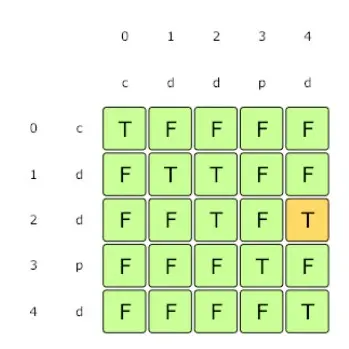
To build the second table for finding the minimum cuts, we can iterate through the first table built for isPalindrome(). At any step, if we get a palindrome, we can cut the string there. Which means minimum cuts will be one plus the cuts needed for the remaining string.
Here is the code for the bottom-up approach:
class Solution {

  public int findMPPCuts(String st) {
    // isPalindrome[i][j] will be 'true' if the string from index 'i' to index 'j' is a palindrome
    boolean[][] isPalindrome = new boolean[st.length()][st.length()];

    // every string with one character is a palindrome
    for (int i = 0; i < st.length(); i++)
      isPalindrome[i][i] = true;

    // populate isPalindrome table
    for (int startIndex = st.length() - 1; startIndex >= 0; startIndex--) {
      for (int endIndex = startIndex + 1; endIndex < st.length(); endIndex++) {
        if (st.charAt(startIndex) == st.charAt(endIndex)) {
          // if it's a two character string or if the remaining string is a palindrome too
          if (endIndex - startIndex == 1 || isPalindrome[startIndex + 1][endIndex - 1]) {
            isPalindrome[startIndex][endIndex] = true;
          }
        }
      }
    }

    // now lets populate the second table, every index in 'cuts' stores the minimum cuts needed
    // for the substring from that index till the end
    int[] cuts = new int[st.length()];
    for (int startIndex = st.length() - 1; startIndex >= 0; startIndex--) {
      int minCuts = st.length(); // maximum cuts
      for (int endIndex = st.length() - 1; endIndex >= startIndex; endIndex--) {
        if (isPalindrome[startIndex][endIndex]) {
          // we can cut here as we got a palindrome
          // also we dont need any cut if the whole substring is a palindrome
          minCuts = (endIndex == st.length() - 1) ? 0 : Math.min(minCuts, 1 + cuts[endIndex + 1]);
        }
      }
      cuts[startIndex] = minCuts;
    }

    return cuts[0];
  }

  public static void main(String[] args) {
    Solution mpp = new Solution();
    System.out.println(mpp.findMPPCuts("abdbca"));
    System.out.println(mpp.findMPPCuts("cdpdd"));
    System.out.println(mpp.findMPPCuts("pqr"));
    System.out.println(mpp.findMPPCuts("pp"));
    System.out.println(mpp.findMPPCuts("madam"));
  }
}
The time and space complexity of the above algorithm is
🤖 Don't fully get this? Learn it with Claude
Stuck on Palindromic Partitioning? Open Claude, copy a block below, and it'll teach you this exact concept — visually and interactively.
Progressively stronger hints — you still solve it.
I'm working on the problem **Palindromic Partitioning** (DSA). Give me a HINT LADDER: start with the tiniest nudge, then wait. Only reveal the next, stronger hint when I ask. Do NOT show the full solution unless I type 'show solution'. Keep me doing the thinking. If you're unsure or a claim isn't standard, say so and reason from first principles instead of guessing.
See the technique, not just code.
Explain the optimal approach to **Palindromic Partitioning** with a VISUAL walkthrough: trace it on a small concrete example using ASCII art / a step-by-step diagram, narrate what changes each step, then give time & space complexity with a one-line derivation. If you're unsure or a claim isn't standard, say so and reason from first principles instead of guessing.
Catch bugs, edge cases, sub-optimality.
I'll paste my solution to **Palindromic Partitioning**. Review it for correctness, missed edge cases, and time/space complexity, then coach me toward the optimal — don't just rewrite it. Ask me to paste my code now. If you're unsure or a claim isn't standard, say so and reason from first principles instead of guessing.
Lock in recognition with look-alikes.
Give me 2 problems that use the SAME underlying pattern as **Palindromic Partitioning**. For each, let me attempt first, then review my answer and name the trigger signal that reveals the pattern. If you're unsure or a claim isn't standard, say so and reason from first principles instead of guessing.