Introduction to Divide and Conquer Algorithm
Divide and conquer solves a problem of size n by splitting it into independent (or nearly independent) subproblems of the same shape, solving each recursively, and stitching the sub-answers together with a combine step — it wins whenever the combine step is cheaper than the savings from solving smaller pieces separately, which is precisely what recursion trees make measurable.
Recognize the pattern
- The problem on the full input can be answered from the answers to the same problem on roughly-halved (or otherwise smaller, disjoint) pieces of the input.
- There is a well-defined combine step — merging, comparing, or aggregating sub-results — that is cheap relative to solving the pieces from scratch.
- Naive brute force scans
O(n^2)pairs across the whole input; splitting first and combining sorted/solved pieces avoids ever comparing most of those pairs directly. - Classic tells: sorting, closest-pair-of-points, max-subarray, fast exponentiation, matrix multiplication (Strassen), quickselect.
Brute force to optimal
Take sorting as the running example. Brute force (selection/insertion sort) compares elements pairwise across the whole array: O(n^2) time, O(1) extra space, no recursion needed. Divide and conquer (merge sort) instead recursively sorts two halves and merges them in linear time: O(n log n) time at the cost of O(n) auxiliary space for the merge buffers. The trade is extra memory (and non-in-place movement) for an asymptotically better time bound — worthwhile once n is large enough that n^2 dwarfs n log n.
Complexity, derived
Merge sort's time cost obeys the recurrence T(n) = 2T(n/2) + O(n), with T(1) = O(1). Unrolling: at recursion depth d there are 2^d subproblems each of size n/2^d, so the total merge work at that level is 2^d * O(n/2^d) = O(n) — every level costs O(n) regardless of depth. The recursion bottoms out when n/2^d = 1, i.e. d = log2(n) levels. Summing O(n) work over log2(n) levels gives T(n) = O(n log n). This matches the Master Theorem for T(n) = aT(n/b) + f(n) with a=2, b=2, f(n)=O(n): since f(n) = Theta(n^{log_b a}) = Theta(n), we're in the balanced case, adding a log n factor. (The theorem's three cases compare f(n) against n^{log_b a}: f polynomially smaller → Theta(n^{log_b a}); equal → multiply by log n; polynomially larger, with the regularity condition → Theta(f(n)).)
Space, derived the same way: walk the same recursion tree, but count memory instead of comparisons. Each call to merge at depth d allocates two temp arrays covering its slice, so the arrays live only for the duration of that call and are freed on return. In this code a merge only runs after both of its recursive children have returned (and freed their own temp arrays), so merges never nest — at any single moment exactly one merge's buffers are live, and the peak is the single largest merge: the root's two arrays summing to n, i.e. O(n). So auxiliary heap space peaks at O(n), not O(n) per level summed — the arrays are not all alive simultaneously, they are allocated and released as the recursion unwinds. On top of that, the call stack holds one frame per active recursive call along the current path, which has depth d = log2(n), adding O(log n). Total auxiliary space: O(n) for merge buffers plus O(log n) for the call stack, dominated by the O(n) term.
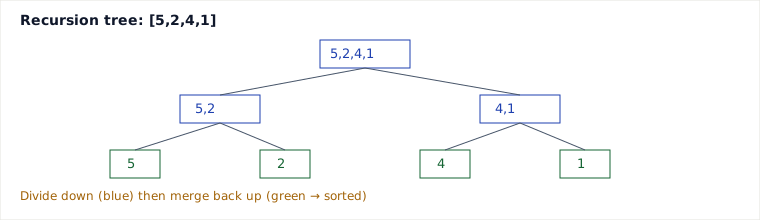
Traced example — merge sort on [5, 2, 4, 1]
| Step | Action | Result |
|---|---|---|
| 1 | Split [5,2,4,1] | [5,2] and [4,1] |
| 2 | Split [5,2] | [5] and [2] |
| 3 | Merge [5] and [2] | [2,5] |
| 4 | Split [4,1] | [4] and [1] |
| 5 | Merge [4] and [1] | [1,4] |
| 6 | Merge [2,5] and [1,4]: compare 2&1→1, 2&4→2, 5&4→4, remainder 5 | [1,2,4,5] |
Java implementation
import java.util.Arrays;

class MergeSort {
    static void mergeSort(int[] arr, int left, int right) {
        if (left < right) {
            int mid = left + (right - left) / 2;
            mergeSort(arr, left, mid);
            mergeSort(arr, mid + 1, right);
            merge(arr, left, mid, right);
        }
    }

    static void merge(int[] arr, int left, int mid, int right) {
        int[] L = Arrays.copyOfRange(arr, left, mid + 1);
        int[] R = Arrays.copyOfRange(arr, mid + 1, right + 1);
        int i = 0, j = 0, k = left;
        while (i < L.length && j < R.length) {
            arr[k++] = (L[i] <= R[j]) ? L[i++] : R[j++];
        }
        while (i < L.length) arr[k++] = L[i++];
        while (j < R.length) arr[k++] = R[j++];
    }
}
Pitfalls
- Computing mid as
(left + right) / 2overflows for huge indices — useleft + (right - left) / 2. - Forgetting the base case (
left < right) causes infinite recursion or stack overflow on size-1 arrays. - Re-allocating temp arrays inside every recursive call multiplies GC pressure; a single reusable buffer sized
nis faster in practice. - Assuming divide and conquer is always
O(n log n)— it depends entirely on the recurrence; a maximally unbalanced split givesT(n) = T(n-1) + O(n)(e.g. quicksort's worst case), which degrades toO(n^2).
When to use / when not
Use divide and conquer when subproblems are independent and the combine cost is sub-quadratic — sorting, closest pair, fast multiplication, binary search variants. Avoid it when subproblems overlap heavily (the same smaller subproblem gets solved repeatedly across branches): that signals dynamic programming instead, which memoizes shared subresults rather than resolving them from scratch each time. Also avoid it when the input is already small or nearly sorted, where a simple O(n^2) or even O(n) pass (insertion sort, linear scan) has lower constant-factor overhead and no recursion/allocation cost.
Takeaways
- Divide and conquer = split into independent subproblems + recursively solve + cheaply combine.
- Complexity comes from a recurrence; unroll it level by level (or apply the Master Theorem) rather than memorizing the answer — and derive space the same way, by tracking what is actually alive at once, not by assertion.
- The combine step's cost, not the split, usually determines whether you beat brute force.
- When subproblems overlap instead of being independent, switch to dynamic programming.
Recall: Why does merge sort's per-level work stay O(n) even as the number of subproblems doubles at each depth?
Synthesized for interview-prep depth; core mechanism and Java code verified against the source page's Merge Sort walkthrough.
🤖 Don't fully get this? Learn it with Claude
Stuck on Introduction to Divide and Conquer Algorithm? Open Claude, copy a block below, and it'll teach you this exact concept — visually and interactively.
Build the mental picture, not memorization.
I just read a lesson on **Introduction to Divide and Conquer Algorithm** (DSA) and want to truly understand it. Explain Introduction to Divide and Conquer Algorithm from first principles using ONE vivid real-world analogy and a visual mental model — draw it as ASCII art or a clear step-by-step diagram — with a concrete example using real numbers. Then ask me one question to check I got the mental picture, and wait for my reply. If you're unsure or a claim isn't standard, say so and reason from first principles instead of guessing.
Socratic — adapts to where you're stuck.
Teach me **Introduction to Divide and Conquer Algorithm** interactively. Ask me ONE guiding question at a time, wait for my answer, and adapt to my confusion — build the idea with me step by step instead of explaining it all at once. If you're unsure or a claim isn't standard, say so and reason from first principles instead of guessing.
Active recall exposes what you missed.
Quiz me on **Introduction to Divide and Conquer Algorithm** with 5 questions, easy to tricky, ONE at a time. Tell me if each answer is right; at the end, explain clearly what I got wrong and why. If you're unsure or a claim isn't standard, say so and reason from first principles instead of guessing.
Intuition + hook + flashcards for long-term memory.
Help me remember **Introduction to Divide and Conquer Algorithm** for the long term: give the one-sentence intuition, a memorable hook/mnemonic, a tiny worked example, and 3 active-recall flashcards (Q -> A). If you're unsure or a claim isn't standard, say so and reason from first principles instead of guessing.