Hashing, Collisions, Overflow, and Resizing in Hashtables
Remember, we said that our earlier Hash Table implementation was naive. By that, we meant that the code doesn't cater to some frequently occurring issues. Let's see what these issues really are.
Collisions
A collision in a Hash Table occurs when an insert operation tries to insert an item at a table slot already occupied by another item. How can this ever happen? Let's find out.
Collision example
Reconsider our earlier example of the Hash Table for the public library book information storage. Assume, for the sake of simplicity, the Hash Table has the max_length equal to
| Key | Title | Placement Info |
|---|---|---|
| 1008 | Introduction to Algorithms | A1 Shelf |
| 1009 | Data Structures: A Pseudocode Approach | B2 Shelf |
| 1010 | System Design Interview Roadmap | C3 Shelf |
| 1011 | Grokking the Coding Interview | D4 Shelf |
| 1021 | Grokking the Art of Recursion for Coding Interviews | E5 Shelf |
Here is the hash value calculation for the first four entries:
| Key | Hash Value |
|---|---|
| 1008 | |
| 1009 | |
| 1010 | |
| 1011 |
So the hash table array would look something like this:
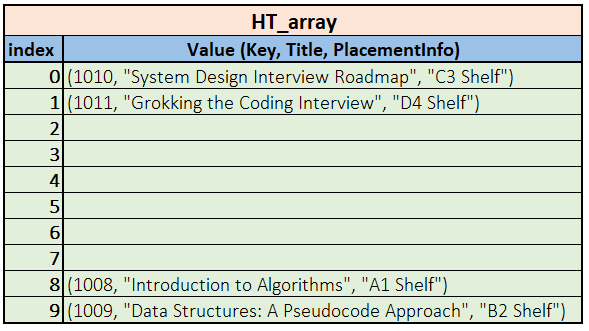
Now, what happens if we try inserting the record with the Key Key
The phenomenon is depicted in the following illustration.

Collisions occur frequently in hash tables when two different keys hash to the same bucket. Without proper collision handling, lookup performance degrades from
Overflows
Overflow in a hash table occurs when the number of elements inserted exceeds the fixed capacity allocated for the underlying bucket array. For example, if you already have inserted information of ten books in the earlier discussed hash table, inserting the
One important point to note here is that as the underlying bucket array starts filling towards its maximum capacity, the expectation of collisions starts increasing. Thereby the overall efficiency of hash table operations starts decreasing.
An ideal hash table implementation must resolve collisions effectively and must act to avoid any overflow early. In the next section, we will explore different strategies for handling collisions.
Resolving Collisions
Remember that our naive hash table implementation directly overwrote existing records when collisions occurred. This is inaccurate as it loses data on insertion. This section describes how we can avoid such data losses with the help of collision resolution techniques.
Based on how we resolve the collisions, the collision resolution techniques are classified into two types:
- Open addressing / Closed hashing
- Chaining / Open hashing
Let's find out how these schemes help us resolve the collisions without losing any data.
Open Addressing (Closed Hashing):
Open addressing techniques resolve hash collisions by probing for the next available slot within the hash table itself. This approach is called open addressing since it opens up the entire hash table for finding an empty slot during insertion.
It is also known as closed hashing because the insertion is restricted to existing slots within the table without using any external data structures.
Depending on how you jump or probe to find the next empty slot, the closed hashing is further divided into multiple types. Here are the main collision resolution schemes used in the open-addressing scheme:
- Linear probing: Linear probing is the simplest way to handle collisions by linearly searching consecutive slots for the next empty location.
- Quadratic probing: When a collision occurs, the quadratic probing attempts to find an alternative empty slot for the key by using a
quadratic functionto probe the successive possible positions. - Double hashing: It uses two hash functions to determine the next probing location in case of a successive collision.
- Random probing: Random probing uses a pseudo-random number generator (PRNG) to compute the step size or increment value for probes in case of collisions.
Implementation of insertion, search, and deletion operations is slightly different for each type of the operations.
Separate Chaining (Open Hashing):
Selecting the right closed hashing technique for resolving collisions can be tough. You need to keep the pros and cons of different strategies in mind and then have to make a decision.
Separate chaining offers a rather simpler chaining mechanism to resolve collisions. Each slot in the hash table points to a separate data structure, such as a linked-list. This linked-list or chain stores multiple elements that share the same hash index. When a collision occurs, new elements are simply appended to the existing list in the corresponding slot.
Separate chaining is an "open hashing" technique because the hash table is "open" to accommodate multiple elements within a single bucket (usually using a chain) to handle collisions. Here is the generalized conceptual diagram for the chaining method:

Example: Recall our earlier example of the hash table for storing books' information. Assume you have a hash table (with open hashing) of size

Now, here is what the hash table would look like after inserting a new book record (1724, "Compilers Theory", "E4 Shelf"):

The key
Let's now move on to implementing the hash table with separate chaining.
A complete implementation
Insertion in a hash table with separate chaining is simple. For an item with hash key
Here is a complete implementation of the hash table we developed for books storage:
import java.util.ArrayList;
import java.util.List;

class Record {

  int Key;
  String Title;
  String PlacementInfo;

  public Record(int key, String title, String placement_info) {
    Key = key;
    Title = title;
    PlacementInfo = placement_info;
  }
}

class HashTable {

  private List<List<Record>> buckets; // List of lists to store the chains
  private int max_length; // To store the maximum number of elements a Hash table can store

  public HashTable(int size) {
    max_length = size;
    buckets = new ArrayList<>(size);
    for (int i = 0; i < size; i++) {
      buckets.add(new ArrayList<>());
    }
  }

  private int H(int key) {
    return key % max_length;
  }

  public boolean Insert(Record item) {
    int index = H(item.Key);

    // Traverse the chain at the index
    for (Record record : buckets.get(index)) {
      if (record.Key == item.Key) {
        return false; // Key already exists in the chain, cannot insert
      }
    }

    buckets.get(index).add(item);
    return true;
  }

  public boolean Search(int key, Record returnedItem) {
    int index = H(key);

    // Traverse the chain at the index
    for (Record record : buckets.get(index)) {
      if (record.Key == key) {
        returnedItem.Key = record.Key;
        returnedItem.Title = record.Title;
        returnedItem.PlacementInfo = record.PlacementInfo;
        return true; // Return true to indicate the record was found
      }
    }

    return false; // Record not found
  }

  public boolean Delete(int key) {
    int index = H(key);

    // Traverse the chain at the index
    List<Record> chain = buckets.get(index);
    for (int i = 0; i < chain.size(); i++) {
      Record record = chain.get(i);
      if (record.Key == key) {
        chain.remove(i);
        return true;
      }
    }

    return false; // The key is not found in the chain
  }

  public void ShowTable() {
    System.out.println("Index\tValue (Key, Title, PlacementInfo)");
    for (int i = 0; i < max_length; i++) {
      System.out.print(i + "\t");
      List<Record> chain = buckets.get(i);
      if (chain.isEmpty()) {
        System.out.println("[EMPTY BUCKET]");
      } else {
        for (int j = 0; j < chain.size(); j++) {
          Record record = chain.get(j);
          if (j > 0) {
            System.out.print("--> ");
          }
          System.out.print(
            "(" +
              record.Key +
              ", " +
              record.Title +
              ", " +
              record.PlacementInfo +
              ")"
          );
        }
        System.out.println();
      }
    }
  }
}

class Solution {

  public static void main(String[] args) {
    int tableSize = 11;
    HashTable hashTable = new HashTable(tableSize);

    // Insert initial book information
    hashTable.Insert(new Record(1701, "Internet of Things", "G1 Shelf"));
    hashTable.Insert(new Record(1712, "Statistical Analysis", "G1 Shelf"));
    hashTable.Insert(new Record(1718, "Grid Computing", "H2 Shelf"));
    hashTable.Insert(new Record(1735, "UML Modeling", "G1 Shelf"));
    hashTable.Insert(new Record(1752, "Professional Practices", "G2 Shelf"));

    // Display the hash table after initial insertions
    System.out.println("\nHash Table after initial insertions:");
    hashTable.ShowTable();

    // Insert the following record
    hashTable.Insert(new Record(1725, "Deep Learning with Python", "C3 Shelf"));

    // Display the hash table after the last insertion
    System.out.println("\nHash Table inserting Book Key 1725:");
    hashTable.ShowTable();

    // Delete two records
    hashTable.Delete(1701);
    hashTable.Delete(1718);

    // Display the hash table after deletions
    System.out.println("\nHash Table after deleting 1701 and 1718:");
    hashTable.ShowTable();
  }
}
Perks of separate chaining
Separate chaining has the following perks over the closed hashing techniques:
- Dynamic Memory Usage: Insertions append new nodes at the chains. Unlike closed hashing, where we just put deletion mark, deleting items causes their nodes to completely removed from the chain. Thereby, the table with separate chaining can grow and shrink as per number of elements.
- Simple Implementation: Implementing separate chaining is straightforward, using linked lists to manage collisions, making the code easy to understand and maintain.
- Graceful Handling of Duplicates: This technique gracefully handles duplicate keys, allowing multiple records with the same key to be stored and retrieved accurately.
Downsides of separate chaining
Separate chaining has the following downsides:
- Increased Memory Overhead: Separate chaining requires additional memory to store pointers or references to linked lists for each bucket, leading to increased memory overhead, especially when dealing with small data sets.
- Cache Inefficiency: As separate chaining involves linked lists, cache performance can be negatively impacted due to non-contiguous memory access when traversing the lists, reducing overall efficiency.
- External Fragmentation: The dynamic allocation of memory for linked lists can lead to external fragmentation, which may affect the performance of memory management in the system.
- Worst-Case Time Complexity: In the worst-case scenario, when multiple keys are hashed to the same bucket and form long linked lists, the time complexity for search, insert, and delete operations can degrade to O(n), making it less suitable for time-critical applications.
- Memory Allocation Overhead: Dynamic memory allocation for each new element can add overhead and might lead to performance issues when the system is under high memory pressure.
Handling Overflows
Closed hashing techniques like linear probing experience overflow when entries fill up the fixed hash table slots. Overflow can loosely indicate that the table has exceeded the suitable load factor.
Ideally, for closed hashing, the load-factor
Chaining encounters overflow when chain lengths become too long, thereby increasing the search time. The load-factor
Resizing the hash table can help alleviate the overflow issues. Let's explore what resizing is and when it is suitable to do.
Resizing
Resizing is increasing the size of the hash table to avoid overflows and maintain certain load-factor. Once the load-factor of the hash table increases a certain threshold (e.g.,
When resizing, do the old values remain in the same place in the new table? The answer is "No." As resizing changes the table size, the values must be rehashed to maintain the correctness of the data structure.
Rehashing
Rehashing involves applying a new hash function (s) to all the entries in a hash table to make the table more evenly distributed. In context to resizing, it means recalculating hashes (according to the new table size) of all the entries in the old table and re-inserting those in the new table. Rehashing takes
After rehashing, the new distribution of entries across the larger table leads to fewer collisions and improved performance. We perform rehashing periodically when the load-factor exceeds thresholds or based on metrics like average chain length.
Resizing and Rehashing Process:
- Determine that the load-factor has exceeded the threshold (e.g., alpha >
) and that the hash table needs resizing. - Create a new hash table with a larger capacity (e.g., double the size of the original table).
- Iterate through the existing hash table and rehash each element into the new one using the primary hash function with the new table size.
- After rehashing all the elements, the new hash table replaces the old one, and the old table is deallocated from memory.
Selecting a Hash Function
Throughout the hashing portion, we discussed only one or two hash functions. The question arises, how to develop a new hash function? Is there any technique to make your customized hash function? Let's find out the answers.
But first, we must know how to distinguish between a good and a bad hash function. Here are some ways to explain the characteristics of a good hash function in simple terms:
Characteristics of a good hash function:
Here are some characteristics that every good hash function must follow: -
-
Uniformity and Distribution: The hash function should spread out keys evenly across all slots in the hash table. It should not cram keys into only a few slots. Each slot should have an equal chance of being hashed to, like spreading items randomly across shelves. This ensures a balanced distribution without crowded clusters in some places.
-
Efficiency: It should require minimal processing power and time to compute. Complex and slow hash functions defeat the purpose of fast lookup. The faster, the better.
-
Collision Reduction: Different keys should end up getting mapped to different slots as much as possible. If multiple keys keep colliding in the same slot, the hash table operations will deteriorate time efficiency over time.
Hash function design techniques:
Here are a few of the commonly used techniques for creating good hash functions:
Division method
The division method is one of the simplest and most widely used techniques to compute a hash code. It involves calculating the remainder obtained by dividing the key by the size of the hash table (the number of buckets). The remainder is taken as the hash code. Mathematically, the division method is expressed as:
The division method is simple to implement and computationally efficient. However, it may not be the best choice if the key distribution is not uniform or the table size is not a prime number, which may lead to clustering.
Folding method
The folding method involves dividing the key into smaller parts (subkeys) and then combining them to calculate the hash code. It is particularly useful when dealing with large keys or when the key does not evenly fit into the hash table size.
There are several ways to perform folding:
- Digit sum:
Split the key into groups of digits, and their sum is taken as the hash code. For example, you can hash the key
- Reduction:
Split the key in folds and use a reduction using any associative operation like XOR to reduce folds to a single value. Now, pass this single value through the simple division hash function to generate the final hash value.
For example, suppose you want a
We can also add the parts:
The folding method can handle large keys efficiently and provides better key distribution than the division method. It finds common applications where the keys are lengthy or need to be split into subkeys for other purposes.
Mid-square Method:
The mid-square method involves squaring the key, extracting the middle part, and then using it as the hash code. This technique is particularly useful when keys are short and do not have patterns in the lower or upper digits. The steps for calculating mid-square are as follows:
- Square the key.
- Extract the K middle digits of the square.
- Apply simple division on these middle digits to get the final hash.
For example, consider the key 3729, and we want to hash it into a hash table of size 10.
- Square the key:
. - Extract the middle digits to get the hash value:
. - Calculate the hash index:
.
Therefore, the key
The mid-square method is easy to implement and works well when the key values are uniformly distributed, providing a good spread of hash codes. However, it may not be suitable for all types of keys, especially those with patterns or significant leading/trailing zeros.
In the next section, we will solve some coding interview problems related to Hash Tables.
🤖 Don't fully get this? Learn it with Claude
Stuck on Hashing, Collisions, Overflow, and Resizing in Hashtables? Open Claude, copy a block below, and it'll teach you this exact concept — visually and interactively.
Build the mental picture, not memorization.
I just read a lesson on **Hashing, Collisions, Overflow, and Resizing in Hashtables** (DSA) and want to truly understand it. Explain Hashing, Collisions, Overflow, and Resizing in Hashtables from first principles using ONE vivid real-world analogy and a visual mental model — draw it as ASCII art or a clear step-by-step diagram — with a concrete example using real numbers. Then ask me one question to check I got the mental picture, and wait for my reply. If you're unsure or a claim isn't standard, say so and reason from first principles instead of guessing.
Socratic — adapts to where you're stuck.
Teach me **Hashing, Collisions, Overflow, and Resizing in Hashtables** interactively. Ask me ONE guiding question at a time, wait for my answer, and adapt to my confusion — build the idea with me step by step instead of explaining it all at once. If you're unsure or a claim isn't standard, say so and reason from first principles instead of guessing.
Active recall exposes what you missed.
Quiz me on **Hashing, Collisions, Overflow, and Resizing in Hashtables** with 5 questions, easy to tricky, ONE at a time. Tell me if each answer is right; at the end, explain clearly what I got wrong and why. If you're unsure or a claim isn't standard, say so and reason from first principles instead of guessing.
Intuition + hook + flashcards for long-term memory.
Help me remember **Hashing, Collisions, Overflow, and Resizing in Hashtables** for the long term: give the one-sentence intuition, a memorable hook/mnemonic, a tiny worked example, and 3 active-recall flashcards (Q -> A). If you're unsure or a claim isn't standard, say so and reason from first principles instead of guessing.