medium Find the Median of a Number Stream
Problem Statement
Design a class to calculate the median of a stream of numbers. The class should have the following two methods:
insertNum(int num): stores the number in the classfindMedian(): returns the median of all numbers inserted in the class
If the count of numbers inserted in the class is even, the median will be the average of the two middle numbers.
Example 1:
1. insertNum(3)
2. insertNum(1)
3. findMedian() -> output: 2.0
4. insertNum(5)
5. findMedian() -> output: 3.0
6. insertNum(4)
7. findMedian() -> output: 3.5
Constraints:
- -105 <= num <= 105
- There will be at least one element in the data structure before calling
findMedian. - At most 5 * 104 calls will be made to
insertNumandfindMedian.
Try it yourself
Try solving this question here:
✅ Solution Find the Median of a Number Stream
Problem Statement
Design a class to calculate the median of a stream of numbers. The class should have the following two methods:
insertNum(int num): stores the number in the classfindMedian(): returns the median of all numbers inserted in the class
If the count of numbers inserted in the class is even, the median will be the average of the two middle numbers.
Example 1:
1. insertNum(3)
2. insertNum(1)
3. findMedian() -> output: 2.0
4. insertNum(5)
5. findMedian() -> output: 3.0
6. insertNum(4)
7. findMedian() -> output: 3.5
Constraints:
- -105 <= num <= 105
- There will be at least one element in the data structure before calling
findMedian. - At most 5 * 104 calls will be made to
insertNumandfindMedian.
Solution
As we know, the median is the middle value in an ordered integer list. So a brute force solution could be to maintain a sorted list of all numbers inserted in the class so that we can efficiently return the median whenever required. Inserting a number in a sorted list will take O(N) time if there are ‘N’ numbers in the list. This insertion will be similar to the Insertion sort. Can we do better than this? Can we utilize the fact that we don’t need the fully sorted list - we are only interested in finding the middle element?
Assume ‘x’ is the median of a list. This means that half of the numbers in the list will be smaller than (or equal to) ‘x’ and half will be greater than (or equal to) ‘x’. This leads us to an approach where we can divide the list into two halves: one half to store all the smaller numbers (let’s call it smallNumList) and one half to store the larger numbers (let’s call it largeNumList). The median of all the numbers will either be the largest number in the smallNumList or the smallest number in the largeNumList. If the total number of elements is even, the median will be the average of these two numbers.
The best data structure that comes to mind to find the smallest or largest number among a list of numbers is a Heap. Let’s see how we can use a heap to find a better algorithm.
- We can store the first half of numbers (i.e.,
smallNumList) in a Max Heap. We should use a Max Heap as we are interested in knowing the largest number in the first half. - We can store the second half of numbers (i.e.,
largeNumList) in a Min Heap, as we are interested in knowing the smallest number in the second half. Inserting a number in a heap will take O(logN), which is better than the brute force approach. At any time, the median of the current list of numbers can be calculated from the top element of the two heaps.
Let’s take the Example-1 mentioned above to go through each step of our algorithm:
insertNum(3): We can insert a number in the Max Heap (i.e. first half) if the number is smaller than the top (largest) number of the heap. After every insertion, we will balance the number of elements in both heaps, so that they have an equal number of elements. If the count of numbers is odd, let’s decide to have more numbers in Max Heap than the Min Heap.

insertNum(1): As ‘1’ is smaller than ‘3’, let’s insert it into the Max Heap.
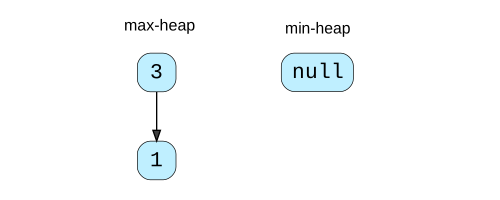
Now, we have two elements in the Max Heap and no elements in Min Heap. Let’s take the largest element from the Max Heap 3 and insert it into the Min Heap, to balance the number of elements in both heaps.

-
findMedian(): As we have an even number of elements, the median will be the average of the top element of both the heaps -> (1+3)/2 = 2.0 -
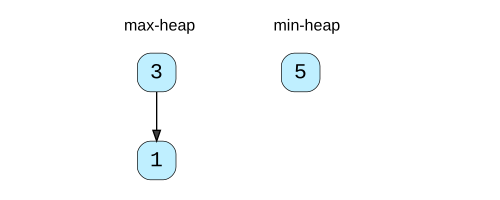
insertNum(5): As ‘5’ is greater than the top element of the Max Heap, we can insert it into the Min Heap. After the insertion, the total count of elements will be odd. As we had decided to have more numbers in the Max Heap than the Min Heap, we can take the top (smallest) number from the Min Heap and insert it into the Max Heap.
-
findMedian(): Since we have an odd number of elements, the median will be the top element of Max Heap -> 3. An odd number of elements also means that the Max Heap will have one extra element than the Min Heap. -
insertNum(4): Insert ‘4’ into Min Heap.
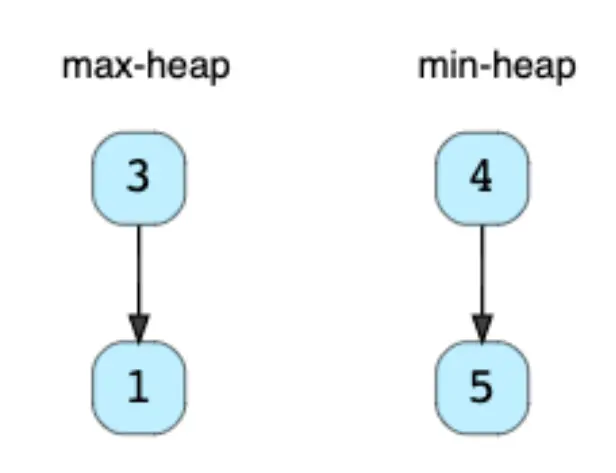
findMedian(): As we have an even number of elements, the median will be the average of the top element of both the heaps -> (3+4)/2 = 3.5
Code
Here is what our algorithm will look like:
import java.util.*;

class Solution {

  PriorityQueue<Integer> maxHeap; //containing first half of numbers
  PriorityQueue<Integer> minHeap; //containing second half of numbers

  public Solution() {
    maxHeap = new PriorityQueue<>((a, b) -> b - a);
    minHeap = new PriorityQueue<>((a, b) -> a - b);
  }

  public void insertNum(int num) {
    if (maxHeap.isEmpty() || maxHeap.peek() >= num) maxHeap.add(num);
    else minHeap.add(num);

    // either both the heaps will have equal number of elements or max-heap will have one
    // more element than the min-heap
    if (maxHeap.size() > minHeap.size() + 1) minHeap.add(maxHeap.poll());
    else if (maxHeap.size() < minHeap.size()) maxHeap.add(minHeap.poll());
  }

  public double findMedian() {
    if (maxHeap.size() == minHeap.size()) {
      // we have even number of elements, take the average of middle two elements
      return maxHeap.peek() / 2.0 + minHeap.peek() / 2.0;
    }
    // because max-heap will have one more element than the min-heap
    return maxHeap.peek();
  }

  public static void main(String[] args) {
    Solution medianOfAStream = new Solution();
    medianOfAStream.insertNum(3);
    medianOfAStream.insertNum(1);
    System.out.println("The median is: " + medianOfAStream.findMedian());
    medianOfAStream.insertNum(5);
    System.out.println("The median is: " + medianOfAStream.findMedian());
    medianOfAStream.insertNum(4);
    System.out.println("The median is: " + medianOfAStream.findMedian());
  }
}
Time Complexity
The time complexity of the insertNum() will be O(logN) due to the insertion in the heap. The time complexity of the findMedian() will be O(1) as we can find the median from the top elements of the heaps.
Space Complexity
The space complexity will be O(N) because, as at any time, we will be storing all the numbers.
🤖 Don't fully get this? Learn it with Claude
Stuck on Find the Median of a Number Stream? Open Claude, copy a block below, and it'll teach you this exact concept — visually and interactively.
Progressively stronger hints — you still solve it.
I'm working on the problem **Find the Median of a Number Stream** (DSA). Give me a HINT LADDER: start with the tiniest nudge, then wait. Only reveal the next, stronger hint when I ask. Do NOT show the full solution unless I type 'show solution'. Keep me doing the thinking. If you're unsure or a claim isn't standard, say so and reason from first principles instead of guessing.
See the technique, not just code.
Explain the optimal approach to **Find the Median of a Number Stream** with a VISUAL walkthrough: trace it on a small concrete example using ASCII art / a step-by-step diagram, narrate what changes each step, then give time & space complexity with a one-line derivation. If you're unsure or a claim isn't standard, say so and reason from first principles instead of guessing.
Catch bugs, edge cases, sub-optimality.
I'll paste my solution to **Find the Median of a Number Stream**. Review it for correctness, missed edge cases, and time/space complexity, then coach me toward the optimal — don't just rewrite it. Ask me to paste my code now. If you're unsure or a claim isn't standard, say so and reason from first principles instead of guessing.
Lock in recognition with look-alikes.
Give me 2 problems that use the SAME underlying pattern as **Find the Median of a Number Stream**. For each, let me attempt first, then review my answer and name the trigger signal that reveals the pattern. If you're unsure or a claim isn't standard, say so and reason from first principles instead of guessing.