Operations on Singly Linked List
A singly linked list works because each node stores a value plus one pointer to the next node, so any structural change — insert, delete, traverse — is done by rewiring a handful of next pointers rather than shifting a contiguous block of memory; the cost of an operation is dominated entirely by how many nodes you must walk to reach the rewiring point, not by how many nodes exist after it.
Recognize the pattern
- The problem talks about a sequence where elements are added/removed frequently at arbitrary positions, and random access (
arr[i]) is not required. - You see phrases like "insert before/after a given node", "remove the node with value X", or "reverse a list" — all pointer-rewiring tasks.
- The data structure is drawn as boxes connected by arrows in one direction only (no arrow back to the previous box) — that single-direction constraint is the tell that separates it from a doubly linked list.
Brute force vs optimal
Brute force (array-backed sequence): to insert or delete at position k in an array, every element after k must be shifted — O(n) data movement per operation, plus occasional O(n) resize copies.
Optimal (linked list): once you hold a reference to the node just before the target position, insertion/deletion is O(1) pointer updates — no data movement. The only O(n) cost left is the search to reach that position, which is unavoidable in a singly linked list because there is no random access.
So the real trade is: arrays pay O(n) to move data; linked lists pay O(n) to locate a spot, then O(1) to change it. When the position is already known (e.g., you're holding the predecessor node while scanning), the linked list wins outright.
Complexity, derived
| Operation | Work performed | Time | Space |
|---|---|---|---|
| Traverse | 1 pointer read + 1 comparison per node, n nodes | O(n) | O(1) |
| Insert at head | allocate node, 2 pointer writes | O(1) | O(1) |
| Insert at tail (no tail ptr) | walk n-1 links to reach last node, then 2 writes | O(n) | O(1) |
| Insert at tail (tail ptr kept) | 0 links to walk, 2 writes | O(1) | O(1) |
| Insert/delete at position k | walk k-1 links, then O(1) writes | O(k), worst O(n) | O(1) |
| Delete at head | 1 pointer write (head = head.next) | O(1) | O(1) |
Space is O(1) for every operation because we mutate pointers in place — the only extra memory is a fixed number of reference variables (current, prev), independent of n. This is the recurrence-free case: cost = (nodes visited to locate the target) × O(1) work per node. One caveat: reversing the list is Θ(n) time either way, but only the iterative version (three rolling references) is Θ(1) space — the recursive version unwinds T(n)=T(n−1)+O(1) across Θ(n) stack frames, so it is not an O(1)-space reverse.
Worked example
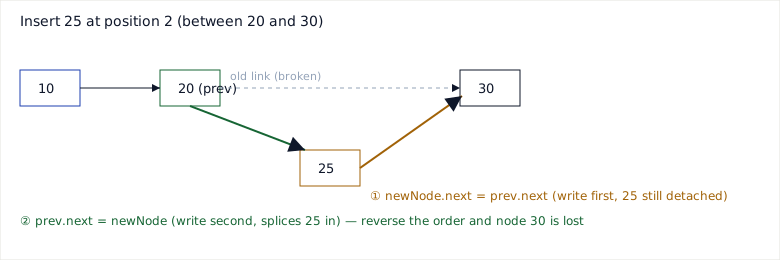
List: 10 -> 20 -> 30 -> NULL. Insert value 25 at position 2 (0-indexed, so it lands between 20 and 30).
| Step | Action | State |
|---|---|---|
| 1 | newNode = Node(25), newNode.next = null | 25 -> null (detached) |
| 2 | position != 0, so find node at position-1 = 1: prev = head; move once → prev = node(20) | prev points at 20 |
| 3 | newNode.next = prev.next (25.next = 30) — this write happens FIRST, while 25 is still detached | 25 -> 30 |
| 4 | prev.next = newNode (20.next = 25) — only now is 25 spliced in; reversing this order would drop node 30 | 10 -> 20 -> 25 -> 30 -> NULL |
Total links walked: 1 (to reach node 20). Total pointer writes: 2. Deleting 25 back out reverses the same two writes: prev.next = prev.next.next.
Code (Java)
import java.util.NoSuchElementException;

class Node {
    int val;
    Node next;
    Node(int val) { this.val = val; }
}

class SinglyLinkedList {
    Node head;

    void insertAt(int position, int value) {
        Node newNode = new Node(value);
        if (position == 0) {
            newNode.next = head;
            head = newNode;
            return;
        }
        Node prev = head;
        for (int i = 0; i < position - 1 && prev != null; i++) prev = prev.next;
        if (prev == null) throw new IndexOutOfBoundsException("invalid position");
        newNode.next = prev.next;
        prev.next = newNode;
    }

    void deleteAt(int position) {
        if (head == null) throw new NoSuchElementException("list is empty");
        if (position == 0) { head = head.next; return; }
        Node prev = head;
        for (int i = 0; i < position - 1 && prev.next != null; i++) prev = prev.next;
        if (prev.next == null) throw new IndexOutOfBoundsException("invalid position");
        prev.next = prev.next.next;
    }

    void traverse() {
        Node current = head;
        while (current != null) {
            System.out.print(current.val + " -> ");
            current = current.next;
        }
        System.out.println("NULL");
    }
}
Pitfalls
- Losing the head: overwriting
headbefore saving a reference to the old first node causes the entire list to leak/become unreachable. - Off-by-one on the predecessor: inserting/deleting at position k needs the node at
k-1, notk— a common bug is stopping one step too early or late. - Null dereference at the tail: forgetting to check
prev == null/prev.next == nullbefore dereferencing when the position exceeds list length. - Write-order bug on insert: you must set
newNode.next = prev.nextbeforeprev.next = newNode— reversing the order overwrites the only reference to the rest of the list beforenewNodehas captured it, silently truncating the list (see the diagram above). - Dangling node.next after deletion: in garbage-collected languages this is harmless, but in manual-memory languages failing to free the removed node leaks memory; conversely, freeing it before rewiring
prev.nextcauses a use-after-free. - Forgetting to update a tail pointer (if maintained) after deleting the last node, leaving it stale.
When to use / when not
Use a singly linked list when insertions/deletions happen at the front or at a position you already hold a reference to (e.g., implementing a stack, or a queue with head+tail pointers), and you don't need backward traversal or random access.
vs. Doubly Linked List: a doubly linked list adds a prev pointer, enabling O(1) deletion given only a reference to the node itself (no need to re-scan for the predecessor) and O(1) traversal in both directions — at the cost of extra memory per node (one more pointer) and more pointer writes to keep consistent. Choose singly linked when memory is tight and you never need to walk backward or delete via a bare node reference; choose doubly linked (e.g., LRU cache implementations) when O(1) arbitrary deletion matters.
vs. Dynamic array (ArrayList): arrays give O(1) random access and better cache locality (contiguous memory) but O(n) shifting for mid-list insert/delete. Linked lists give O(1) structural edits at a known point but O(n) search and poor cache locality due to scattered allocations.
Takeaways
- Every linked-list operation's cost = (nodes traversed to reach the edit point) + O(1) pointer rewiring — there's no hidden data-shifting cost.
- Head operations are always O(1); anything else pays for the walk.
- Guard against null before dereferencing
.next— that's the single most common bug source. - Pick doubly linked lists over singly linked ones specifically when you need O(1) deletion from a bare node reference or backward traversal.
Recall: Why is deleting the last node of a singly linked list O(n) even though deleting the first node is O(1)?
Synthesized from standard DSA curricula (CLRS-style linked list treatment) and the source lesson's traversal/insertion/deletion algorithm walkthroughs.
🤖 Don't fully get this? Learn it with Claude
Stuck on Operations on Singly Linked List? Open Claude, copy a block below, and it'll teach you this exact concept — visually and interactively.
Build the mental picture, not memorization.
I just read a lesson on **Operations on Singly Linked List** (DSA) and want to truly understand it. Explain Operations on Singly Linked List from first principles using ONE vivid real-world analogy and a visual mental model — draw it as ASCII art or a clear step-by-step diagram — with a concrete example using real numbers. Then ask me one question to check I got the mental picture, and wait for my reply. If you're unsure or a claim isn't standard, say so and reason from first principles instead of guessing.
Socratic — adapts to where you're stuck.
Teach me **Operations on Singly Linked List** interactively. Ask me ONE guiding question at a time, wait for my answer, and adapt to my confusion — build the idea with me step by step instead of explaining it all at once. If you're unsure or a claim isn't standard, say so and reason from first principles instead of guessing.
Active recall exposes what you missed.
Quiz me on **Operations on Singly Linked List** with 5 questions, easy to tricky, ONE at a time. Tell me if each answer is right; at the end, explain clearly what I got wrong and why. If you're unsure or a claim isn't standard, say so and reason from first principles instead of guessing.
Intuition + hook + flashcards for long-term memory.
Help me remember **Operations on Singly Linked List** for the long term: give the one-sentence intuition, a memorable hook/mnemonic, a tiny worked example, and 3 active-recall flashcards (Q -> A). If you're unsure or a claim isn't standard, say so and reason from first principles instead of guessing.