Introduction to Matrix
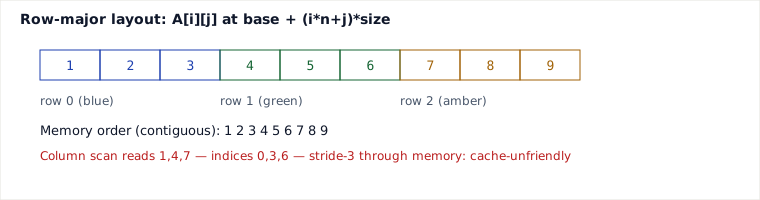
A matrix is a two-dimensional array laid out in contiguous memory so that the address of element A[i][j] is computed directly from i and j via arithmetic — base + (i * n + j) * elemSize for an m×n row-major matrix — which is why access needs no traversal, unlike a linked structure.
Recognize the pattern
- Input is described as a grid, board, image, or 2D map of cells (explicit rows/cols).
- You must move between neighboring cells (4- or 8-directional) — flood fill, number of islands, shortest path on a grid.
- Sub-problems index naturally by two coordinates — DP tables like
dp[i][j], edit distance, unique paths. - You need O(1) lookup of "is there an edge between i and j" — adjacency matrix for dense graphs.
Brute force to optimal
Naive layout: simulate a 2D structure with a hash map keyed by (i,j) pairs. It works for sparse data but every access pays hashing cost, and neighboring cells can be scattered anywhere in the heap — no cache locality.
Matrix (array-of-arrays or a flattened 1D array): fixed-size contiguous storage. Access is direct address arithmetic; scanning a row touches consecutive memory, exploiting the CPU cache line and prefetcher. The trade-off is that resizing means reallocating and copying the whole block, and space is reserved for every cell whether used or not — wasteful for sparse data (e.g. a graph with few edges).
Complexity, derived
| Operation | Time | Why |
|---|---|---|
| Access A[i][j] | O(1) | two multiplies (i*n, then ×elemSize) plus one add (+j) yield the byte offset directly; no traversal |
| Row scan | O(n) | n contiguous reads — cache-friendly |
| Column scan | O(m) | m reads, each stride n apart — cache-unfriendly in row-major layout |
| Full traversal | O(m·n) | every cell visited exactly once |
| Space | O(m·n) | one slot allocated per cell, dense or not |
The column-scan cost is the key derivation people miss: in row-major storage, element A[i][j] and A[i+1][j] are n slots apart in memory, so a column walk jumps n elements each step — it can defeat the cache even though, per element touched, both scans do the same O(1) work — and for a square matrix (m = n) the two scans' totals, O(m) and O(n), are literally identical in Big-O while their real speed differs by the cache behavior.
Worked example: address computation and traversal order
Take the 3×3 matrix A = [[1,2,3],[4,5,6],[7,8,9]] stored row-major starting at base address 1000 with 4-byte ints.
| Element | i | j | offset = (i*3+j)*4 | address |
|---|---|---|---|---|
| A[0][0]=1 | 0 | 0 | 0 | 1000 |
| A[1][2]=6 | 1 | 2 | 20 | 1020 |
| A[2][1]=8 | 2 | 1 | 28 | 1028 |
A row-major traversal visiting i outer, j inner reads addresses 1000,1004,1008,...,1032 in strictly increasing order — one cache line typically covers several consecutive elements. Swapping the loop order (j outer, i inner) reads 1000,1012,1024,1004,1016,1028,... — a stride-12 pattern that can trigger a cache miss on every access for large matrices.
Java and Go: allocation and safe traversal
Both traversals below deliberately re-read each row's own length inside the loop rather than hoisting one fixed n before the loop — the discipline the Pitfalls section calls for, and the only version that stays correct if a row is ever ragged.
// Java — ragged-safe traversal
int[][] A = {{1,2,3},{4,5,6},{7,8,9}};
int m = A.length;
int sum = 0;
for (int i = 0; i < m; i++) {
    int n = A[i].length;        // per-row length, not a fixed outer n
    for (int j = 0; j < n; j++) {
        sum += A[i][j];
    }
}
// sum = 45 for the matrix above; still correct if a row is shorter/longer
// Go — slice of slices, same per-row-length discipline
A := [][]int{{1, 2, 3}, {4, 5, 6}, {7, 8, 9}}
sum := 0
for i := range A {
for j := range A[i] { // len(A[i]) per row, ragged-safe
sum += A[i][j]
}
}
// sum == 45; Go slices are ragged by default, so this is the natural idiomPitfalls
- Ragged arrays: in Java/C#/JS, rows of a 2D array can have different lengths (
int[][]is really an array of array references) — always readA[i].lengthper row instead of assuming a fixedn, as the traversal above does. - Swapped index order: confusing
A[row][col]withA[x][y](x=column) is a classic off-by-axis bug in grid/graph problems. - Column-major traversal cost: looping column-outer over a large row-major matrix silently degrades performance from cache-friendly to cache-thrashing while the asymptotic complexity looks unchanged.
- Dense matrix for sparse data: using an adjacency matrix for a graph with n=10^5 nodes and few edges wastes O(n²) memory; an adjacency list is the correct alternative.
When to use / when not, and trade-offs
Use a matrix when the domain is naturally dense and grid-shaped (images, boards, DP tables, dense graphs) and you need O(1) random access plus cache-friendly bulk scans. Use it for adjacency representation only when the graph is dense (edges close to n²) or you need O(1) edge-existence checks.
Alternative — adjacency list / hash map of coordinates: better when data is sparse — space is O(number of actual entries) instead of O(m·n), and iterating only real neighbors avoids wasted work, at the cost of O(1) amortized (not guaranteed contiguous) access and worse cache locality per lookup.
Takeaways
- A matrix trades flexibility for O(1) address-computed access and cache-friendly contiguous scans.
- Row-major vs column-major layout matters for performance, not just correctness — walk with the grain.
- Dense, grid-shaped, coordinate-indexed problems are the tell; sparse relational data should prefer adjacency lists or maps.
Recall: Why can a column scan and a row scan on a square (m = n) row-major matrix both be O(n) yet perform very differently in practice?
Compiled from standard DSA references on array/matrix memory layout and cache behavior (CLRS-style algorithm analysis; common systems-programming treatments of row-major vs column-major storage).
🤖 Don't fully get this? Learn it with Claude
Stuck on Introduction to Matrix? Open Claude, copy a block below, and it'll teach you this exact concept — visually and interactively.
Build the mental picture, not memorization.
I just read a lesson on **Introduction to Matrix** (DSA) and want to truly understand it. Explain Introduction to Matrix from first principles using ONE vivid real-world analogy and a visual mental model — draw it as ASCII art or a clear step-by-step diagram — with a concrete example using real numbers. Then ask me one question to check I got the mental picture, and wait for my reply. If you're unsure or a claim isn't standard, say so and reason from first principles instead of guessing.
Socratic — adapts to where you're stuck.
Teach me **Introduction to Matrix** interactively. Ask me ONE guiding question at a time, wait for my answer, and adapt to my confusion — build the idea with me step by step instead of explaining it all at once. If you're unsure or a claim isn't standard, say so and reason from first principles instead of guessing.
Active recall exposes what you missed.
Quiz me on **Introduction to Matrix** with 5 questions, easy to tricky, ONE at a time. Tell me if each answer is right; at the end, explain clearly what I got wrong and why. If you're unsure or a claim isn't standard, say so and reason from first principles instead of guessing.
Intuition + hook + flashcards for long-term memory.
Help me remember **Introduction to Matrix** for the long term: give the one-sentence intuition, a memorable hook/mnemonic, a tiny worked example, and 3 active-recall flashcards (Q -> A). If you're unsure or a claim isn't standard, say so and reason from first principles instead of guessing.