Sliding Window — Fixed vs Variable, Traced
From O(n²) nested loops to one O(n) pass
Many "longest/shortest/contains substring or subarray" problems look like "check every range" = O(n²). The
sliding window keeps a range [L, R] and moves both pointers only right: grow
R to include more, shrink L when a constraint breaks. Each index enters and leaves the
window once → O(n).
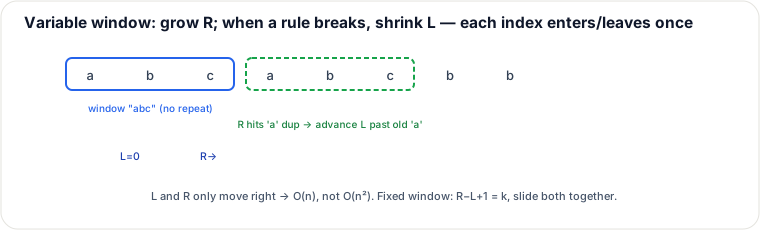
The two shapes
// VARIABLE window — longest substring without repeating chars
int L=0, best=0; Set<Character> win = new HashSet<>();
for (int R=0; R < s.length(); R++) {
    while (win.contains(s.charAt(R))) win.remove(s.charAt(L++));  // shrink until valid
    win.add(s.charAt(R));
    best = Math.max(best, R - L + 1);                            // window is valid here
}
return best;

// FIXED window of size k — slide both together
long sum=0, best=Long.MIN_VALUE;
for (int R=0; R < n; R++) {
    sum += a[R];
    if (R >= k) sum -= a[R - k];   // drop the element leaving the window
    if (R >= k-1) best = Math.max(best, sum);
}
The trace ("abcabcbb")
| R | char | window | L | best |
|---|---|---|---|---|
| 0–2 | a b c | "abc" | 0 | 3 |
| 3 | a (dup) | shrink past old a → "bca" | 1 | 3 |
| 4 | b (dup) | "cab" | 2 | 3 |
| 5 | c (dup) | shrink past old c → "abc" | 3 | 3 |
| 6 | b (dup) | shrink past a, b → "cb" | 5 | 3 |
| 7 | b (dup) | shrink past c, b → "b" | 7 | 3 |
Final answer: best = 3 ("abc"). Cost accounting: R advances n times and each index is removed from the set at most once as L advances → ≤ 2n set operations total, Θ(n) time; space is Θ(min(n, σ)) for the window charset (σ = alphabet size).
Edge checks (hand-run them)
- Empty string → best = 0 (loop never runs).
- Single char → best = 1.
- All unique → best = n (L never moves).
- All same, "aaaa" → best = 1 (every step shrinks exactly once).
Pitfalls
- When to shrink: shrink while invalid (a
while, not anif) — multiple elements may need to leave. - Window size is
R - L + 1— off-by-one here is the classic bug. - Only for contiguous subarrays/substrings; non-contiguous needs a different tool.
- Variable windows on sums need non-negative elements: if the array can contain negatives, growing the window can decrease the sum and the shrink-while-valid logic is wrong — use prefix sums (often with a hash map) instead. Fixed-size sum windows stay valid with negatives.
- Max/min of a window: a plain running variable cannot reverse when the extremum leaves — use a monotonic deque (amortized O(1) per step).
- Arbitrary range queries: if windows are not visited in left-to-right sliding order, prefer a prefix-sum array over a sliding window. Full trade-offs: see Introduction to Sliding Window Pattern.
Takeaways
- Two pointers moving only right → O(n); each element enters/leaves once.
- Fixed window: slide both together. Variable: grow R, shrink L while invalid.
- Track the valid-window state (a set/map/sum) incrementally, not by re-scanning.
Re-authored for this guide; window-slide diagram hand-authored as SVG. See also: Two Pointers, Hashing, Arrays.
🤖 Don't fully get this? Learn it with Claude
Stuck on Sliding Window — Fixed vs Variable, Traced? Open Claude, copy a block below, and it'll teach you this exact concept — visually and interactively.
Build the mental picture, not memorization.
I just read a lesson on **Sliding Window — Fixed vs Variable, Traced** (DSA) and want to truly understand it. Explain Sliding Window — Fixed vs Variable, Traced from first principles using ONE vivid real-world analogy and a visual mental model — draw it as ASCII art or a clear step-by-step diagram — with a concrete example using real numbers. Then ask me one question to check I got the mental picture, and wait for my reply. If you're unsure or a claim isn't standard, say so and reason from first principles instead of guessing.
Socratic — adapts to where you're stuck.
Teach me **Sliding Window — Fixed vs Variable, Traced** interactively. Ask me ONE guiding question at a time, wait for my answer, and adapt to my confusion — build the idea with me step by step instead of explaining it all at once. If you're unsure or a claim isn't standard, say so and reason from first principles instead of guessing.
Active recall exposes what you missed.
Quiz me on **Sliding Window — Fixed vs Variable, Traced** with 5 questions, easy to tricky, ONE at a time. Tell me if each answer is right; at the end, explain clearly what I got wrong and why. If you're unsure or a claim isn't standard, say so and reason from first principles instead of guessing.
Intuition + hook + flashcards for long-term memory.
Help me remember **Sliding Window — Fixed vs Variable, Traced** for the long term: give the one-sentence intuition, a memorable hook/mnemonic, a tiny worked example, and 3 active-recall flashcards (Q -> A). If you're unsure or a claim isn't standard, say so and reason from first principles instead of guessing.