Introduction to Dependency Inversion Principle
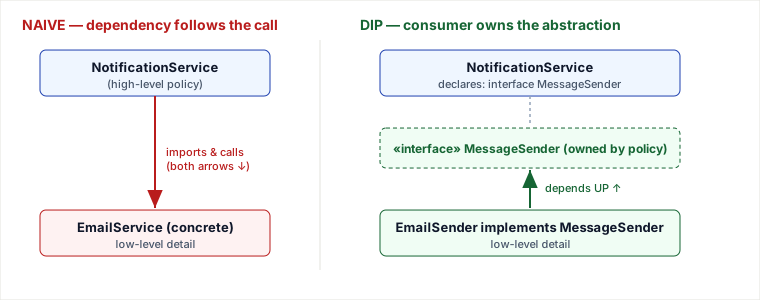
The Dependency Inversion Principle works by making the consumer define the interface it needs and forcing the concrete worker to implement that consumer-owned interface — so the source-code dependency arrow points from the low-level detail up to the high-level policy, the reverse of the natural call direction.
Robert C. Martin states it as two rules:
1. High-level modules should not depend on low-level modules. Both should depend on abstractions.
2. Abstractions should not depend on details; details should depend on abstractions.
What "inversion" actually means — the part everyone skips
Ask the question that names the principle: inverted relative to what? In a naive design the call direction and the dependency direction point the same way. NotificationService calls EmailService.sendEmail(), and to compile, NotificationService must import and reference EmailService. Both arrows point downward, high → low. The high-level policy is now chained to a low-level detail.
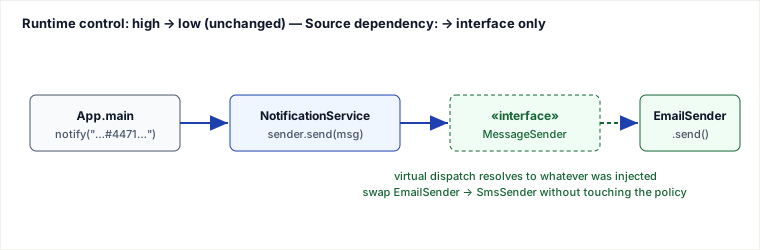
DIP separates those two arrows. Runtime control still flows high → low — the notification policy still drives the email sending. But the source-code dependency is inverted to point low → high. We achieve this by an ownership flip: the abstraction (MessageSender) is defined by and belongs to the high-level module — it is phrased in the policy's vocabulary ("send a message"), not the detail's vocabulary ("open an SMTP socket"). The low-level EmailSender now depends on the policy's interface to exist. That is the inversion: the detail conforms to the policy's contract, not the other way round.
Why the naive version is wrong
In the original code the constructor does emailService = new EmailService();. Two distinct problems hide in that one line. First, NotificationService names a concrete type, so its .class file literally cannot compile or load without EmailService — a compile-time chain to a detail. Second, it constructs the dependency itself, so a caller can never hand it a different sender. Adding SMS means editing the policy class. DIP fixes the first problem (depend on an interface); dependency injection fixes the second (receive the implementation, don't build it).
The DIP-compliant version
The interface lives with the policy and speaks the policy's language. The concrete sender implements it. The wiring decision moves out to the composition root (often main or a DI container).
// Abstraction — OWNED BY the high-level module, named in policy terms
public interface MessageSender {
    void send(String message);
}

// High-level policy: depends ONLY on the interface, receives it (DI)
public class NotificationService {
    private final MessageSender sender;

    public NotificationService(MessageSender sender) { // injected
        this.sender = sender;
    }

    public void notify(String message) {
        sender.send(message);
    }
}

// Low-level detail: depends UP on MessageSender to exist
public class EmailSender implements MessageSender {
    @Override public void send(String message) {
        System.out.println("Sending email: " + message);
    }
}

public class SmsSender implements MessageSender {
    @Override public void send(String message) {
        System.out.println("Sending SMS: " + message);
    }
}

// Composition root — the ONLY place that knows concrete types
public class App {
    public static void main(String[] args) {
        MessageSender sender = new EmailSender();        // swap here, nowhere else
        NotificationService svc = new NotificationService(sender);
        svc.notify("Your order #4471 has shipped");
    }
}
Traced example: shipping notification, then a same-day swap to SMS
Concrete input: order #4471 ships, message "Your order #4471 has shipped". Follow what each line touches and which dependency arrow it crosses.
| Step | Code | Concrete value | Dependency crossed |
|---|---|---|---|
| 1 | new EmailSender() | an EmailSender instance | App → EmailSender (only here) |
| 2 | new NotificationService(sender) | sender field = the EmailSender, typed as MessageSender | App → NotificationService; field is the abstraction |
| 3 | svc.notify("…#4471…") | message = "Your order #4471 has shipped" | caller → policy |
| 4 | sender.send(message) | dispatches on the interface | policy → MessageSender (NOT EmailSender) |
| 5 | EmailSender.send runs | prints Sending email: Your order #4471 has shipped | runtime control flows high → low ✓ |
Now requirements change: ship via SMS. Edit one line in step 1 to new SmsSender(). Output becomes Sending SMS: Your order #4471 has shipped. NotificationService is not recompiled, not even reopened — its source has no idea SMS exists. That is the payoff of the inverted arrow: the policy was sealed against changes in the detail.
Pitfalls
- Interface owned by the wrong module. If
MessageSenderlives in the email package and is phrased assendEmail(), you have a header file, not an inversion. The dependency still points at the detail's vocabulary. The interface must live with and read like the high-level policy ("send a message"), or nothing was inverted. - DIP without DI — the hidden
new. Coding to an interface but still writingsender = new EmailSender()inside the constructor re-couples you at construction time. You can't substitute a fake in tests or a different sender in prod. Inject through the constructor or a factory. - Leaky abstraction. An interface that exposes
getSmtpConnection()or throwsSQLExceptiondrags the detail back into the contract — rule 2 violated (abstraction now depends on details). Keep the interface in the policy's terms. - One interface, one implementation, forever. Adding an interface that will only ever have a single implementation buys indirection and zero flexibility. DIP earns its keep when implementations vary (swap, test-double, plugin) — not by reflex on every class.
- Over-abstracting stable code. Wrapping
Stringor the JDK collections behind your own interfaces "for DIP" adds layers nobody will ever swap. Invert dependencies on things that change or that you want to fake, not on the language runtime.
When to apply DIP — and when not to
Reach for it when a high-level policy talks to something volatile or external: a notification channel, a payment gateway, a database, a clock, the filesystem, a third-party API. The signals are concrete: you want to unit-test the policy without the real thing, you expect the implementation to be swapped or have multiple variants, or the detail lives across a deployment / module boundary you don't control.
Don't bother when the collaborator is stable and internal — a value object, a pure helper, a data structure that will never be faked or swapped. The cost of DIP is real: an extra interface, an extra indirection a reader must follow, a wiring decision pushed to a composition root, and a stack trace with one more frame. Paying that for a type that will only ever have one implementation is negative-value abstraction.
Versus the alternatives
- DIP + DI vs. a plain
newinside the class. Direct construction is the simplest thing and is correct for stable internals. You gain zero substitutability and zero testability-in-isolation. Choose DIP when you need to swap or fake the collaborator; keep the directnewwhen you never will. - DIP vs. the Service Locator pattern. Both decouple from the concrete. A locator (
Registry.get(MessageSender.class)) hides the dependency inside the method body, so the class's true needs aren't visible in its signature and tests must configure global state. Constructor-injected DIP makes dependencies explicit and the object honest. Prefer the locator only in legacy code where you can't change constructors; prefer DIP-by-constructor otherwise. - DIP vs. an
if/switchon a type flag. Aswitch(channel)keeps everything in one file — fine for two-or-three fixed cases that rarely change. But every new channel reopens the policy (an Open/Closed violation), and you can't inject a test double. Choose DIP when channels are added by other teams/plugins or must be mocked; keep the switch when the set is tiny, closed, and owned by you.
One-liner: choose DIP + constructor injection when the collaborator is volatile, external, or must be faked in tests; prefer a direct new when it is stable and internal and will only ever have one implementation.
Takeaways
- The "inversion" is an ownership flip: the high-level module defines the interface in its own vocabulary, and the low-level detail implements it — flipping the source-code dependency to point detail → policy, even though runtime control still flows policy → detail.
- DIP (depend on an abstraction) and DI (receive the implementation) are different moves; you need both to actually swap or fake a collaborator.
- The interface must live with the policy and read in the policy's terms — an interface in the detail's package or phrased in the detail's terms is not an inversion.
- Invert dependencies on what is volatile, external, or must be tested in isolation; leave stable internal types alone — every abstraction costs indirection.
Sources: Robert C. Martin, "The Dependency Inversion Principle" (C++ Report, 1996) and Agile Software Development: Principles, Patterns, and Practices; Martin Fowler, "Inversion of Control Containers and the Dependency Injection pattern" (2004) for the DIP-vs-Service-Locator and composition-root distinctions; Seemann & van Deursen, Dependency Injection Principles, Practices, and Patterns for the constructor-injection and composition-root guidance. Re-authored and deepened for this guide — added the ownership-flip explanation of why it is called "inversion," a runtime-vs-source-dependency trace, the DIP-without-DI bug fix, and the selection/trade-off analysis.
🤖 Don't fully get this? Learn it with Claude
Stuck on Introduction to Dependency Inversion Principle? Open Claude, copy a block below, and it'll teach you this exact concept — visually and interactively.
Build the mental picture, not memorization.
I just read a lesson on **Introduction to Dependency Inversion Principle** (OO & Low-Level Design) and want to truly understand it. Explain Introduction to Dependency Inversion Principle from first principles using ONE vivid real-world analogy and a visual mental model — draw it as ASCII art or a clear step-by-step diagram — with a concrete example using real numbers. Then ask me one question to check I got the mental picture, and wait for my reply. If you're unsure or a claim isn't standard, say so and reason from first principles instead of guessing.
Socratic — adapts to where you're stuck.
Teach me **Introduction to Dependency Inversion Principle** interactively. Ask me ONE guiding question at a time, wait for my answer, and adapt to my confusion — build the idea with me step by step instead of explaining it all at once. If you're unsure or a claim isn't standard, say so and reason from first principles instead of guessing.
Active recall exposes what you missed.
Quiz me on **Introduction to Dependency Inversion Principle** with 5 questions, easy to tricky, ONE at a time. Tell me if each answer is right; at the end, explain clearly what I got wrong and why. If you're unsure or a claim isn't standard, say so and reason from first principles instead of guessing.
Intuition + hook + flashcards for long-term memory.
Help me remember **Introduction to Dependency Inversion Principle** for the long term: give the one-sentence intuition, a memorable hook/mnemonic, a tiny worked example, and 3 active-recall flashcards (Q -> A). If you're unsure or a claim isn't standard, say so and reason from first principles instead of guessing.