Origin Server vs Edge Server
An edge server cuts latency by terminating the user's TCP/TLS connection at a nearby point-of-presence and answering from a cached copy of the origin's bytes — so the expensive long-distance trip to the origin happens only on a cache miss, not on every request. The origin is the one authoritative machine (or cluster) that holds the real content and computes dynamic responses; the edge is one of hundreds of geographically scattered caches that stand in front of it. The whole design is a bet: most requests are for the same cacheable objects, so a copy held close to users serves the crowd while the origin is touched rarely.
The two roles, precisely
Origin server — the source of truth. It stores original, unmodified content (HTML, images, CSS, JS, video segments) and runs the application logic that produces dynamic and personalized responses. It is the only place a write lands and the only place that can regenerate content. Because every uncached request eventually funnels back here, an unshielded origin is the scalability bottleneck and the single point of failure.
Edge server — a caching reverse proxy in a CDN PoP, placed close to users. It holds copies of origin objects, keyed by URL (plus any Vary dimensions), and serves them directly. It also terminates TLS near the user, absorbs traffic spikes, and shields the origin. It is deliberately not authoritative: it can hold a slightly stale copy and it cannot, on its own, produce content it has never seen.
| Dimension | Origin | Edge |
|---|---|---|
| Count / location | One authoritative cluster, one (or few) regions | Hundreds of PoPs, near users |
| Holds truth? | Yes — writes and dynamic compute land here | No — cached copy, may be stale |
| Serves on | Cache miss / uncacheable / write | Cache hit (the common case) |
| Failure impact | Global outage if unshielded | Requests fail over to another PoP or origin |
A traced request: Paris user, New York origin
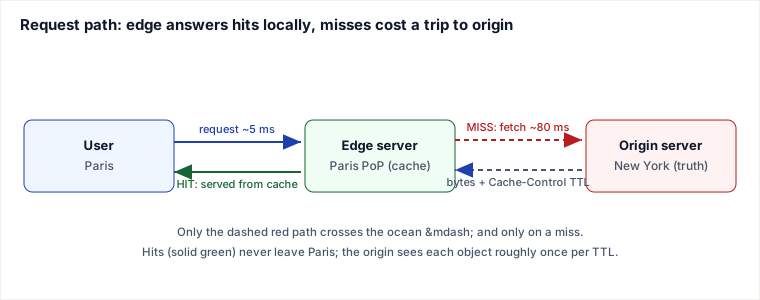
A user in Paris requests https://cdn.example.com/promo.mp4. The origin lives in New York; a CDN PoP sits in Paris. Assume Paris↔Paris-PoP round-trip ≈ 5 ms and Paris-PoP↔New-York ≈ 80 ms, TLS 1.3 (1 RTT) over TCP (1 RTT). Follow the first (cold) request, then the next user's (warm) request.
Request 1 — cache MISS (object never seen at this PoP)
| Step | What happens | Cost |
|---|---|---|
| 1 | DNS / anycast routes cdn.example.com to the Paris PoP | (resolved once, cached) |
| 2 | TCP + TLS handshake to Paris edge (2 RTT × 5 ms) | ~10 ms |
| 3 | Edge looks up cache key GET /promo.mp4 → MISS | ~0 ms |
| 4 | Edge fetches from NY origin over a warm keep-alive connection (1 RTT + first byte) | ~80 ms |
| 5 | Origin returns bytes + Cache-Control: max-age=3600; edge stores with TTL and streams to user | streaming |
Time to first byte ≈ 90 ms — the miss paid the full transatlantic trip once.
Request 2 — cache HIT (a second Paris user, seconds later)
| Step | What happens | Cost |
|---|---|---|
| 1 | TCP + TLS to the same Paris edge (2 RTT × 5 ms) | ~10 ms |
| 2 | Cache key GET /promo.mp4 → HIT, TTL not expired | ~0 ms |
| 3 | Edge serves the cached bytes directly — origin never touched | ~5 ms first byte |
Time to first byte ≈ 15 ms, and the New York origin sees zero load. If a thousand Parisians watch the promo in the next hour, the origin serves it exactly once; the edge serves it a thousand times. That ratio — the cache hit ratio — is the entire value of the edge tier.
TTL, freshness, and the miss penalty
The edge does not guess how long to keep an object — the origin tells it, via HTTP caching headers. Cache-Control: max-age=3600 means “this copy is fresh for one hour.” While fresh, hits are served with no origin contact. After the TTL expires the object is stale; the edge revalidates with a conditional request (If-None-Match + ETag), and a 304 Not Modified lets it keep serving the same bytes without re-downloading them.
And if origin is down? Revalidation of a stale object against a dead origin fails, and by default the user gets the error — the edge will not serve stale on its own initiative. Cache-Control: stale-if-error=600 (RFC 5861) is the directive that changes this: it authorizes the edge to serve the last good copy for a bounded window, turning an origin outage into bounded staleness instead of a user-facing 5xx. See the CDN security/availability deep dive for the full availability-shield treatment.
This exposes the central trade-off of the edge tier: freshness versus load. A long TTL means high hit ratio and a quiet origin, but users can see stale content for up to the TTL after you change it. A short TTL keeps content fresh but drives up misses, and every miss pays the full round trip to origin plus origin CPU. There is no free lunch — you are choosing, per object, how stale you are willing to be. The escape hatch is active invalidation (a purge/ban API) so you can push a long TTL for hit ratio yet still force-refresh the moment content actually changes. stale-while-revalidate softens the cliff further: serve the stale copy instantly and refresh in the background.
TTL by content type
| Content type | TTL | Invalidation |
|---|---|---|
| Versioned static assets | 1 year (immutable) | Filename hash |
| Marketing / public pages | Minutes–hours + stale-if-error=600 | Purge API |
| API responses | Seconds–minutes | Cache-Control or surrogate keys |
| Personalized / auth data | None (no-store) | N/A |
Pitfalls
- Caching personalized responses. If a logged-in user's dashboard is cached under a shared URL key, the next visitor gets someone else's private page. Mark such responses
Cache-Control: private, no-store, or key the cache correctly withVary/ cookie-aware keys. This is a real security-incident class, not a performance nit. - Cache-key explosion from query strings and cookies. If the edge keys on the full URL including tracking params (
?utm_source=…) or on every cookie, each variant is a separate object and the hit ratio collapses toward zero — every request becomes a miss and the origin drowns. Normalize the cache key: strip irrelevant params, whitelist the cookies that actually matter. - Cache stampede / thundering herd. When a hot object's TTL expires, many concurrent misses can all fire at the origin at once. Use request coalescing (single-flight) at the edge and an origin shield (a tiered mid-tier cache) so a popular object is fetched from origin once, not once per PoP.
- Treating the edge as the source of truth. Writes, auth, and anything that must be strongly consistent belong at the origin. An edge hit can be stale by up to the TTL — never read money balances or inventory counts from a cached edge response and treat them as authoritative.
- Long TTL with no purge path. Shipping a broken CSS file with
max-age=86400and no invalidation means a day of broken pages. Pair long TTLs with content-hashed filenames (app.9f3c.css) or a purge API.
When to push work to the edge — and when NOT to
The origin/edge split is an architectural choice, not a default. The decision is per-workload, driven by cacheability and audience geography.
Push to the edge when the response is the same for many users (static assets, images, video segments, public pages, API responses that change slowly), the audience is geographically spread, traffic is read-heavy or spiky, and you can tolerate TTL-bounded staleness. These are the signals that a cached copy will be hit far more often than it is refreshed — exactly where the edge pays off.
Prefer serving directly from origin when every response is unique and personalized per request (a real-time trading view, per-user feeds computed on the fly), the audience is single-region and small, or the workload demands strong consistency where any staleness is unacceptable. Here the hit ratio would be near zero, so an edge cache adds indirection, a second failure surface, and cache-key risk while buying almost nothing. (Note: edge PoPs can still help such traffic via TLS termination and optimized backbone routing — dynamic acceleration — even with caching off.)
Trade-offs vs the named alternatives
- vs. serving everything from a single origin. Edge caching gains low global latency and origin offload; it costs freshness (bounded by TTL), a new class of cache-correctness bugs, and CDN spend. Choose a bare origin when content is fully dynamic or the audience is local — you keep strong consistency and one simple place to reason about.
- vs. full regional replication (deploying app servers and a database replica in each region). Replication puts dynamic compute and data close to users, so it can accelerate personalized, write-adjacent workloads that an edge cache cannot. But it costs enormously more: replicated state, cross-region consistency and conflict handling, and multi-region ops. Edge caching is the cheap 80% answer for cacheable content; regional replication is the expensive answer you reach for only when dynamic per-user latency is the actual bottleneck.
Choose the edge when your traffic is dominated by cacheable, read-heavy, globally-distributed requests. Prefer a plain origin when responses are per-user and consistency-critical; reach for regional replication only when you must run dynamic compute and data close to users and can pay the consistency bill.
Takeaways
- Edge = a nearby cache that answers the common case; origin = the one authoritative source touched only on a miss or a write. The value is the hit ratio — one origin fetch serves the whole crowd for a TTL.
- A miss pays the full round trip to origin plus origin CPU; a hit is answered locally. Your job is to maximize hits without serving stale-beyond-tolerance content.
- TTL is the dial between freshness and origin load; pair long TTLs with content hashing or a purge API so you get hit ratio and the ability to force a refresh.
- Never cache personalized or consistency-critical responses under a shared key, and never trust an edge copy as the source of truth — that is where correctness and security bugs live.
Re-authored and deepened for this guide. Sources: MDN Web Docs — HTTP caching, Cache-Control, and conditional requests (ETag / 304); Cloudflare and Fastly documentation on cache keys, TTLs, origin shielding, and purge/invalidation; Akamai edge-caching architecture notes; Alex Xu, System Design Interview (CDN chapter); Grokking the System Design Interview (CDN). Latency figures are representative round-trip values used to make the trace concrete, not measurements of a specific network.
🤖 Don't fully get this? Learn it with Claude
Stuck on Origin Server vs Edge Server? Open Claude, copy a block below, and it'll teach you this exact concept — visually and interactively.
Build the mental picture, not memorization.
I just read a lesson on **Origin Server vs Edge Server** (System Design) and want to truly understand it. Explain Origin Server vs Edge Server from first principles using ONE vivid real-world analogy and a visual mental model — draw it as ASCII art or a clear step-by-step diagram — with a concrete example using real numbers. Then ask me one question to check I got the mental picture, and wait for my reply. If you're unsure or a claim isn't standard, say so and reason from first principles instead of guessing.
Socratic — adapts to where you're stuck.
Teach me **Origin Server vs Edge Server** interactively. Ask me ONE guiding question at a time, wait for my answer, and adapt to my confusion — build the idea with me step by step instead of explaining it all at once. If you're unsure or a claim isn't standard, say so and reason from first principles instead of guessing.
Active recall exposes what you missed.
Quiz me on **Origin Server vs Edge Server** with 5 questions, easy to tricky, ONE at a time. Tell me if each answer is right; at the end, explain clearly what I got wrong and why. If you're unsure or a claim isn't standard, say so and reason from first principles instead of guessing.
Intuition + hook + flashcards for long-term memory.
Help me remember **Origin Server vs Edge Server** for the long term: give the one-sentence intuition, a memorable hook/mnemonic, a tiny worked example, and 3 active-recall flashcards (Q -> A). If you're unsure or a claim isn't standard, say so and reason from first principles instead of guessing.