Checksum — CRC Mechanism, Detection Guarantees & the End-to-End Argument (Deep Dive)
The core pages say "use a checksum, CRC is the workhorse." This page answers the three senior "but why?" questions the topic hinges on: why a plain sum is weak, why CRC catches the errors it does (with the actual polynomial mechanism and guarantees), and why real systems still layer an application-level hash on top of per-hop checksums.
1. Why a plain sum is blind
A sum-based check (add up the words, keep the low bits — e.g. the 16-bit ones-complement TCP checksum) is cheap but structurally weak because addition is commutative and associative:
- Reordering of words leaves the sum unchanged — swap two fields and it still "passes".
- Canceling errors: +1 in one word and −1 in another net to zero. Two correlated bit flips can be invisible.
- Carry/positional blindness: it does not encode where a bit is, so many burst patterns collide to the same sum.
CRC is not a sum — it is the remainder of a polynomial division, which is sensitive to bit position and pattern, so exactly these adversarial cases are caught.
2. CRC mechanism: division over GF(2)
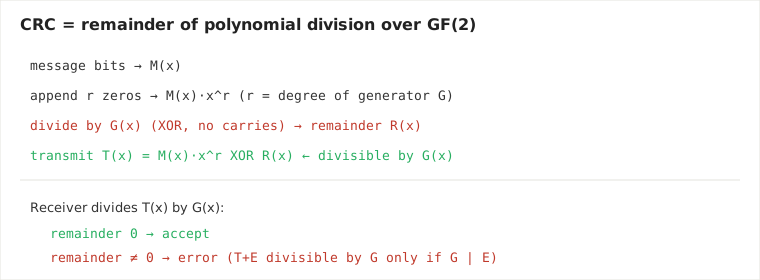
Treat the message bits as coefficients of a polynomial M(x) over GF(2) (arithmetic mod 2: addition and subtraction are both XOR, no carries). Pick a generator polynomial G(x) of degree r (e.g. CRC-32 uses a fixed degree-32 polynomial). Shift the message left by r bits (multiply by x^r), divide by G(x), and take the remainder R(x) — that is the r-bit CRC. Transmit T(x) = M(x)·x^r XOR R(x), which is by construction exactly divisible by G(x).
The receiver divides the received word by G(x). If the remainder is 0, accept. Any error is an added error polynomial E(x): the receiver sees T(x) XOR E(x), which is divisible by G(x) iff G(x) divides E(x). So an error is missed only when the error pattern itself is a multiple of the generator — that single fact yields every guarantee below.
Worked division: 4 data bits, 3-bit CRC
Seeing the division once on actual bits makes the whole mechanism concrete. Message M = 1101, generator G = 1011 (x³+x+1, so r = 3). Append r zeros: 1101000. Divide by repeated XOR — at each step, align G under the current leftmost 1 (there is no "borrow" or "carry"; GF(2) division is just this cascade):
| Step | Working value | XOR with (G shifted) | Result |
|---|---|---|---|
| 1 | 1101000 | 1011000 | 0110000 |
| 2 | 0110000 | 0101100 | 0011100 |
| 3 | 0011100 | 0010110 | 0001010 |
| 4 | 0001010 | 0001011 | 0000001 |
The leftmost 1 is now below degree r, so the division stops: remainder R = 001. Transmit T = 1101 001 (message + CRC). The receiver runs the same cascade on what it got:
- Clean receive
1101001:1101001 → 0110001 → 0011101 → 0001011 → 0000000. Remainder000→ accept. - One flipped bit (receive
1111001):1111001 → 0100001 → 0001101 → 0000110. Remainder110 ≠ 0→ reject.
Note the clean receive ends at exactly zero — that is the "T(x) is divisible by G(x) by construction" claim from above, verified on real bits.
3. What CRC is guaranteed to detect
From "missed iff G | E":
- All single-bit errors —
E(x) = x^iis never divisible by aG(x)with ≥2 terms. - All odd numbers of bit errors — only if
G(x)has(x+1)as a factor, and that depends on which CRC you picked. Why the factor works: over GF(2),(x+1)divides a polynomial exactly when evaluating it atx=1gives 0 — i.e. when the polynomial has an even number of terms. An odd-weight errorEhas an odd number of terms, soE(1)=1, so(x+1)does not divideE— and thenEcannot be a multiple of anyGthat contains(x+1). Many standard 16-bit CRCs include this factor for exactly this reason: CRC-16-IBM (x¹⁶+x¹⁵+x²+1) and CRC-16-CCITT (x¹⁶+x¹²+x⁵+1) each have 4 terms, soG(1)=0. CRC-32 (Ethernet/ZIP/PNG) does not: its generator has 15 terms, soG(1)=1and(x+1)is not a factor — CRC-32 therefore does not guarantee detection of all odd-weight errors. Concrete counterexample: the 15-bit error pattern equal to the generator itself is odd-weight and passes undetected, sinceG | Gtrivially. What CRC-32 gives instead is a minimum Hamming distance of 4 out to common frame lengths — every 1-, 2-, and 3-bit error is caught there (Koopman's published CRC polynomial evaluations tabulate the exact length bounds per polynomial). - All burst errors of length ≤ r — a burst of length ≤
risx^j · B(x)withdeg B < r; a degree-rGcan't divide a lower-degree factor, so it's always caught. Longer bursts are caught with probability ≈1 − 2^(−r)(for CRC-32, all-but-1-in-4-billion).
Random independent errors are governed by the code's Hamming distance: a code with minimum distance d detects any d−1 bit errors. This is the precise sense in which CRC's detection is guaranteed, not probabilistic, up to those bounds — which a sum can never promise.
4. CRC vs cryptographic hash (SHA-256)
They solve different problems. CRC detects random corruption (noise, bit rot, link errors) cheaply and with the hard guarantees above — but it is not secure: an adversary can trivially craft a different message with the same CRC (it's linear). SHA-256 is collision-resistant, so it defends against deliberate tampering, at ~1–2 orders of magnitude more CPU per byte. Rule of thumb: CRC for transport/storage integrity against nature; a cryptographic hash (or HMAC/signature) when an attacker is in the threat model or you need content-addressing.
5. The end-to-end argument (Saltzer, Reed & Clark) — and what Stone & Partridge measured
Per-hop checksums (Ethernet CRC, then a fresh TCP checksum per segment) protect each link — but data is regenerated at each hop (router memory, NICs, software), and a fault there is covered by neither neighbor's check. Stone & Partridge's measurement study ("When the CRC and TCP Checksum Disagree", SIGCOMM 2000) found the 16-bit TCP checksum fails to catch a corrupted packet somewhere between roughly 1 in 16 million and 1 in 10 billion packets — rare per-packet, but at datacenter scale (billions of packets/day) that is real, silent corruption. The end-to-end argument — the design principle from Saltzer, Reed & Clark, "End-to-End Arguments in System Design" (1984), for which Stone & Partridge supplied the empirical ammunition — concludes: if correctness matters, the application must verify end-to-end (a strong checksum/hash over the stored or transferred object), because the per-hop checks structurally cannot. This is why S3/HDFS/backup systems checksum objects at the application layer. For large objects, systems build a Merkle tree of per-block hashes rather than one flat digest: a mismatch localizes to a single block, and a remote peer can prove one block is intact by sending only that block's hash path — no need to re-transfer or re-hash the whole object (ZFS, Git, and BitTorrent v2 all rely on this).
6. Behaviour at scale
Verify-always vs background scrub. Verifying a checksum on every read costs CPU and adds tail latency on the hot path (CRC-32 is cheap and often hardware-accelerated; SHA-256 is not free at high QPS). The alternative is background scrubbing: a low-priority sweep re-reads and re-verifies data on a cadence to catch bit rot before it's requested, keeping the read path fast. Real storage systems do both: cheap CRC inline, periodic deep scrub.
Corrupting-link failure mode. A persistently corrupting link doesn't just drop the odd packet — each corruption fails the checksum, triggers a retransmit, and under TCP's loss-equals-congestion assumption the sender also backs off. The result is throughput collapse on a link that is technically "up". Diagnosing "slow but not down" links as corruption (not congestion) is the senior follow-up here.
Judgment layer
- CRC — default for link/storage integrity against random errors; guaranteed bounds, cheap, hardware-accelerated. Not when an attacker can forge (it's linear).
- Cryptographic hash / HMAC — when tampering is in the threat model or you need content-addressing; accept the CPU cost.
- Plain sum — only where speed utterly dominates and the medium is benign; know it's blind to reordering and canceling errors.
- Verify-on-read vs scrub — hot, latency-sensitive path → cheap inline CRC + background deep scrub; cold/archival → verify-on-read is fine.
Takeaways
- CRC = remainder of division by
G(x)over GF(2); an error is missed only if the error pattern is a multiple ofG— that one fact gives all its guarantees. - It guarantees all single-bit and all burst-≤-
rerrors; all odd-bit errors only when the generator contains the(x+1)factor (the CRC-16s do; CRC-32 does not) — hard guarantees a commutative sum can never make. - CRC catches nature, not adversaries; use a cryptographic hash when tampering is possible.
- Per-hop checksums miss ~1-in-10⁷-to-10¹⁰ packets, so correctness-critical systems verify end-to-end at the application layer.
Re-authored/Deepened for this guide.
🤖 Don't fully get this? Learn it with Claude
Stuck on Checksum — CRC Mechanism, Detection Guarantees & the End-to-End Argument (Deep Dive)? Open Claude, copy a block below, and it'll teach you this exact concept — visually and interactively.
Build the mental picture, not memorization.
I just read a lesson on **Checksum — CRC Mechanism, Detection Guarantees & the End-to-End Argument (Deep Dive)** (System Design) and want to truly understand it. Explain Checksum — CRC Mechanism, Detection Guarantees & the End-to-End Argument (Deep Dive) from first principles using ONE vivid real-world analogy and a visual mental model — draw it as ASCII art or a clear step-by-step diagram — with a concrete example using real numbers. Then ask me one question to check I got the mental picture, and wait for my reply. If you're unsure or a claim isn't standard, say so and reason from first principles instead of guessing.
Socratic — adapts to where you're stuck.
Teach me **Checksum — CRC Mechanism, Detection Guarantees & the End-to-End Argument (Deep Dive)** interactively. Ask me ONE guiding question at a time, wait for my answer, and adapt to my confusion — build the idea with me step by step instead of explaining it all at once. If you're unsure or a claim isn't standard, say so and reason from first principles instead of guessing.
Active recall exposes what you missed.
Quiz me on **Checksum — CRC Mechanism, Detection Guarantees & the End-to-End Argument (Deep Dive)** with 5 questions, easy to tricky, ONE at a time. Tell me if each answer is right; at the end, explain clearly what I got wrong and why. If you're unsure or a claim isn't standard, say so and reason from first principles instead of guessing.
Intuition + hook + flashcards for long-term memory.
Help me remember **Checksum — CRC Mechanism, Detection Guarantees & the End-to-End Argument (Deep Dive)** for the long term: give the one-sentence intuition, a memorable hook/mnemonic, a tiny worked example, and 3 active-recall flashcards (Q -> A). If you're unsure or a claim isn't standard, say so and reason from first principles instead of guessing.