TLS & mTLS — The Handshake, Step by Step
The problem: a private conversation over a public wire
Two strangers must (a) agree a secret key no eavesdropper can learn and (b) prove they're the right party — before any data flows. TLS (the S in HTTPS) does both in a handshake:
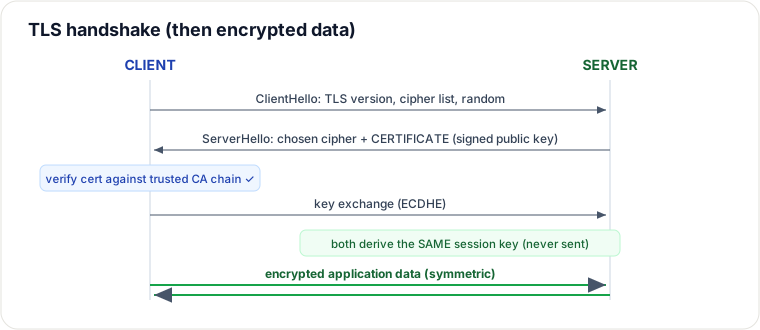
- Hello: client offers versions+ciphers; server picks one and sends its certificate (public key signed by a CA).
- Verify identity: client checks the cert's signature chain against trusted CAs — this is what blocks impostors.
- Key exchange (ECDHE): both sides independently derive the same session key without sending it (forward secrecy).
- Encrypted: all further traffic uses that symmetric key. TLS 1.3 does this in one round trip.
mTLS — both sides prove identity
Normal TLS authenticates only the server. mutual TLS has the client present a cert too → both ends verified — the backbone of zero-trust service-to-service traffic in a mesh.
| In transit | At rest | |
|---|---|---|
| How | TLS / mTLS | Disk/DB encryption (AES), KMS keys |
| Threat | Eavesdropping, MITM | Stolen disk / leaked backup |
Takeaways
- Handshake = agree cipher → verify identity via CA-signed cert → derive shared key → encrypt.
- mTLS = both present certs (zero-trust). Encrypt in transit AND at rest — different threats.
Re-authored from-scratch; diagram hand-authored (SVG) for this guide.
🤖 Don't fully get this? Learn it with Claude
Stuck on TLS & mTLS — The Handshake, Step by Step? Open Claude, copy a block below, and it'll teach you this exact concept — visually and interactively.
🎨 Explain it visually
Build the mental picture, not memorization.
I just read a lesson on **TLS & mTLS — The Handshake, Step by Step** (System Design) and want to truly understand it. Explain TLS & mTLS — The Handshake, Step by Step from first principles using ONE vivid real-world analogy and a visual mental model — draw it as ASCII art or a clear step-by-step diagram — with a concrete example using real numbers. Then ask me one question to check I got the mental picture, and wait for my reply. If you're unsure or a claim isn't standard, say so and reason from first principles instead of guessing.
🤔 Walk me through it (interactive)
Socratic — adapts to where you're stuck.
Teach me **TLS & mTLS — The Handshake, Step by Step** interactively. Ask me ONE guiding question at a time, wait for my answer, and adapt to my confusion — build the idea with me step by step instead of explaining it all at once. If you're unsure or a claim isn't standard, say so and reason from first principles instead of guessing.
🧪 Quiz me & fix my gaps
Active recall exposes what you missed.
Quiz me on **TLS & mTLS — The Handshake, Step by Step** with 5 questions, easy to tricky, ONE at a time. Tell me if each answer is right; at the end, explain clearly what I got wrong and why. If you're unsure or a claim isn't standard, say so and reason from first principles instead of guessing.
🧠 Make it stick
Intuition + hook + flashcards for long-term memory.
Help me remember **TLS & mTLS — The Handshake, Step by Step** for the long term: give the one-sentence intuition, a memorable hook/mnemonic, a tiny worked example, and 3 active-recall flashcards (Q -> A). If you're unsure or a claim isn't standard, say so and reason from first principles instead of guessing.