Heartbeat — Split-Brain, Phi-Accrual Detection & the Cost of a False Positive (Deep Dive)
The base page explains "send periodic pings; miss a few and declare dead." This page adds the parts an interviewer drills: what happens under a symmetric partition (split-brain), why a hand-tuned static timeout breaks on a jittery WAN (phi-accrual), what a false positive actually costs at scale, the scaling arithmetic of who monitors whom, and the consistency guarantee during the detection window. It also corrects a common mis-attribution.
1. Split-brain: detection is symmetric
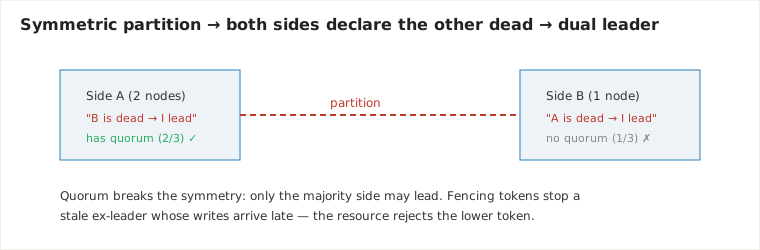
The #1 heartbeat pitfall: a network partition is symmetric. Each side simply stops hearing the other and, by the same rule, independently concludes the other is dead. If leadership follows "I no longer see the leader, so I become leader," both sides elect a leader — dual leaders, divergent writes, data corruption on heal.
Remedy = quorum + fencing. Require a majority to hold leadership: in a 3-node cluster split 2–1, only the 2-node side has quorum and may lead; the minority side must step down (it can't reach a majority). That breaks the symmetry. But quorum alone isn't enough — a former leader that GC-paused can wake up believing it still leads and issue a late write. A monotonic fencing token (incremented each election) makes the resource reject any write carrying a token lower than the highest it has seen, so the stale leader's write is refused. Quorum decides who leads; fencing protects against when a deposed leader acts late.
2. Phi-accrual: adaptive failure detection
A static timeout T forces a bad binary choice: too small → false positives on a normal latency spike; too large → slow detection. It breaks precisely when the network is jittery. Example: monitor and node are in different datacenters, WAN RTT ~40 ms but occasionally spiking to 200 ms. A static T = 100 ms declares the node dead on every spike; T = 500 ms detects a real death far too slowly.
Phi (φ) accrual (Cassandra, Akka, Hazelcast) replaces the binary flag with a suspicion level: it models the recent inter-arrival times of heartbeats as a distribution and outputs φ = −log10(P(heartbeat is later than now)). φ rises smoothly as a heartbeat grows overdue relative to the observed variance, so a jittery link naturally tolerates more delay before suspicion crosses the action threshold. The knob becomes "act at φ = 8" (a probability), and the detector auto-adapts to changing network conditions instead of needing a hand-tuned constant.
One worked number: by the definition above, φ is just the negative exponent of the estimated probability that the silence is innocent: φ = 1 ↔ P ≈ 10⁻¹, and φ = 8 ↔ P ≈ 10⁻⁸ — "act at φ = 8" means "act when the model estimates a one-in-a-hundred-million chance this heartbeat is merely late." Concretely: say heartbeats have been arriving every ~1 s with little jitter. One second after the last beat, the model still expects a beat any moment — P is high, φ ≈ 0–1. At 3 s overdue on this quiet link, P might be ~10⁻⁴ → φ ≈ 4: suspicious. Around 6 s, P ~ 10⁻⁸ → φ crosses 8: act. Now take the same 3 s delay on a jittery WAN link whose observed inter-arrivals routinely stretch to seconds: P stays large, φ stays low, and no false alarm fires. Same wall-clock delay, different suspicion, because the distribution is per-link. (The intermediate probabilities are illustrative — they depend on the distribution the detector has fitted, not on universal constants.)
3. The blast radius of a false positive
Declaring a live node dead is not free. It triggers failover: leader re-election, connection draining, and — for a data node — re-replication of every shard it owned to restore the replication factor. If the node was merely slow (overloaded, not dead), the recovery work adds load, and when it reappears you re-replicate back — flapping. At scale this becomes a rebalance/retry storm that can take out the cluster you were trying to protect.
Mitigations: hysteresis (require sustained failure to mark dead, and a longer clean streak to mark alive again — asymmetric thresholds damp flapping); quorum-of-monitors (act only when several independent monitors agree the node is dead, so one monitor's bad link can't evict a healthy node); quarantine/grace (mark suspected, delay destructive recovery for a grace period, and cap concurrent re-replication so a false positive can't saturate the network).
4. Who monitors whom — the scaling arithmetic
- Central monitor: one node pings all others every interval
Δ. Load isO(n)messages perΔ— at n=10,000 and Δ=1 s that's 10,000 msg/s through one node, plus it's a single point of failure and its own uptime gates detection. - Gossip/SWIM: each node pings a few random peers and disseminates suspicions; membership converges in
O(log n)rounds withO(1)load per node — this is why large clusters (Cassandra, Consul/Serf) gossip rather than centralize. - Piggybacking: the cheapest heartbeat is the request you were already sending — infer liveness from existing RPC/replication traffic and only send explicit pings when idle, cutting dedicated heartbeat traffic to near zero on busy links.
5. What is guaranteed during the detection window?
Between a node actually failing and the system confirming it, there's a suspicion window where ownership is ambiguous — and you must state your stance. A CP system (needs a single writer) sacrifices availability here: it withholds writes/leadership until quorum confirms the death and a new leader is fenced in, so no split-brain write is ever accepted (a brief unavailability). An AP system stays available but may accept writes on both sides and reconcile later. The honest interview answer names the window explicitly: "for the detection window plus failover, this key is unavailable for writes (CP), guaranteeing we never double-write," or "it stays available and we reconcile with vector clocks/LWW (AP)." An acked write can be lost only if you ack before the fenced quorum commits — which is why CP systems ack after quorum.
6. A correction worth knowing
The ambiguity that underlies heartbeats — you can never be certain a silent peer is dead versus just unreachable over an asynchronous network — is the problem that unreliable failure detectors study, formalized by Chandra & Toueg (1996). It is not the Two Generals' Problem (Akkoyunlu, Ekanadham & Huber 1975; Gray 1978), which is about the impossibility of two parties reaching guaranteed common agreement over a channel that can silently lose messages. And it is not the Byzantine Generals Problem (Lamport, Shostak & Pease, 1982), which is the distinct question of tolerating malicious/arbitrary participants. Heartbeat detection lives in the crash-fault world of unreliable failure detectors, not in the agreement problem of Two Generals or the malicious-fault model of Byzantine generals.
Judgment layer & takeaways
| Situation | Choose | Why |
|---|---|---|
| n < 50 | Central monitor | Simple, O(n) traffic is fine. |
| n > 500 | Gossip / SWIM | O(1) per node, O(log n) convergence; no monitor SPOF. |
| Stable LAN | Static timeout | Simple, low jitter. |
| Jittery WAN / cloud | Phi-accrual | Adapts to observed latency variance. |
- Leadership: always pair "declare dead → elect" with quorum + fencing, or you will build split-brain.
- Tuning: a shorter interval detects faster but raises false-positive risk — and false positives are expensive (re-replication storms). Add hysteresis and cap recovery concurrency.
Failure trace — a false positive at work
- A data node is temporarily slow (a kernel flush, a long GC) — alive, but silent past the timeout.
- The monitor's rule is hair-trigger: a few missed heartbeats and it declares the node dead.
- It schedules re-replication of every block the node owned.
- The slow node recovers; the extra replicas must now be found and deleted.
- The network is saturated by unnecessary traffic during an already-slow period.
- Fix: phi-accrual + hysteresis + a cap on concurrent re-replications.
HDFS deliberately does the opposite of this hair-trigger rule — a production worked example of this page's thesis. With Hadoop defaults, a DataNode heartbeats every 3 s (dfs.heartbeat.interval); after 30 s of silence (dfs.namenode.stale.datanode.interval) the NameNode marks it merely stale — deprioritized for reads, nothing evicted; and it declares the node dead only after 2 × dfs.namenode.heartbeat.recheck-interval + 10 × heartbeat interval = 2 × 300 s + 10 × 3 s = 630 s ≈ 10.5 minutes. That two-tier, ten-minute conservatism exists precisely because the re-replication storm traced above costs more than routing reads around a slow node for a while.
When NOT to trust heartbeats alone
- As the only fencing mechanism — a "dead" node may still accept writes; you need a lease/epoch/STONITH alongside detection.
- Too-aggressive timeouts on GC-heavy JVMs — false positives thrash leadership.
- When timeouts correlate — an AZ-wide slowdown trips every detector at once; a burst of simultaneous "deaths" usually means network trouble, not mass node failure. Gate mass evictions on that signal.
Drill ladder
- L1: Why does a symmetric partition cause split-brain?
Bar: each side independently applies the same missing-heartbeat rule, so both conclude the other died — and if leadership follows detection, both lead. - L2: What does a fencing token protect against?
Bar: a deposed leader acting after its replacement was promoted — the resource rejects the stale, lower-than-highest-seen token. - L3: How does phi-accrual differ from a static timeout?
Bar: a binary threshold on a hand-tuned constant vs continuous suspicion computed from the observed inter-arrival distribution. - L4: A JVM leader GC-pauses for 8 s while the heartbeat timeout is 3 s — what happens?
Bar: it is marked dead while alive, and can resume mid-write still believing it leads; design pause-aware detection (longer timeout or phi-accrual) plus fencing — no timeout value eliminates the resume-late case.
Re-authored/Deepened for this guide.
🤖 Don't fully get this? Learn it with Claude
Stuck on Heartbeat — Split-Brain, Phi-Accrual Detection & the Cost of a False Positive (Deep Dive)? Open Claude, copy a block below, and it'll teach you this exact concept — visually and interactively.
Build the mental picture, not memorization.
I just read a lesson on **Heartbeat — Split-Brain, Phi-Accrual Detection & the Cost of a False Positive (Deep Dive)** (System Design) and want to truly understand it. Explain Heartbeat — Split-Brain, Phi-Accrual Detection & the Cost of a False Positive (Deep Dive) from first principles using ONE vivid real-world analogy and a visual mental model — draw it as ASCII art or a clear step-by-step diagram — with a concrete example using real numbers. Then ask me one question to check I got the mental picture, and wait for my reply. If you're unsure or a claim isn't standard, say so and reason from first principles instead of guessing.
Socratic — adapts to where you're stuck.
Teach me **Heartbeat — Split-Brain, Phi-Accrual Detection & the Cost of a False Positive (Deep Dive)** interactively. Ask me ONE guiding question at a time, wait for my answer, and adapt to my confusion — build the idea with me step by step instead of explaining it all at once. If you're unsure or a claim isn't standard, say so and reason from first principles instead of guessing.
Active recall exposes what you missed.
Quiz me on **Heartbeat — Split-Brain, Phi-Accrual Detection & the Cost of a False Positive (Deep Dive)** with 5 questions, easy to tricky, ONE at a time. Tell me if each answer is right; at the end, explain clearly what I got wrong and why. If you're unsure or a claim isn't standard, say so and reason from first principles instead of guessing.
Intuition + hook + flashcards for long-term memory.
Help me remember **Heartbeat — Split-Brain, Phi-Accrual Detection & the Cost of a False Positive (Deep Dive)** for the long term: give the one-sentence intuition, a memorable hook/mnemonic, a tiny worked example, and 3 active-recall flashcards (Q -> A). If you're unsure or a claim isn't standard, say so and reason from first principles instead of guessing.