hard Back-Pressure Mechanisms: block, drop, or shed
Mechanism: back-pressure is the missing feedback loop
A producer and a consumer sit on either end of a queue. If the producer emits faster than the consumer drains, the gap between them has to go somewhere — and if nothing constrains it, it goes into the queue, which grows without limit. An unbounded queue does not fail loudly; it fails by silently trading memory for time: resident memory climbs, GC pressure rises, and every item's wait-in-queue time keeps growing until the process is OOM-killed or the tail latency becomes unusable — unbounded lag. Back-pressure is the feedback signal that tells the producer “slow down” before that happens, and it only works if the buffer between them is bounded — because a bound is what forces the system to decide, the instant it fills, what happens next.
Once the buffer is bounded, there are exactly three things you can do the moment it fills:
- Block the producer (flow control) — the enqueue call itself stalls until a slot frees up. No item is lost; the slowness is pushed upstream, all the way back to whoever originally requested the work. Examples: a bounded
BlockingQueue.put(), TCP's receive window (the sender stops when the advertised window hits zero), Reactive Streams backpressure. - Drop (load-shed) — reject or discard instead of enqueueing, and tell the caller so (HTTP
429/503, a NACK). Memory and latency stay bounded because the queue never grows past its cap; the cost is that some work never gets done. - Sample / degrade — keep accepting everything but do less per item (coarser aggregation, a lower-fidelity response, skip non-essential fields). A softer cousin of dropping: you shed cost per item instead of shedding whole items.
Credit-based flow control: making "block" explicit instead of reactive
A plain bounded queue only signals back-pressure after it is already full — that is reactive, and by the time the producer notices, a full buffer's worth of items are already sitting in line. Credit-based flow control (Reactive Streams' request(n), gRPC and HTTP/2 flow-control windows) makes the demand explicit instead: the consumer grants the producer a credit of N items it can currently absorb; the producer may send at most N and must then stop; as the consumer finishes processing items, it refills the credit. The producer never has to guess or overshoot into a full buffer — it only ever sends what the consumer has already said it can take. This is still "block" in spirit (no loss, upstream propagation) but the signal arrives one round-trip earlier and is explicit rather than inferred from a stall.
Traced: 10,000/s in, 6,000/s out, a queue of 10,000
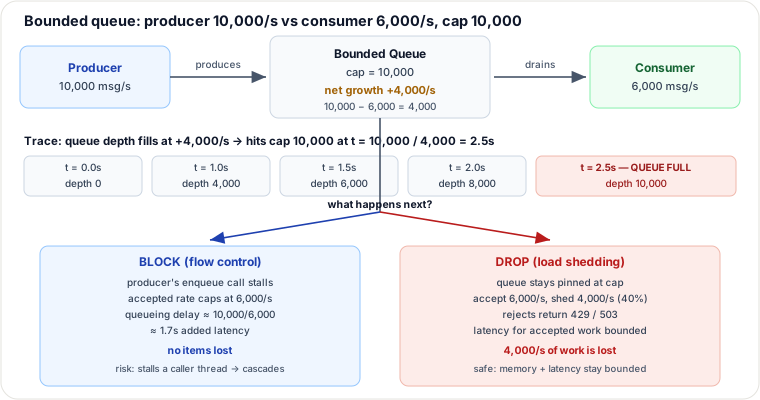
Take a producer emitting 10,000 messages/second into a queue bounded at 10,000 slots, drained by a consumer that can only process 6,000/second. The queue grows by the difference every second:
| quantity | value |
|---|---|
| produced | 10,000/s |
| consumed | 6,000/s |
| net growth | 10,000 − 6,000 = 4,000/s |
| time to fill cap 10,000 | 10,000 / 4,000 = 2.5s |
So 2.5 seconds after the burst starts, the queue is completely full and the system must apply one of the two hard responses below.
What happens at t = 2.5s: the two paths diverge
Block (flow control): the producer's next enqueue call stalls because there is no free slot. From this instant, the pipeline's accepted throughput is capped at the consumer's drain rate — 6,000/s, no faster, no matter how hard the producer pushes. Anything already queued now waits queue depth ÷ drain rate ≈ 10,000 / 6,000 ≈ 1.7 additional seconds before it is even looked at. If the thing calling the producer is itself a user-facing request handler, that caller now blocks for that same 1.7s+ on top of normal processing time. No item is lost — and for a burst that ends, every item offered is eventually processed — but the slowness has propagated one hop upstream. That “eventually” holds only while average offered load stays below the 6,000/s drain capacity over the window: under sustained overload (10,000/s offered indefinitely) blocking never catches up — the excess 4,000/s is deferred upstream forever, and the block propagates hop by hop until some upstream buffer fills or callers start timing out.
Drop (load-shed): the queue is held at its cap; the system keeps accepting only what the consumer can actually drain (6,000/s) and immediately rejects the remaining 4,000/s — 40% of offered load — typically with an HTTP 429/503 so the caller knows to back off or retry elsewhere. Queue depth and therefore latency for anything that is accepted stay flat and bounded, because the buffer never grows past 10,000. The cost is explicit: 4,000 requests/second get no work done at all unless the caller retries.
Pitfalls
- An unbounded queue "just in case": removing the cap does not remove the overload — it just removes the moment where the system is forced to decide. The failure still happens, later and worse, as an OOM kill or an unbounded p99, with none of the containment either BLOCK or DROP would have given you.
- Blocking a user-facing thread: if the component that stalls under back-pressure is a request-handling thread from a fixed-size pool, one slow downstream consumer can occupy every thread in the pool waiting on
put()— and the service now refuses unrelated requests too. Flow control that is correct for an internal pipeline becomes a cascading, service-wide stall at a request boundary. - No back-pressure across an async boundary: a fire-and-forget publish into a message queue with nobody watching consumer lag has no back-pressure at all — the queue just grows on the broker until an alert fires (or doesn't) and it is discovered in production, hours after the imbalance started.
The judgment layer: block vs drop vs "just make the buffer bigger"
Block / flow control is the right call inside a pipeline you control end-to-end, where correctness matters more than latency and there is no user sitting on the other end of the stalled call — internal ETL stages, a Kafka consumer group falling behind its partition, TCP itself. You get zero loss, but you must be sure the block cannot deadlock (producer and consumer must not be waiting on each other in a cycle) and cannot be felt by an unrelated caller.
Drop / load-shed is the right call at a user-facing edge — an API gateway, a load balancer, an ingress queue — where keeping the system alive and responsive for the requests it does accept matters more than completing every single request. You trade completeness for a hard, predictable bound on memory and latency; this only works if dropped requests are safe to lose or the caller is expected to retry (idempotently) elsewhere. Shedding also needs an explicit priority order, not FIFO rejection of whoever arrives after the cap: shed the lowest-value work first — anonymous reads and speculative prefetch before logged-in writes, analytics before checkout, and never health checks or payments — so the capacity you keep serves the requests that matter most.
"Just make the buffer bigger" is not a genuine third option — it is the same unbounded-queue failure mode with the crash pushed further out. A bigger cap raises the ceiling on both memory and worst-case queueing latency (every accepted item now waits behind a longer line before it is even seen), so it trades a later, larger failure for worse latency in the meantime. Size the buffer to absorb real, short-lived bursts you've measured — not as a substitute for choosing block or drop.
Takeaways
- Back-pressure only exists because the buffer is bounded — the bound is what forces a decision the instant it fills; unbounded just delays and worsens the failure.
- Block (flow control) trades latency-propagation-upstream for zero loss; drop (load-shed) trades lost work for a hard bound on memory and latency — there is no lossless and bounded option.
- Credit-based flow control (Reactive Streams / gRPC / HTTP2) makes demand explicit so the producer never overshoots into a full buffer in the first place, catching the signal one round-trip earlier than a plain blocking queue.
- Match the mechanism to the boundary: block inside a pipeline you own end-to-end; shed at a user-facing edge where availability for accepted traffic outranks completing every request.
When NOT to block (and when NOT to drop)
- Do not block on a fixed request-thread pool edge — one slow sink stalls the whole service (pool exhaustion).
- Do not drop non-idempotent money side-effects without a durable outbox/retry path — “shed” becomes silent financial loss.
- Do not “fix” overload only by enlarging the buffer — you buy seconds of delay and a larger OOM; size for measured bursts only.
Interviewer follow-ups & drills
- Why not unbounded queue + more consumers? Without a bound there is no forced decision; lag grows until memory or p99 dies. Scale consumers and keep a bound + policy.
- Ops signals: queue depth → cap, reject rate (429/503), producer block time, consumer lag. Alert when depth stays >80% cap for N minutes.
- Drill: 20k in / 12k out, cap 24k. Time to full? Net 8k/s → 3s. Prefer block or drop at an HTTP edge? Drop/shed at the edge; block only inside owned pipelines.
Synthesized from TCP flow-control (receive-window semantics), the Reactive Streams specification, gRPC/HTTP2 flow-control windows, the Google SRE Book's treatment of load shedding, and Nygard's Release It! on bulkheads and cascading failure. Re-authored/Deepened for this guide.
🤖 Don't fully get this? Learn it with Claude
Stuck on Back-Pressure Mechanisms: block, drop, or shed? Open Claude, copy a block below, and it'll teach you this exact concept — visually and interactively.
Build the mental picture, not memorization.
I just read a lesson on **Back-Pressure Mechanisms: block, drop, or shed** (System Design) and want to truly understand it. Explain Back-Pressure Mechanisms: block, drop, or shed from first principles using ONE vivid real-world analogy and a visual mental model — draw it as ASCII art or a clear step-by-step diagram — with a concrete example using real numbers. Then ask me one question to check I got the mental picture, and wait for my reply. If you're unsure or a claim isn't standard, say so and reason from first principles instead of guessing.
Socratic — adapts to where you're stuck.
Teach me **Back-Pressure Mechanisms: block, drop, or shed** interactively. Ask me ONE guiding question at a time, wait for my answer, and adapt to my confusion — build the idea with me step by step instead of explaining it all at once. If you're unsure or a claim isn't standard, say so and reason from first principles instead of guessing.
Active recall exposes what you missed.
Quiz me on **Back-Pressure Mechanisms: block, drop, or shed** with 5 questions, easy to tricky, ONE at a time. Tell me if each answer is right; at the end, explain clearly what I got wrong and why. If you're unsure or a claim isn't standard, say so and reason from first principles instead of guessing.
Intuition + hook + flashcards for long-term memory.
Help me remember **Back-Pressure Mechanisms: block, drop, or shed** for the long term: give the one-sentence intuition, a memorable hook/mnemonic, a tiny worked example, and 3 active-recall flashcards (Q -> A). If you're unsure or a claim isn't standard, say so and reason from first principles instead of guessing.