Replication Lag & Failover — Read-Your-Writes, Split-Brain & Fencing
Replicas make reads fast — and consistency hard
You add read replicas to scale reads and survive a node loss. The catch: replication is usually asynchronous, so a follower is always slightly behind the leader. That replication lag (tens to hundreds of ms, or seconds under load) produces real, user-visible bugs.
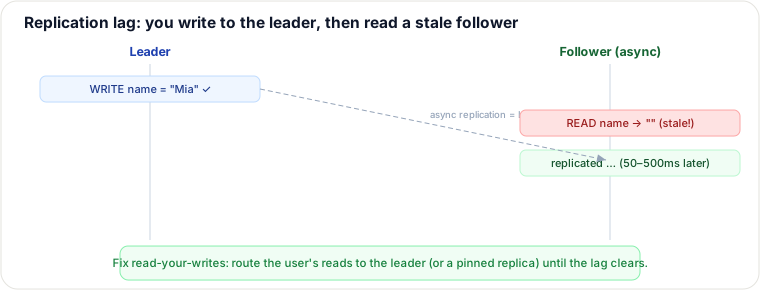
The three anomalies lag causes
- Read-your-writes: you update your profile, the next read hits a lagging replica, and your change is "gone." Fix: route a user's reads to the leader (or a pinned replica) for a short window after they write.
- Monotonic reads: two reads hit replicas at different lag → the user sees data go backwards. Fix: pin a user to one replica.
- Consistent prefix: across partitions, effects can appear before causes. Fix: causal ordering.
Sync vs async: synchronous replication (wait for a replica to ack) removes lag but adds write latency and stalls if the replica is down. Most systems use semi-sync — one synchronous replica for durability, the rest async.
Failover: when the leader dies
A follower is promoted to leader. The dangers:
- Data loss: async writes not yet replicated are lost on promotion (bounded by your durability/RPO).
- Split-brain: the old leader comes back and also thinks it's leader → two leaders accept conflicting writes. Prevent with a quorum/consensus election (only a majority can elect) and fencing (a monotonically increasing epoch token; storage rejects the stale old leader).
- Detection: too-aggressive failover on a transient blip causes needless churn; tune heartbeat timeouts.
Takeaways
- Async replication → lag → read-your-writes / monotonic-read anomalies; fix by routing/pinning reads.
- Sync = no lag but slower writes; semi-sync is the common middle ground.
- Failover risks data loss (async) and split-brain — prevent with quorum election + fencing tokens.
Re-authored for this guide; replication-lag timeline hand-authored as SVG. Follows DDIA ch. 5. See also: Quorum, Leader and Follower, CAP Theorem, and (Concurrency) the same race/visibility intuition.
🤖 Don't fully get this? Learn it with Claude
Stuck on Replication Lag & Failover — Read-Your-Writes, Split-Brain & Fencing? Open Claude, copy a block below, and it'll teach you this exact concept — visually and interactively.
Build the mental picture, not memorization.
I just read a lesson on **Replication Lag & Failover — Read-Your-Writes, Split-Brain & Fencing** (System Design) and want to truly understand it. Explain Replication Lag & Failover — Read-Your-Writes, Split-Brain & Fencing from first principles using ONE vivid real-world analogy and a visual mental model — draw it as ASCII art or a clear step-by-step diagram — with a concrete example using real numbers. Then ask me one question to check I got the mental picture, and wait for my reply. If you're unsure or a claim isn't standard, say so and reason from first principles instead of guessing.
Socratic — adapts to where you're stuck.
Teach me **Replication Lag & Failover — Read-Your-Writes, Split-Brain & Fencing** interactively. Ask me ONE guiding question at a time, wait for my answer, and adapt to my confusion — build the idea with me step by step instead of explaining it all at once. If you're unsure or a claim isn't standard, say so and reason from first principles instead of guessing.
Active recall exposes what you missed.
Quiz me on **Replication Lag & Failover — Read-Your-Writes, Split-Brain & Fencing** with 5 questions, easy to tricky, ONE at a time. Tell me if each answer is right; at the end, explain clearly what I got wrong and why. If you're unsure or a claim isn't standard, say so and reason from first principles instead of guessing.
Intuition + hook + flashcards for long-term memory.
Help me remember **Replication Lag & Failover — Read-Your-Writes, Split-Brain & Fencing** for the long term: give the one-sentence intuition, a memorable hook/mnemonic, a tiny worked example, and 3 active-recall flashcards (Q -> A). If you're unsure or a claim isn't standard, say so and reason from first principles instead of guessing.