Security & Privacy — Privacy Engineering (Anonymization, k-Anonymity, Differential Privacy) & Availability as a Security Property (Deep Dive)
This guide already covers the crypto and token pieces of security engineering in depth elsewhere: certificate validation/revocation and envelope key management live in the Encryption deep-dive, and token replay/refresh-revocation live in the Authorization deep-dive (both cross-referenced below, not repeated). What is genuinely missing is the layer that sits on top of encryption and access control: once you have correctly authenticated and authorized access to data, how do you engineer the data itself so that releasing, sharing, or analyzing it doesn't leak who a record belongs to? That is privacy engineering — anonymization, k-anonymity, and differential privacy — and it is the core of this page. A short second section closes the last gap in the CIA triad: availability as a security property, i.e. why a DoS/DDoS attack is a security failure, not just an ops incident.
1. Anonymization vs pseudonymization — the reversibility line
Pseudonymization replaces a direct identifier (name, email, national ID) with a token or alias, but keeps a mapping table somewhere that can reverse it — user_8841 → alice@example.com lives in a lookup table, a key vault, or is derivable from a keyed hash. Because that mapping exists, pseudonymized data is still personal data under GDPR: anyone who can reach the mapping (an attacker who breaches it, an insider, a subpoena) can re-attach identity. Pseudonymization reduces exposure — a leaked pseudonymized dataset alone doesn't identify anyone — but it is not a privacy guarantee, only a stronger access-control boundary around one extra artifact (the mapping table).
Anonymization is meant to be irreversible: no mapping exists, by construction, to recover identity from the released data, even with unlimited auxiliary information. This is a much stronger and much harder claim to actually make true — most of this page is about the two dominant ways engineers try to make it true (k-anonymity's generalization and differential privacy's noise) and why the naive approach ("just remove the name column") fails.
Tokenization sits between the two: it replaces a sensitive value (e.g. a PAN, SSN, or email) with a randomly generated token and keeps the real value in a separate, tightly controlled token vault. Unlike pseudonymization, the token has no mathematical relationship to the original value; unlike anonymization, the mapping still exists so authorized systems can recover the original. It is the standard pattern for PCI DSS card-number handling — the merchant stores only tokens, the vault stores the real PAN. The cost is that the vault itself becomes a high-value target, so it must be network-segmented, audited, and encrypted at rest.
2. Re-identification and linkage risk — why removing the name isn't enough
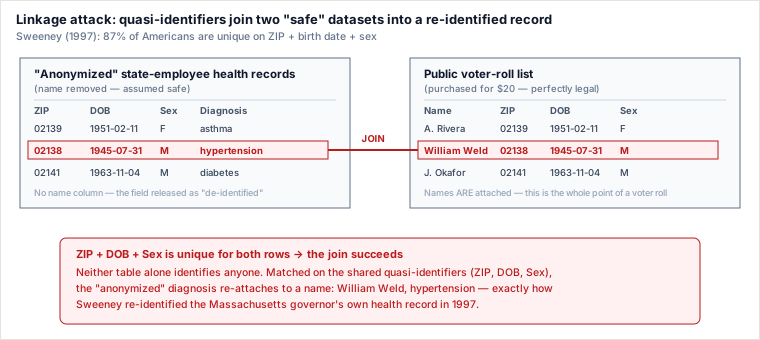
Mechanism: a dataset with direct identifiers stripped still usually contains quasi-identifiers — attributes that aren't identifying alone (ZIP code, birth date, sex) but become identifying in combination, because their combination is rare enough to be unique. An attacker doesn't need to "break" anything cryptographic; they join the "anonymized" release against a second, independently public dataset that shares those same quasi-identifier columns but also has names attached. Wherever a row matches uniquely on the shared columns, the join re-attaches an identity to the sensitive fields.
Latanya Sweeney's 2000 paper, building on her 1997 Weld re-identification demonstration, quantified exactly how easy this is: 87% of the U.S. population is uniquely identifiable from ZIP code + birth date + sex alone — three fields that appear "safe" individually and are routinely left in "de-identified" releases. She demonstrated it concretely: Massachusetts' Group Insurance Commission released "anonymized" hospital records for state employees with names removed; Sweeney bought the full Cambridge, MA voter roll for $20 (public record, includes name + ZIP + birth date + sex) and joined the two on those three fields. The join uniquely identified then-Governor William Weld's own hospital record, which she mailed to his office to prove the point.
Two more releases show this is not a one-off: in the 2006 AOL search-log leak, AOL published 20 million search queries tagged only with an anonymous numeric user ID (no name) — but one user's queries alone ("landscapers in Lilburn, Georgia," searches for people with her own last name) were specific enough that New York Times reporters identified her as Thelma Arnold within days, using search content itself as the quasi-identifier. In the 2006 Netflix Prize dataset, Netflix released 100 million movie ratings with user IDs replaced by random numbers; Narayanan and Shmatikov showed that cross-referencing a user's ratings and rough rating dates against public IMDb reviews (auxiliary/"background" data, not part of the release) uniquely matched a large fraction of Netflix subscribers, including some whose apparent movie preferences were sensitive enough to matter (e.g. political or sexual-orientation signals). In both cases the released dataset alone looked safe; the attack came from an independent dataset with overlapping fields.
3. k-Anonymity — the generalization defense, traced
Mechanism: a table is k-anonymous if every combination of quasi-identifier values appears in at least k rows — so any single record is indistinguishable from at least k−1 others on the columns an attacker could join against. You get there by generalization (replace a precise value with a coarser range/category: exact ZIP → 3-digit ZIP prefix, exact birth date → 5-year age band) and suppression (drop or blank outlier rows/columns that can't be generalized into a large-enough group).
Worked example (k=3): take five raw patient rows and generalize ZIP and age until every remaining combination of (ZIP-prefix, age-band, sex) covers at least 3 rows.
| # | Raw ZIP | Raw age | Sex | Diagnosis |
|---|---|---|---|---|
| 1 | 02138 | 29 | M | flu |
| 2 | 02139 | 31 | M | flu |
| 3 | 02141 | 27 | M | migraine |
| 4 | 02138 | 52 | F | diabetes |
| 5 | 02139 | 55 | F | diabetes |
Rows 1–3 share sex (M) and are close in age but have three different ZIPs — generalize ZIP to its 3-digit prefix (021**) and age to a 10-year band (20–29 vs 30–39 won't merge them, so widen to a 15-year band, 20–34) so all three collapse onto the same quasi-identifier combination. Rows 4–5 already share sex (F) and are within a 10-year span, so a 50–59 band merges them — but that's only k=2, one short. With no third female 50s record available in this tiny sample, the only ways to reach k=3 are to suppress those rows entirely (do not publish them) or to widen the ZIP/age bands until a third record falls into the same equivalence class. This is why real k-anonymity tooling either generalizes more aggressively or drops outliers. The k=3 result for rows 1–3:
| # | ZIP (generalized) | Age (generalized) | Sex | Diagnosis |
|---|---|---|---|---|
| 1 | 021** | 20–34 | M | flu |
| 2 | 021** | 20–34 | M | flu |
| 3 | 021** | 20–34 | M | migraine |
Now any one of these three rows is indistinguishable from the other two on the columns an attacker could join against — a linkage attempt using ZIP+age+sex narrows a victim down to an equivalence class of 3, not a unique row. That's the entire mechanism: k-anonymity doesn't hide the sensitive value, it hides which row in the group belongs to the target.
4. k-Anonymity's weaknesses — and the two refinements they motivate
- Homogeneity attack. Look at the equivalence class again: all three rows are M, 20–34, 021** — but two of the three share the same diagnosis (flu). If an attacker knows their target is a 28-year-old man in ZIP 02138, they've narrowed the target to this group of 3, and even though they can't tell which row is the target, 2-out-of-3 already have "flu" — so they can conclude "most likely flu" with real confidence despite k-anonymity being technically satisfied. k-anonymity guarantees indistinguishability of the row, not diversity of the sensitive value inside the group.
- Background-knowledge attack. Even where the sensitive values in a class are more varied, an attacker with outside knowledge (e.g. "my neighbor doesn't have diabetes, he told me so last week") can eliminate values from the class and shrink the effective uncertainty — k-anonymity has no mechanism to account for what an attacker might already know.
l-diversity (Machanavajjhala et al.) directly answers the homogeneity attack: require each equivalence class to contain at leastl"well-represented" distinct values for the sensitive attribute — so no class can be 2-out-of-3 flu. It doesn't fully solve background-knowledge attacks (an attacker can still weight thelpossibilities unevenly using outside facts) or skewness (anl-diverse class where the sensitive values are diverse in count but still overwhelmingly one value, e.g. 1 rare-disease row diluted among 99 healthy rows still leaks "probably healthy").t-closeness (Li, Li, Venkatasubramanian) goes further: require the distribution of the sensitive attribute within each equivalence class to be within a thresholdtof the distribution in the overall table — not just diverse, but proportionally representative — closing the skewness gapl-diversity leaves open, at the cost of even more generalization (and therefore even more utility loss) to hit that distributional match.
5. Differential privacy — a mathematical guarantee instead of a table property
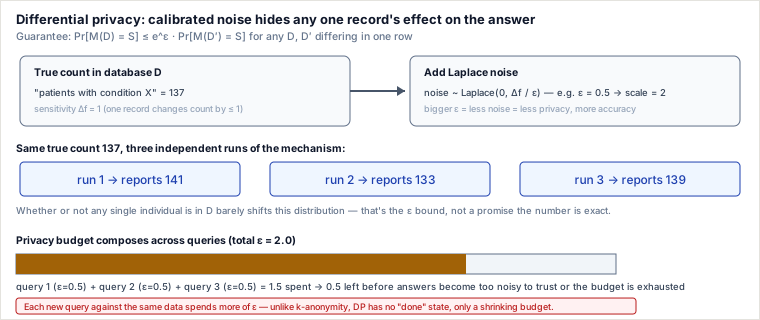
Mechanism: instead of generalizing the data once and releasing a static table, differential privacy (Dwork et al., 2006) adds calibrated random noise to the output of a query, so that the presence or absence of any single individual's record changes the probability of any particular output by at most a factor of e^ε. Formally, a mechanism M is ε-differentially private if for any two datasets D, D′ differing in exactly one row, and any output S: Pr[M(D) = S] ≤ e^ε · Pr[M(D′) = S]. Note what this promises and what it doesn't: it says nothing about whether the reported number is close to the true count (that's accuracy, a separate axis) — it says the distribution of possible reported numbers barely depends on whether any one specific person's data was included at all. Someone looking at the output can't confidently conclude "this person's record must have been in the database," because almost the same output distribution would have occurred without them.
The standard mechanism for numeric queries is the Laplace mechanism: compute the true answer, then add noise drawn from a Laplace distribution with scale Δf / ε, where Δf ("sensitivity") is the maximum amount one row could change the true answer (for a simple count, Δf = 1). Smaller ε → larger noise scale → stronger privacy, worse accuracy. The Gaussian mechanism is the analogous tool for the relaxed (ε, δ)-differential-privacy definition, common in machine-learning training pipelines.
Composition is the property that makes this a "budget": running two ε-DP queries against the same data and combining their results is (at worst) 2ε-DP — the guarantees add up, they don't reset. This is why real deployments (the 2020 US Census, Apple's on-device telemetry, Google's RAPPOR) track a running privacy budget per dataset or per data subject and stop answering, or add proportionally more noise, once it's spent — DP has no "safely done" state the way a single k-anonymized release does; every additional query against the same underlying data is a new withdrawal from the same account.
6. Data minimization, purpose limitation, retention limits — the design layer underneath all of this
Anonymization and differential privacy are damage-control for data you already collected. The cheaper, upstream control is not collecting or keeping more than necessary in the first place — three principles GDPR Article 5 codifies and that show up as concrete engineering decisions:
- Data minimization — collect only the fields a feature actually needs, not every field that might someday be useful. Every extra column is a future breach's contents and a future re-identification attack's extra quasi-identifier.
- Purpose limitation — data collected for one stated purpose (e.g. fraud detection) shouldn't be silently repurposed for another (e.g. ad targeting) without fresh consent/legal basis — an engineering-visible consequence is that access-control and data-lineage systems need to track why a field exists, not just who can read it.
- Retention limits — data kept past its useful/legal window is pure downside: it can't improve today's product decisions but it can still leak in tomorrow's breach. Automated TTL-based deletion (not "delete it manually, eventually") is the engineering answer.
7. Availability as a security property
Mechanism: the CIA triad's third leg is not an afterthought — an attacker who denies legitimate users service has caused exactly the harm a security program exists to prevent, even though nothing was read, stolen, or corrupted. A DoS/DDoS attack is therefore a security incident, owned by the same threat-modeling process as confidentiality and integrity attacks, not purely an infrastructure/ops concern to be handled after the fact.
Attacks split into two mechanism families: volumetric floods (L3/L4) exhaust network bandwidth or connection-state tables with sheer traffic volume — SYN floods and UDP reflection/amplification are the canonical examples; and application-layer attacks send comparatively little traffic but target expensive server-side work — a Slowloris attack holds many connections open with drip-fed partial HTTP headers to exhaust a server's connection pool without ever completing a request, and an "expensive query" attack (a complex search filter, an unbounded GraphQL query, a deliberately worst-case regular expression) spends attacker-cheap requests against defender-expensive CPU or database time.
This guide already has the full mechanism-level treatment of both the attack side (SYN-flood backlog math, reflection/amplification bandwidth factors, the 2018 GitHub memcached incident) and the defense side (token-bucket rate limiting, traced step by step) in the dedicated DDoS and API-rate-limiter deep dives — see those pages for the derivations. At the availability level, the standing defense set is: rate limiting (token bucket / leaky bucket, capping requests per identity before they reach expensive code paths), load shedding and back-pressure (a service that detects it's over capacity deliberately rejects or queues excess work instead of degrading everything, protecting its own ability to serve any traffic at all), and upstream scrubbing (routing traffic through a provider with far more absorption capacity than your own infrastructure, so volumetric floods are filtered before they ever reach you).
8. Already covered elsewhere in this guide — cross-references, not re-derivations
- TLS certificate validation and revocation (hostname/SAN matching, expiry, CRL vs OCSP vs OCSP stapling, rogue-CA risk and Certificate Transparency) is fully derived in the Encryption deep-dive (Encryption — Key Agreement, Forward Secrecy, Certificates, TLS Attacks & At-Rest) — see that page rather than re-deriving the certificate lifecycle here.
- Key management and envelope encryption (DEK/KEK wrapping, KMS/HSM-mediated rotation, why you rewrap keys instead of re-encrypting data) is also covered in the same Encryption deep-dive — this page's privacy techniques (k-anonymity, DP) are a data-shape control, distinct from and complementary to that key-management layer.
- Token replay and refresh-token revocability (short-lived JWT + opaque refresh token, rotation with reuse detection, nonce/jti replay prevention, audience validation) is fully derived in the Authorization deep-dive (Authorization — PKCE, Multi-Tenancy, Zanzibar & Revocation) — see that page for the revocation-architecture trace.
Judgment layer — pseudonymization, tokenization, anonymization, and differential privacy
- Pseudonymization — use when you need to keep the ability to re-link data to a person (support tickets tied to an account, a clinical trial that must be able to re-contact a participant), and are willing to protect that ability with strict access control over the mapping table instead of removing it. Cost: it is still personal data under GDPR/CCPA — a breach of the mapping (or of the pseudonymized data plus any auxiliary linkage) still exposes identity. Cheapest to implement, weakest guarantee.
- Tokenization — use when you must retain reversibility for operational reasons but want to remove the sensitive value from most systems (PCI card numbers, primary account numbers). Cost: the token vault becomes a concentrated target and must be segmented and audited; if the vault is breached, the data is recoverable, so it is stronger than pseudonymization but weaker than anonymization.
- k-anonymity (and l-diversity/t-closeness) — use for one-off or infrequent releases of a static dataset (a research dataset, a public report) where you can afford to generalize columns and accept a fixed, inspectable table as the final artifact. Cost: utility loss is a step function you control directly (wider bands = safer but coarser), but the guarantee is only as strong as your assumption about what quasi-identifiers an attacker can access — a new external dataset can retroactively break a k-anonymous release that was safe when published (this happened to the Netflix Prize data as IMDb grew).
- Differential privacy — use when the same underlying data will be queried repeatedly (an internal analytics system, a live public statistics API, ML model training) and you need a guarantee that holds regardless of what future auxiliary data an attacker might obtain — the mathematical bound doesn't depend on enumerating quasi-identifiers. Cost: every query spends irreplaceable privacy budget, accuracy degrades with more queries or a tighter
ε, and it requires real statistical/engineering expertise to implement correctly (get the sensitivity calculation wrong and the guarantee is void) — noticeably more operational overhead than a static k-anonymized table. - Rule of thumb: static single release with a fixed audience → k-anonymity family; ongoing/queryable system or an adversary you can't fully characterize → differential privacy; need reversibility for operational lookup across many systems → tokenization, with a hardened vault; need reversibility for a small, controlled mapping table → pseudonymization, protected like any other secret.
Pitfalls
- "Anonymized" ≠ safe. Removing direct identifiers is not anonymization if quasi-identifiers remain — treat every "de-identified" release as pseudonymous at best until you've actually checked for linkage risk against plausible external datasets.
- k-anonymity without l-diversity/t-closeness. A k-anonymous table can still leak the sensitive attribute wholesale via the homogeneity attack — k alone bounds row-identifiability, not attribute-disclosure.
- Setting ε too large "for accuracy." An
εof, say, 10+ makese^εenormous — the mathematical bound is technically satisfied but so weak it provides negligible real protection; treat a very largeεas "differential privacy in name only." - Ignoring budget composition. Answering "just one more query" against the same dataset without tracking cumulative
εsilently erodes the guarantee the first query'sεpromised. - Assuming today's auxiliary data is all an attacker will ever have. A release safe against known external datasets today can become unsafe as new public datasets appear later (the Netflix/IMDb case) — k-anonymity's guarantee is only as strong as your threat model's assumptions at publish time, and those assumptions age.
- Treating DoS/DDoS as "just infrastructure." Skipping it from the security threat model because "nothing was stolen" misses that denying service is itself the security failure the CIA triad's availability leg exists to name.
- Hashing an identifier and calling it anonymized. A plain hash of an email or phone number is not anonymization — the input domain is small and enumerable, so an attacker rebuilds the mapping by hashing every candidate value (a dictionary/rainbow attack), and the same input always yields the same digest, so the hash is still a stable join key across datasets. A salted-and-peppered HMAC keyed with a server-held secret is a stronger pseudonym (an attacker without the key cannot brute-force it), but it is still reversible by anyone holding the key and therefore still personal data — treat it as pseudonymization, not anonymization.
Takeaways
- Pseudonymization and tokenization are both reversible (a mapping exists) and still count as personal data; tokenization is the PCI-style pattern that removes the sensitive value from most systems and centralizes it in a vault. Anonymization must be irreversible by construction — most real engineering effort goes into proving that irreversibility, not just deleting a name column.
- Quasi-identifiers (ZIP + birth date + sex uniquely identifies ~87% of Americans) make "anonymized" data re-identifiable by joining against an independent, non-anonymized dataset that shares those columns — the Sweeney/Weld, AOL, and Netflix cases are the same attack shape three times.
- k-anonymity generalizes quasi-identifiers into equivalence classes of size ≥ k, but says nothing about the sensitive attribute's diversity inside a class (homogeneity attack) — l-diversity and t-closeness patch that gap at the cost of more generalization; differential privacy instead adds calibrated noise for a guarantee that holds regardless of what an attacker already knows, at the cost of a depleting privacy budget and lower per-query accuracy.
- Availability is a security property, not just an ops concern — DoS/DDoS defenses (rate limiting, load shedding, upstream scrubbing) belong in the same threat model as encryption and access control, with the mechanism-level derivations living in this guide's DDoS and rate-limiter pages.
Related pages
- Encryption — Key Agreement, Forward Secrecy, Certificates, TLS Attacks & At-Rest (Deep Dive) — the certificate/key-management layer this page's data-shape controls sit on top of.
- Authorization — PKCE, Multi-Tenancy, Zanzibar & Revocation (Deep Dive) — the access-control layer that must already be correct before privacy engineering (anonymization, DP) becomes the relevant question.
- What are DDoS Attacks — the attack-side mechanics (SYN floods, amplification) behind the availability-as-security-property section.
- Designing an API Rate Limiter — the token-bucket/leaky-bucket defense mechanism referenced as a standing DoS mitigation.
Sources: Sweeney, L. (2000/2002), "k-anonymity: A model for protecting privacy," and the 1997 Massachusetts GIC/voter-roll re-identification of Gov. William Weld; Narayanan, A. & Shmatikov, V. (2008), "Robust De-anonymization of Large Sparse Datasets" (Netflix Prize dataset); the 2006 AOL search-log release and subsequent NYT re-identification reporting; Machanavajjhala, A. et al. (2007), "l-diversity: Privacy Beyond k-anonymity"; Li, N., Li, T. & Venkatasubramanian, S. (2007), "t-closeness: Privacy Beyond k-anonymity and l-diversity"; Dwork, C. et al. (2006), "Calibrating Noise to Sensitivity in Private Data Analysis" (the Laplace mechanism and the formal ε-differential-privacy definition); Dwork, C. & Roth, A. (2014), "The Algorithmic Foundations of Differential Privacy"; GDPR Article 5 (data minimization, purpose limitation, storage limitation). Re-authored/Deepened for this guide.
🤖 Don't fully get this? Learn it with Claude
Stuck on Security & Privacy — Privacy Engineering (Anonymization, k-Anonymity, Differential Privacy) & Availability as a Security Property (Deep Dive)? Open Claude, copy a block below, and it'll teach you this exact concept — visually and interactively.
Build the mental picture, not memorization.
I just read a lesson on **Security & Privacy — Privacy Engineering (Anonymization, k-Anonymity, Differential Privacy) & Availability as a Security Property (Deep Dive)** (System Design) and want to truly understand it. Explain Security & Privacy — Privacy Engineering (Anonymization, k-Anonymity, Differential Privacy) & Availability as a Security Property (Deep Dive) from first principles using ONE vivid real-world analogy and a visual mental model — draw it as ASCII art or a clear step-by-step diagram — with a concrete example using real numbers. Then ask me one question to check I got the mental picture, and wait for my reply. If you're unsure or a claim isn't standard, say so and reason from first principles instead of guessing.
Socratic — adapts to where you're stuck.
Teach me **Security & Privacy — Privacy Engineering (Anonymization, k-Anonymity, Differential Privacy) & Availability as a Security Property (Deep Dive)** interactively. Ask me ONE guiding question at a time, wait for my answer, and adapt to my confusion — build the idea with me step by step instead of explaining it all at once. If you're unsure or a claim isn't standard, say so and reason from first principles instead of guessing.
Active recall exposes what you missed.
Quiz me on **Security & Privacy — Privacy Engineering (Anonymization, k-Anonymity, Differential Privacy) & Availability as a Security Property (Deep Dive)** with 5 questions, easy to tricky, ONE at a time. Tell me if each answer is right; at the end, explain clearly what I got wrong and why. If you're unsure or a claim isn't standard, say so and reason from first principles instead of guessing.
Intuition + hook + flashcards for long-term memory.
Help me remember **Security & Privacy — Privacy Engineering (Anonymization, k-Anonymity, Differential Privacy) & Availability as a Security Property (Deep Dive)** for the long term: give the one-sentence intuition, a memorable hook/mnemonic, a tiny worked example, and 3 active-recall flashcards (Q -> A). If you're unsure or a claim isn't standard, say so and reason from first principles instead of guessing.