The Role of a Cover Letter
A cover letter serves as your personal introduction to a potential employer—often the first deeper impression they’ll have of you beyond your resume.
When done well, it shows that you not only understand the role but also genuinely care about the company’s goals and how you can contribute.
In this section, we’ll explore why personalized cover letters can make or break your application and cover the basics of writing one that stands out.
1. Why Personalized Cover Letters Can Make or Break Your Application
- Demonstrates Genuine Interest
-
Hiring managers want to see that you’ve taken the time to learn about their company and the position. A generic cover letter suggests a lack of effort or motivation.
-
If you highlight specific projects or initiatives that the company is involved in, the employer sees you as someone who’s proactive and detail-oriented.
-
- Allows You to Address Gaps or Changes
-
A resume might not explain why you switched careers or took a gap year. A cover letter provides the space to clarify your situation in a positive light.
-
A hiring manager may be more inclined to overlook a non-traditional path if you show how those experiences shaped your skills and perspective.
-
- Showcases Your Unique Personality
-
Soft skills like communication and cultural fit can set you apart. A well-written cover letter offers insight into your character and work style.
-
Employers often choose between multiple qualified applicants; your cover letter can be the deciding factor if it resonates with the company’s values.
-
- Reflects Your Writing Ability
-
Strong communication skills are essential in most jobs. Your cover letter is a real-time demonstration of how you express ideas.
-
A polished, error-free cover letter signals professionalism and attention to detail.
-
2. Basics of a Cover Letter
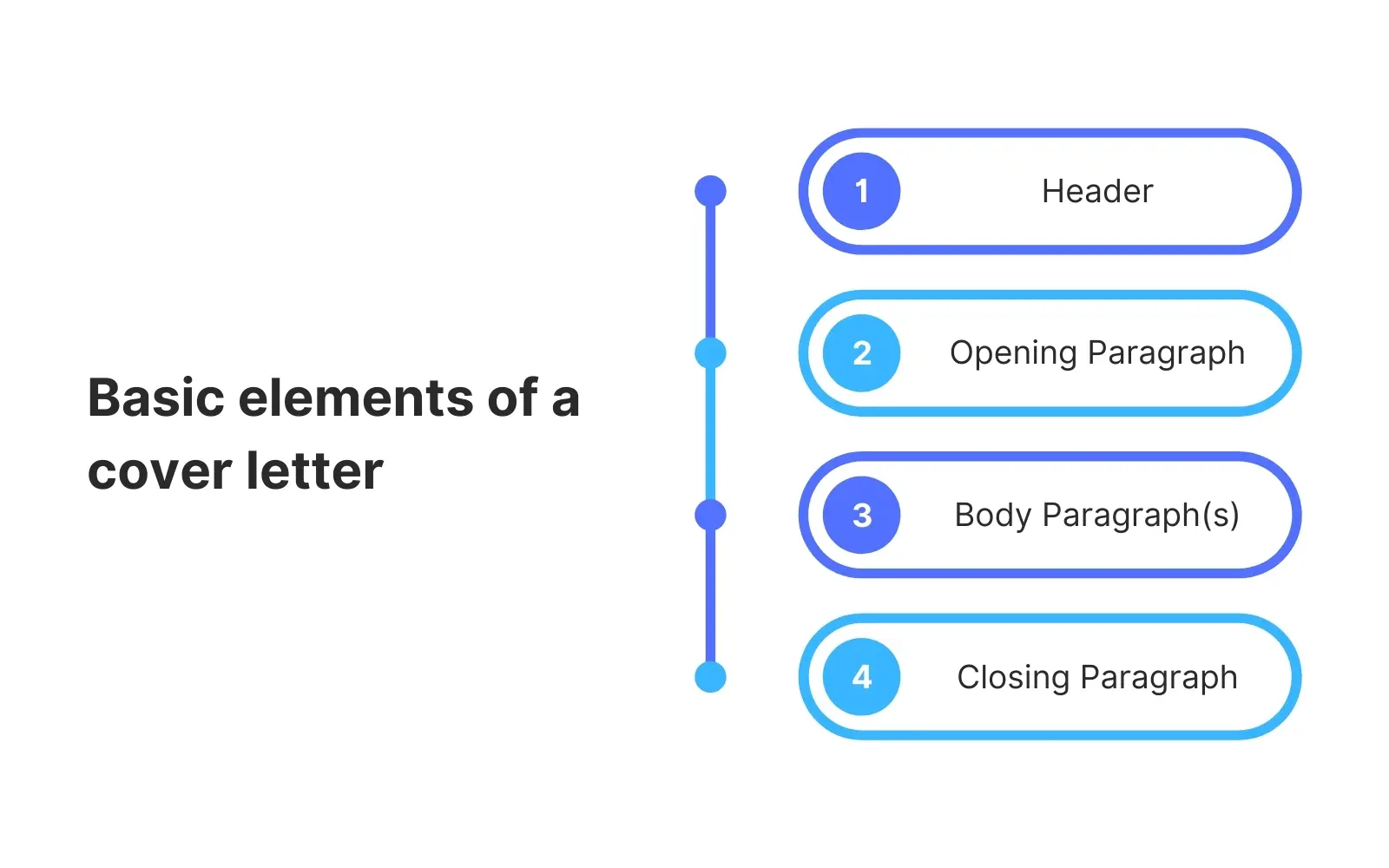
Even though every cover letter should be tailored, each one typically follows a similar structure. Here are the foundational elements:
- Header and Salutation
-
Header: Include your name, email, phone number, and possibly your LinkedIn or personal website link.
-
Greeting: Whenever possible, address a specific person (e.g., “Dear Ms. Johnson”) rather than using a generic salutation.
-
- Opening Paragraph
- Purpose: Grab the reader’s attention by mentioning the position you’re applying for and one or two key reasons you’re a good fit.
- Tip: Try a quick reference to the company’s values or a specific project you admire.
- Body Paragraph(s)
-
Purpose: Elaborate on how your skills and experiences make you the right candidate.
-
Tip: Provide short examples from your past work—like a project success story or a skill that matches the job description.
-
- Closing Paragraph
-
Purpose: Summarize your interest and invite the employer to contact you.
-
Tip: End on a confident note, expressing enthusiasm for the opportunity to discuss your qualifications further.
-
- Signature
-
Final Touch: Thank the reader for their time, and sign off with your name.
-
Optionally: Include a link to your portfolio or LinkedIn profile if it’s relevant and not already in your header.
-
How ChatGPT Can Help
-
Personalization: You can feed ChatGPT specific details about the company or job posting, then ask it to draft a cover letter that incorporates those points.
-
Editing and Polishing: If you have a rough draft, ChatGPT can refine your text for clarity, tone, and grammar.
-
Structure Guidance: You can even request a cover letter outline if you’re unsure how to organize your thoughts.
🤖 Don't fully get this? Learn it with Claude
Stuck on The Role of a Cover Letter? Open Claude, copy a block below, and it'll teach you this exact concept — visually and interactively.
Build the mental picture, not memorization.
I just read a lesson on **The Role of a Cover Letter** (Career & Job Search) and want to truly understand it. Explain The Role of a Cover Letter from first principles using ONE vivid real-world analogy and a visual mental model — draw it as ASCII art or a clear step-by-step diagram — with a concrete example using real numbers. Then ask me one question to check I got the mental picture, and wait for my reply. If you're unsure or a claim isn't standard, say so and reason from first principles instead of guessing.
Socratic — adapts to where you're stuck.
Teach me **The Role of a Cover Letter** interactively. Ask me ONE guiding question at a time, wait for my answer, and adapt to my confusion — build the idea with me step by step instead of explaining it all at once. If you're unsure or a claim isn't standard, say so and reason from first principles instead of guessing.
Active recall exposes what you missed.
Quiz me on **The Role of a Cover Letter** with 5 questions, easy to tricky, ONE at a time. Tell me if each answer is right; at the end, explain clearly what I got wrong and why. If you're unsure or a claim isn't standard, say so and reason from first principles instead of guessing.
Intuition + hook + flashcards for long-term memory.
Help me remember **The Role of a Cover Letter** for the long term: give the one-sentence intuition, a memorable hook/mnemonic, a tiny worked example, and 3 active-recall flashcards (Q -> A). If you're unsure or a claim isn't standard, say so and reason from first principles instead of guessing.