Customization and Common Mistakes to Avoid
A major advantage of using ChatGPT to draft cover letters is the ability to adapt them quickly to different job roles or company cultures.
However, simply copying and pasting the same text for every position can undermine your chances.
Here’s how to make each application stand out:
- Adjust the Tone
-
Corporate vs. Casual: For a formal, established corporation, maintain a more traditional tone. For a creative startup, adopt a friendlier style.
-
Prompt Example:
“Rewrite my cover letter in a more relaxed, team-oriented tone to match a startup culture.”
-
- Manage the Length
-
Keep It Concise: Aim for 250-350 words if possible. Hiring managers often skim cover letters, so be sure your main points are clear and easy to find.
-
Prompt Example:
“Condense my three-paragraph cover letter into two paragraphs without losing essential details.”
-
- Target the Specifics
-
Project Relevance: Emphasize projects or skills that directly match the job description.
-
Prompt Example:
“Highlight my experience with SQL and Tableau, as this role focuses heavily on data analytics and reporting.”
-
Common Mistakes to Avoid
Cover letters can quickly derail when they contain errors or feel impersonal. Below are some pitfalls to watch out for:
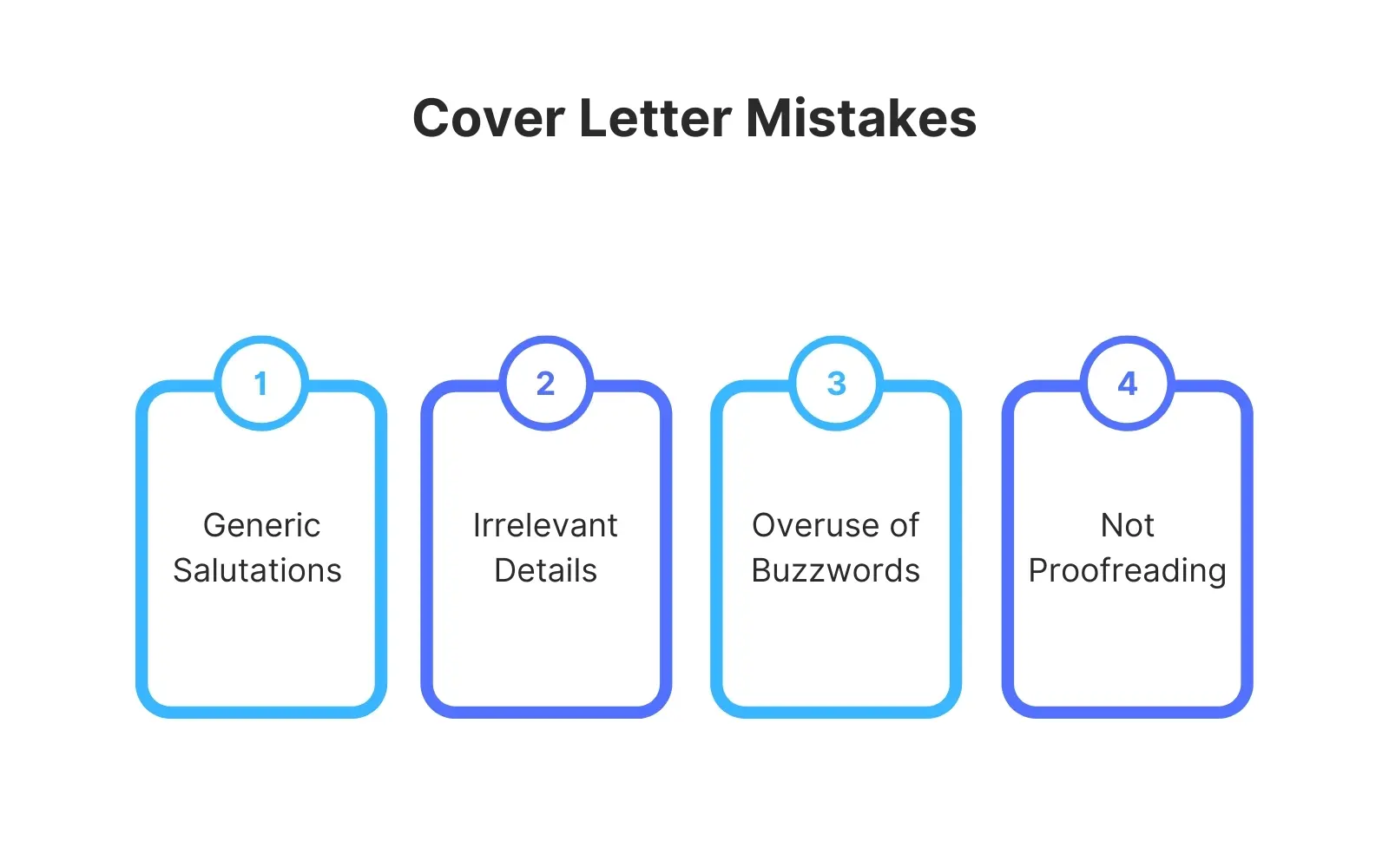
- Generic Salutations
- Opening with “To Whom It May Concern” or “Dear Hiring Manager” makes your letter feel like a form message.
- Tip: Whenever possible, use a specific person’s name. If you’re unsure, try to find the appropriate contact on LinkedIn or the company’s website.
- Irrelevant Details
-
Including too much non-related information (e.g., unrelated hobbies, personal stories) can distract from your main qualifications.
-
Tip: Keep your points focused on what directly ties to the role or the company’s culture.
-
- Overuse of Buzzwords
-
Repeatedly using vague phrases like “passionate” or “team player” without real examples can sound cliché.
-
Tip: Provide specific achievements or scenarios that demonstrate these qualities instead of simply claiming them.
-
- Forgetting to Proofread
-
Typos and grammatical errors lower your perceived professionalism, regardless of experience.
-
Tip: Use ChatGPT for a final grammar check, but also rely on human eyes—friends, family, or colleagues—for a last read-through.
-
A cover letter that addresses the specific needs of the role and avoids common pitfalls will show potential employers that you’re both prepared and genuinely interested—qualities that go a long way in today’s competitive job market.
🤖 Don't fully get this? Learn it with Claude
Stuck on Customization and Common Mistakes to Avoid? Open Claude, copy a block below, and it'll teach you this exact concept — visually and interactively.
Build the mental picture, not memorization.
I just read a lesson on **Customization and Common Mistakes to Avoid** (Career & Job Search) and want to truly understand it. Explain Customization and Common Mistakes to Avoid from first principles using ONE vivid real-world analogy and a visual mental model — draw it as ASCII art or a clear step-by-step diagram — with a concrete example using real numbers. Then ask me one question to check I got the mental picture, and wait for my reply. If you're unsure or a claim isn't standard, say so and reason from first principles instead of guessing.
Socratic — adapts to where you're stuck.
Teach me **Customization and Common Mistakes to Avoid** interactively. Ask me ONE guiding question at a time, wait for my answer, and adapt to my confusion — build the idea with me step by step instead of explaining it all at once. If you're unsure or a claim isn't standard, say so and reason from first principles instead of guessing.
Active recall exposes what you missed.
Quiz me on **Customization and Common Mistakes to Avoid** with 5 questions, easy to tricky, ONE at a time. Tell me if each answer is right; at the end, explain clearly what I got wrong and why. If you're unsure or a claim isn't standard, say so and reason from first principles instead of guessing.
Intuition + hook + flashcards for long-term memory.
Help me remember **Customization and Common Mistakes to Avoid** for the long term: give the one-sentence intuition, a memorable hook/mnemonic, a tiny worked example, and 3 active-recall flashcards (Q -> A). If you're unsure or a claim isn't standard, say so and reason from first principles instead of guessing.