Types of Emails for Job Search and Networking
Effective email communication can open many doors when you’re searching for a job or trying to expand your professional network. The right approach in your emails can mean the difference between getting a response and being ignored.
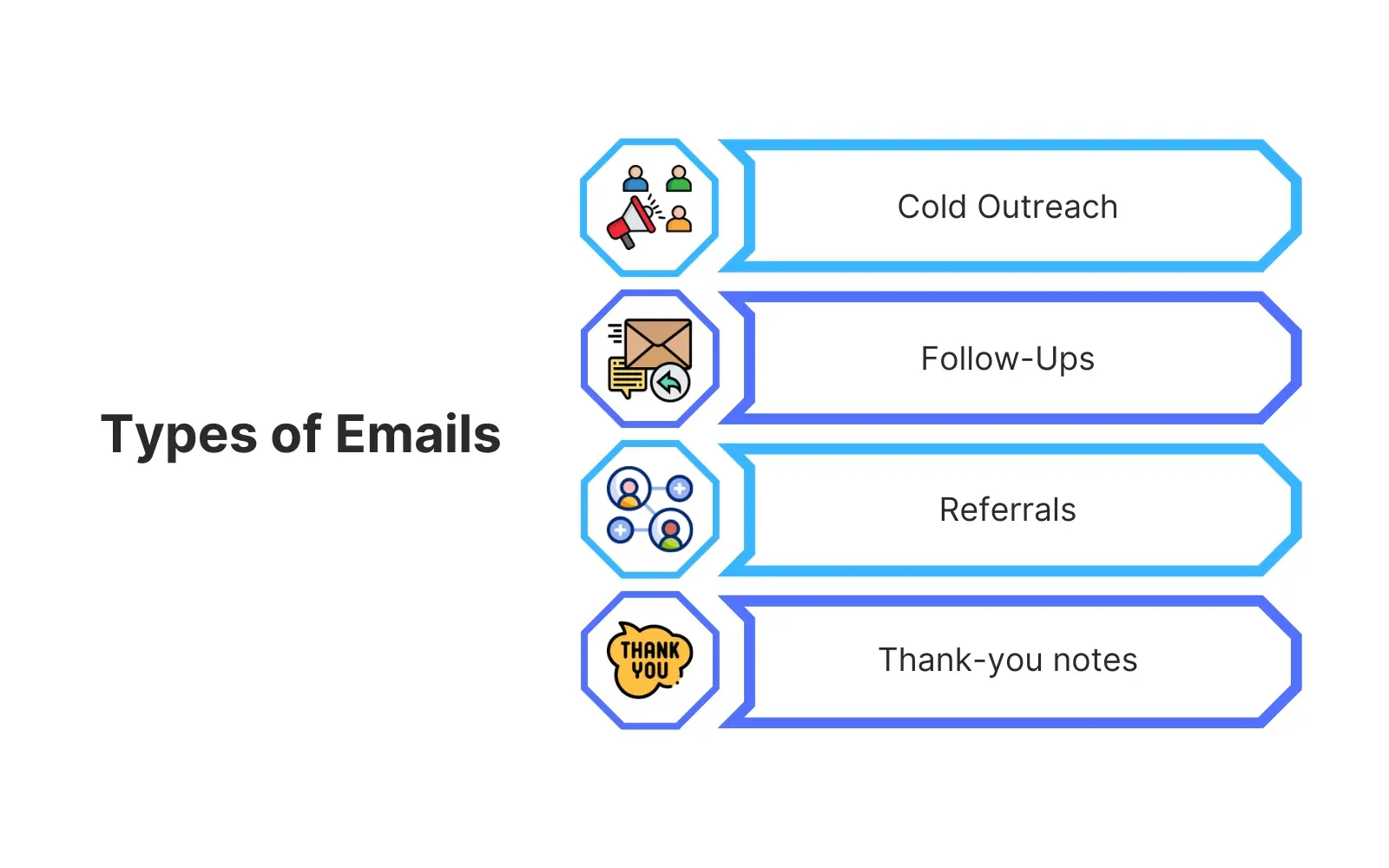
In this section, we’ll explore four common types of emails—cold outreach, follow-ups, referrals, and thank-you notes—along with tips on crafting each one for maximum impact.
1. Cold Outreach
Cold outreach involves contacting someone you don’t know personally—such as a recruiter, hiring manager, or potential mentor.
When to Use It
-
You discover a job opportunity and want to express your interest directly.
-
You’re looking for career advice from professionals in your field.
-
You’d like to connect with someone at a specific company.
Key Elements
-
Subject Line: Keep it brief and to the point (e.g., “Aspiring Data Scientist Seeking Advice”).
-
Introduction: Clearly state who you are and why you’re reaching out.
-
Personalization: Mention something specific about the recipient or their work to show you’ve done your homework.
-
Clear Request: Whether it’s an informational interview, job opening inquiry, or advice, specify what you’d like from them.
2. Follow-Up Emails
Follow-up emails are messages you send after an initial contact or action—like applying for a job or attending a networking event.
When to Use It
-
You’ve applied for a position but haven’t heard back for a week or two.
-
You connected with a professional at a conference and want to continue the conversation.
-
You want to remind a contact about a previously discussed opportunity or meeting.
Key Elements
-
Friendly Reminder: Briefly recall your last interaction (e.g., “We met at the AI Summit last Thursday”).
-
Purpose: State why you’re reaching out again—job application update, project collaboration, or follow-up on a phone call.
-
Respectful Tone: Give them enough space to respond; be polite yet clear that you remain interested.
3. Referrals
Referral emails occur when someone recommends you for a position or introduces you to a new contact.
When to Use It
- A colleague or friend is putting you in touch with their manager or HR team.
- You want to reach out to a mutual connection who can recommend you for a role.
Key Elements
-
Mention the Referrer: Start by stating who referred you and how you know them.
-
Highlight Relevance: Explain why you’re a good fit for the opportunity based on the referrer’s suggestion.
-
Be Grateful: Thank both the referrer and the person you’re contacting for their time.
Example Prompt for ChatGPT
“Write a concise referral email to the hiring manager at Company X. Mention that John Smith, who works on their marketing team, suggested I reach out about the open social media position.”
4. Thank-You Notes
A thank-you email is a short message expressing gratitude—often after an interview, networking event, or any professional favor.
When to Use It
- Immediately after an interview or meeting.
- When someone has provided valuable advice or made an introduction on your behalf.
- After completing a project with a colleague or client.
Key Elements
- Show Appreciation: Start by thanking the person for their time or assistance.
- Recap the Interaction: Mention something you discussed to personalize the note.
- Close with Politeness: Offer to stay in touch or answer any further questions they might have.
Tips for Sending Effective Emails
-
Keep It Short: Professionals have busy inboxes; aim for 2–3 brief paragraphs at most.
-
Proofread: Typos can undermine your credibility. Double-check grammar and clarity.
-
Use a Clear Subject Line: Make it easy for the recipient to understand why you’re emailing.
-
Follow Up Politely: If you don’t hear back, wait a reasonable amount of time (usually about a week) before reaching out again.
By mastering these four types of emails—cold outreach, follow-ups, referrals, and thank-you notes—you’ll enhance your communication strategy, making it easier to build relationships and seize opportunities in your job search and professional network.
🤖 Don't fully get this? Learn it with Claude
Stuck on Types of Emails for Job Search and Networking? Open Claude, copy a block below, and it'll teach you this exact concept — visually and interactively.
Build the mental picture, not memorization.
I just read a lesson on **Types of Emails for Job Search and Networking** (Career & Job Search) and want to truly understand it. Explain Types of Emails for Job Search and Networking from first principles using ONE vivid real-world analogy and a visual mental model — draw it as ASCII art or a clear step-by-step diagram — with a concrete example using real numbers. Then ask me one question to check I got the mental picture, and wait for my reply. If you're unsure or a claim isn't standard, say so and reason from first principles instead of guessing.
Socratic — adapts to where you're stuck.
Teach me **Types of Emails for Job Search and Networking** interactively. Ask me ONE guiding question at a time, wait for my answer, and adapt to my confusion — build the idea with me step by step instead of explaining it all at once. If you're unsure or a claim isn't standard, say so and reason from first principles instead of guessing.
Active recall exposes what you missed.
Quiz me on **Types of Emails for Job Search and Networking** with 5 questions, easy to tricky, ONE at a time. Tell me if each answer is right; at the end, explain clearly what I got wrong and why. If you're unsure or a claim isn't standard, say so and reason from first principles instead of guessing.
Intuition + hook + flashcards for long-term memory.
Help me remember **Types of Emails for Job Search and Networking** for the long term: give the one-sentence intuition, a memorable hook/mnemonic, a tiny worked example, and 3 active-recall flashcards (Q -> A). If you're unsure or a claim isn't standard, say so and reason from first principles instead of guessing.