Avoiding Common Pitfalls
Even well-intentioned emails can fall flat if you miss key details regarding tone, grammar, or excessive AI-generated language.
Below, we’ll examine three frequent mistakes along with practical tips for avoiding them.
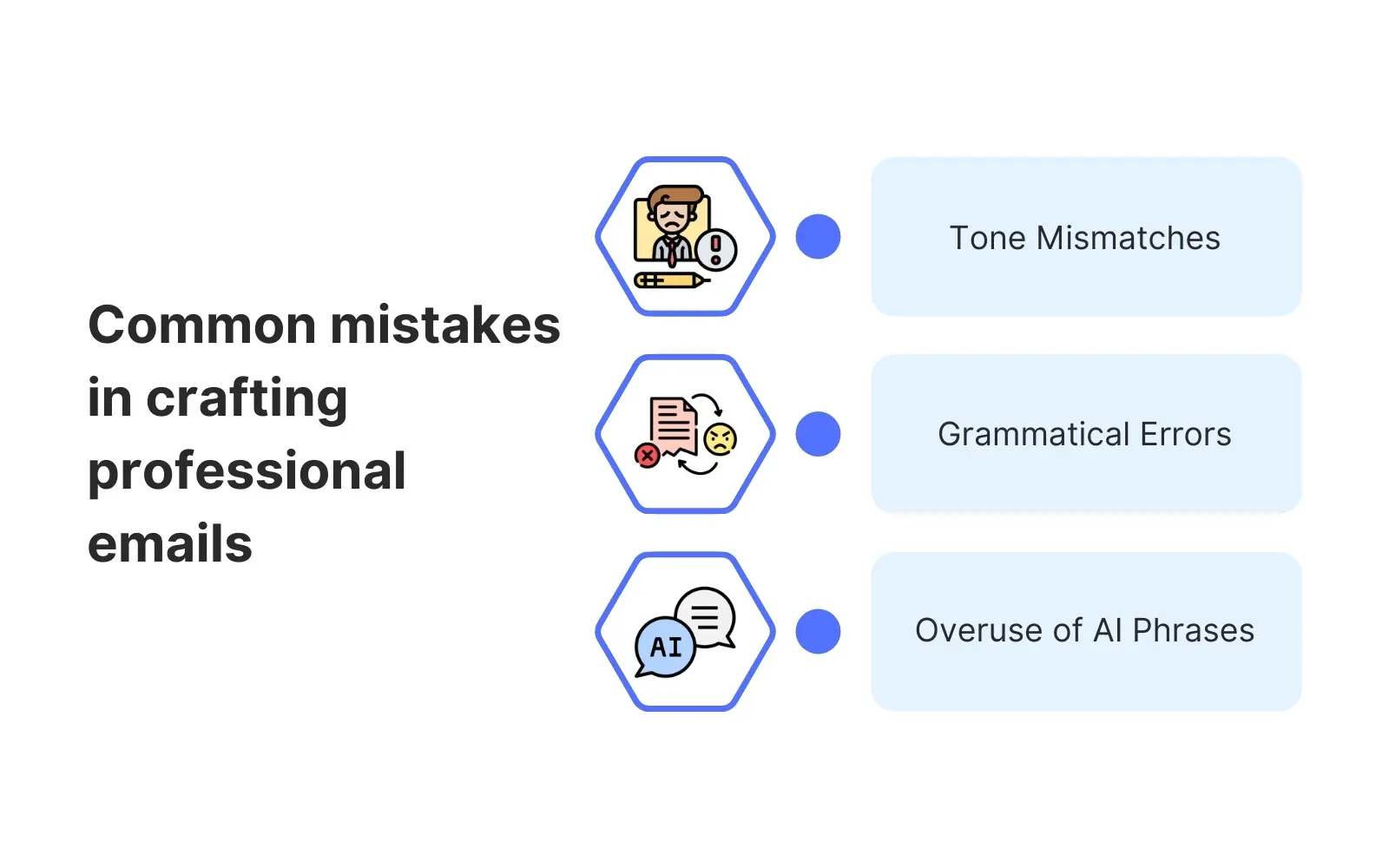
1. Tone Mismatches
Using a writing style that’s either too formal or too casual for the context or recipient, leading to misunderstandings or negative impressions.
Why It Matters:
-
A highly casual tone can seem unprofessional, especially when writing to potential employers or senior managers.
-
An overly formal approach can come off as stiff or unapproachable in more relaxed settings.
How to Avoid It:
-
Know Your Audience: If you’re emailing a start-up founder, a slightly informal tone may be fine. For a large corporation’s HR department, lean more professional.
-
Use Prompt Refinements: Ask ChatGPT to “make the tone more friendly” or “increase formality” to see which version best suits your communication style.
2. Grammatical Errors
Mistakes in punctuation, spelling, or sentence structure that make your email difficult to read or less credible.
Why It Matters:
-
Frequent errors signal a lack of attention to detail.
-
Poor grammar can confuse the message and negatively impact your professional image.
How to Avoid It:
-
Proofread Thoroughly: Even if ChatGPT helps generate your draft, double-check for any lingering mistakes.
-
Read Aloud: Reading your message out loud can catch awkward phrasing and typos.
-
Use Tools: Grammar-checking tools (including ChatGPT itself) can serve as a second set of eyes.
3. Overuse of AI Phrases
Including repetitive or “robotic-sounding” language that makes it obvious an AI wrote—or heavily influenced—the text.
Why It Matters:
-
Excessive AI jargon or formulaic phrasing can seem impersonal, reducing trust or engagement.
-
Recipients might question your authenticity if your emails sound too much like auto-generated copy.
How to Avoid It:
-
Add Personal Touches: Use examples or anecdotes in your own words.
-
Edit for Natural Flow: If you see repeated phrases like “In reference to your request,” replace them with more varied, human-sounding alternatives.
-
Ask for Variation: Try prompts like “Rewrite this to sound more personalized” or “Use a different phrase for ‘Thank you for your time.’”
Key Points
-
Match the Tone: Align your writing style with the expectations of your audience.
-
Eliminate Errors: Proofreading is essential, even if AI has done most of the heavy lifting.
-
Stay Genuine: Use ChatGPT’s suggestions as a starting point, then add your personal flair to avoid generic, repetitive language.
🤖 Don't fully get this? Learn it with Claude
Stuck on Avoiding Common Pitfalls? Open Claude, copy a block below, and it'll teach you this exact concept — visually and interactively.
Build the mental picture, not memorization.
I just read a lesson on **Avoiding Common Pitfalls** (Career & Job Search) and want to truly understand it. Explain Avoiding Common Pitfalls from first principles using ONE vivid real-world analogy and a visual mental model — draw it as ASCII art or a clear step-by-step diagram — with a concrete example using real numbers. Then ask me one question to check I got the mental picture, and wait for my reply. If you're unsure or a claim isn't standard, say so and reason from first principles instead of guessing.
Socratic — adapts to where you're stuck.
Teach me **Avoiding Common Pitfalls** interactively. Ask me ONE guiding question at a time, wait for my answer, and adapt to my confusion — build the idea with me step by step instead of explaining it all at once. If you're unsure or a claim isn't standard, say so and reason from first principles instead of guessing.
Active recall exposes what you missed.
Quiz me on **Avoiding Common Pitfalls** with 5 questions, easy to tricky, ONE at a time. Tell me if each answer is right; at the end, explain clearly what I got wrong and why. If you're unsure or a claim isn't standard, say so and reason from first principles instead of guessing.
Intuition + hook + flashcards for long-term memory.
Help me remember **Avoiding Common Pitfalls** for the long term: give the one-sentence intuition, a memorable hook/mnemonic, a tiny worked example, and 3 active-recall flashcards (Q -> A). If you're unsure or a claim isn't standard, say so and reason from first principles instead of guessing.