Post-Interview Follow-Up
Post-Interview Follow-Up
The interview loop is over, but the hiring decision is not. In the hours and days after you walk out (or close the video call), a set of humans reconstruct you from fragmentary notes, argue in a debrief meeting, and rank you against other candidates they also just met. Post-interview follow-up is the small, deliberate set of communications you send into that window to nudge the reconstruction in your favor. Senior candidates who neglect it leave the last, most-weighted impression to chance.
1. Intuition — why this exists
Two cognitive facts drive everything here. First, the recency effect: the last signal a decision-maker receives is weighted disproportionately. Second, memory decay: interviewers forget the texture of your answers fast — often before the debrief even happens. A short, specific note re-injects your strongest signal at the exact moment people are forming a verdict.
There is also an information-gap problem. Interviews are lossy. You may have fumbled a question, then thought of the clean answer in the parking lot. You may never have gotten to mention the distributed-systems project that is your best evidence. Follow-up is your one sanctioned channel to patch that packet loss — to retransmit dropped signal — without looking desperate.
Finally, follow-up is itself a behavioral data point. For senior and staff roles, hiring managers are evaluating how you communicate with stakeholders. A crisp, well-timed note is a live demonstration of exactly the professional maturity they're screening for.
2. Precise definition / how it works
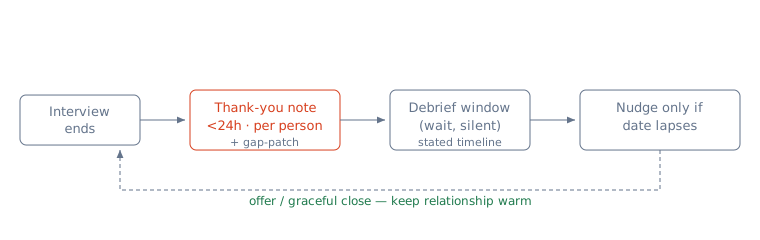
Post-interview follow-up is a sequence, not a single act. The canonical pieces:
- Thank-you note (per interviewer): a short email within 24 hours, ideally same-day. Individualized, referencing something specific to that conversation. This is the highest-leverage piece.
- The gap-patch: if you flubbed a question, this is where you briefly supply the correct/complete answer — framed as reflection, not apology.
- The status nudge: if the promised decision date passes with silence, a polite check-in to the recruiter or hiring manager after the stated timeline lapses.
- The graceful close / withdrawal: if you accept elsewhere or bow out, a clean note that keeps the relationship warm.
Routing matters. Send thank-yous directly to each interviewer if you have their email; otherwise send one message to the recruiter and ask them to relay, or send individually via LinkedIn. Address each person separately — a visible group CC signals you copy-pasted. Keep every message to roughly 3–6 sentences. Structure: (1) thank them for their time, (2) one concrete callback to your conversation, (3) optional gap-patch or added evidence, (4) a forward-looking line reaffirming interest.
3. Concrete example — a script you can actually send
A same-day thank-you to an engineer who probed your rate-limiter design and where you stumbled on a concurrency edge case:
Subject: Thanks — enjoyed the rate-limiter discussion

Hi Priya,

Thanks for taking the time today. I really enjoyed working
through the distributed rate-limiter design with you — the
push on hot-key contention was a good one.

Afterward I kept thinking about the race you raised. The
cleaner fix is a per-key sharded token bucket backed by a
Redis Lua script so the check-and-decrement is atomic, which
removes the read-modify-write window I hand-waved in the room.
I'd have reached for that in production.

The problem space (high-throughput API infra) is exactly
what I want to be working on, so I'm even more interested
after our conversation. Happy to dig into anything else.

Best,
Sam
Why it works: it is specific (names the exact topic), it patches the gap with a better answer rather than excuses, it demonstrates real engineering judgment in three sentences, and it closes with genuine interest. Priya now walks into the debrief with your best answer, not your fumble, top of mind.
4. When to use / when NOT — the judgment layer
Always send the thank-you. The cost is five minutes; the downside is essentially zero. The judgment is about the later, pushier pieces, and about picking follow-up over the named alternatives:
- Thank-you note vs. staying silent: silence is the default many senior candidates rationalize as "letting my performance speak." But it forgoes the recency and gap-patch benefits for free. Send it — unless the recruiter explicitly said "no need to follow up," which some structured processes do.
- Status nudge vs. waiting longer: nudge only after the stated decision date passes. Before that, a nudge reads as anxiety and can annoy the recruiter who is your advocate. If no date was given, one week is a reasonable floor.
- Emailing interviewers directly vs. routing through the recruiter: if you have addresses, direct is warmer and individualized. If you don't, do not guess/scrape emails — that reads as boundary-crossing; route through the recruiter instead.
- Gap-patch vs. letting it go: only patch a material stumble with a genuinely better answer. Re-litigating a minor point you actually got right just signals insecurity.
The meta-trade-off: every extra message spends a little goodwill. Follow-up is a small, well-aimed investment, not a drip campaign. When in doubt, send fewer, sharper messages.
5. Pitfalls / what interviewers probe
- The copy-paste tell: identical notes to five people, or worse, a wrong name / wrong company left in. This actively hurts you. Individualize or don't send.
- Apology framing: "Sorry I bombed the SQL question" plants the failure in their memory. Reframe as forward reflection: "I revisited the query and here's the clean version."
- Volume and cadence: multiple follow-ups before the decision date, or daily nudges, read as desperation and low emotional regulation — the opposite of the seniority signal you want.
- Negotiation leakage: the thank-you is not the place to raise comp, title, or start date. Keep those channels separate.
- Overreach on a rejection: a brief, gracious "thank you, please keep me in mind" is great; arguing the decision or demanding detailed feedback burns the bridge you may need in a year.
- Ghosting the recruiter: if you withdraw or take another offer, say so cleanly. Recruiters have long memories and small worlds; a clean exit is future optionality.
What they're really probing across all of this: do you communicate like a senior engineer under mild social pressure? Concise, specific, self-aware, low-drama. The follow-up is a miniature work sample of exactly that.
Key takeaways
- Follow-up exploits the recency effect and fights memory decay — it re-injects your best signal right as the verdict forms.
- Send an individualized thank-you within 24 hours to each interviewer; this is the highest-leverage, near-zero-risk move.
- Use the note to patch a material gap with a genuinely better answer, framed as reflection — never as an apology.
- Nudge on status only after the stated decision date lapses; earlier nudges spend your recruiter's goodwill.
- Prefer fewer, sharper messages; every extra note costs goodwill, and volume signals desperation, not seniority.
- Close gracefully whether you get the offer or not — relationships and recruiter memory are long-term optionality.
- The whole exchange is a live work sample of senior communication: concise, specific, self-aware, low-drama.
🤖 Don't fully get this? Learn it with Claude
Stuck on Post-Interview Follow-Up? Open Claude, copy a block below, and it'll teach you this exact concept — visually and interactively.
Build the mental picture, not memorization.
I just read a lesson on **Post-Interview Follow-Up** (Career & Job Search) and want to truly understand it. Explain Post-Interview Follow-Up from first principles using ONE vivid real-world analogy and a visual mental model — draw it as ASCII art or a clear step-by-step diagram — with a concrete example using real numbers. Then ask me one question to check I got the mental picture, and wait for my reply. If you're unsure or a claim isn't standard, say so and reason from first principles instead of guessing.
Socratic — adapts to where you're stuck.
Teach me **Post-Interview Follow-Up** interactively. Ask me ONE guiding question at a time, wait for my answer, and adapt to my confusion — build the idea with me step by step instead of explaining it all at once. If you're unsure or a claim isn't standard, say so and reason from first principles instead of guessing.
Active recall exposes what you missed.
Quiz me on **Post-Interview Follow-Up** with 5 questions, easy to tricky, ONE at a time. Tell me if each answer is right; at the end, explain clearly what I got wrong and why. If you're unsure or a claim isn't standard, say so and reason from first principles instead of guessing.
Intuition + hook + flashcards for long-term memory.
Help me remember **Post-Interview Follow-Up** for the long term: give the one-sentence intuition, a memorable hook/mnemonic, a tiny worked example, and 3 active-recall flashcards (Q -> A). If you're unsure or a claim isn't standard, say so and reason from first principles instead of guessing.