Behavioral & Soft Skills Interviews
Behavioral & Soft Skills Interviews
1. Intuition — the problem it solves
A coding screen tells the company whether you can build software. It says almost nothing about whether working with you for the next three years will be pleasant or catastrophic. Most senior engineers are not fired for lacking algorithms — they are quietly managed out for being unable to disagree without drama, hiding bad news until it explodes, or steamrolling teammates. The behavioral interview exists because past behavior is the cheapest available predictor of future behavior. The interviewer cannot observe how you'll handle a production incident at 2am, so they ask you to narrate a time you already did, betting that the shape of that story repeats.
For a senior backend role the stakes are higher: you are expected to influence without authority, absorb ambiguity, and make the people around you better. So the questions shift from "tell me about a challenge" to "tell me about a time you were wrong," "a decision you disagreed with but had to support," and "a time you had to push back on a senior person." They are probing judgment, not vocabulary.
2. Precise definition / how it works
A behavioral interview is a structured conversation in which the interviewer maps your answers to a fixed competency rubric — typically some mix of ownership, collaboration, conflict handling, communication, dealing with ambiguity, and impact. Each question targets one competency; each answer is scored against anchored levels ("resolved conflict" vs. "escalated blindly" vs. "avoided it"). Strong companies calibrate these scores across interviewers so the bar is consistent.
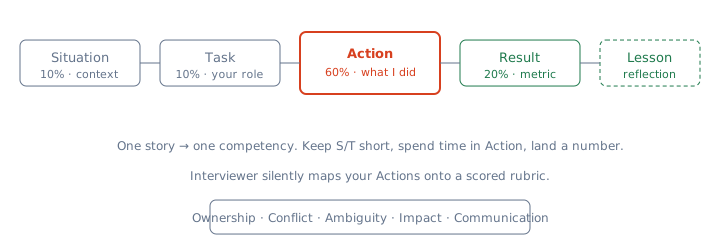
The standard tool for structuring an answer is STAR: Situation (the context, kept short), Task (your specific responsibility), Action (what you did — the bulk of the answer, in first person singular), and Result (the measurable outcome plus what you learned). A refinement, STAR(L), appends an explicit Lesson, which is what separates senior answers: reflection signals you extract patterns, not just anecdotes.
Mechanically, a good answer is roughly 10% Situation, 10% Task, 60% Action, 20% Result/Lesson, lasts 2–3 minutes, and uses "I" far more than "we". The interviewer is scoring your decisions; "we" hides them.
3. A concrete example you can actually say
Question: "Tell me about a time you disagreed with a technical decision."
[S] Our team chose to add a second Kafka cluster to isolate a
    noisy analytics workload — a two-quarter project.
[T] As the service owner I owned the reliability of the primary
    cluster, so I had to either support the plan or object with
    a credible alternative.
[A] I disagreed: I thought the noise was a consumer-lag bug, not
    a capacity limit. Rather than argue in the meeting, I pulled
    two weeks of broker and lag metrics, reproduced the spike in
    staging, and showed it traced to one un-batched consumer.
    I wrote a one-page doc with the data, proposed fixing the
    consumer plus quotas as a one-sprint alternative, and asked
    the tech lead to pressure-test it before we committed spend.
[R] We fixed the consumer; p99 lag dropped ~90% and we shelved
    the second cluster, saving roughly two engineer-quarters and
    the ongoing infra cost.
[L] I learned to disagree with data and a cheaper option in hand,
    not just an opinion — it makes pushback land as help, not
    obstruction.
Notice: first-person actions, a real metric, a named alternative, and a lesson. It demonstrates conflict handling and ownership in under three minutes.
4. When to use / when NOT — vs. the alternatives
STAR is the default for any question starting with "tell me about a time," "describe a situation," or "give me an example." It is the right tool because it forces the concrete specificity interviewers score on.
- STAR vs. free-form storytelling: Free-form feels more natural and can build rapport, but it buries your decisions in narrative and blows past 5 minutes. Use light structure over raw storytelling whenever the question is competency-probing.
- STAR vs. hypothetical answers ("I would..."): If you answer a past-tense question in the hypothetical, you signal you don't actually have the experience. Only go hypothetical when explicitly asked ("how would you handle...") or when you genuinely lack the example — and then say so honestly.
- STAR vs. the CARL/PAR variants: These reorder emphasis (CARL front-loads Context then Action-Result-Learning). Pick one and stay consistent; the marginal difference matters far less than delivery. Don't over-optimize the acronym.
- When NOT to STAR: Rapid-fire values questions ("what's your ideal team?") or reverse questions to the interviewer don't need the scaffold — a crisp direct answer is better than a forced 4-part story.
5. Pitfalls / what interviewers probe
- The "we" fog. Answers drowning in "we" invite the killer follow-up: "what did you personally do?" If you can't answer, your score drops. Pre-attribute your slice of every team story.
- No result / no metric. "It went well" is unscoreable. Interviewers dig: "how did you measure success?" Have a number, even an estimate.
- The hero with no conflict. Stories where everyone agreed and you were flawless read as either low-stakes or dishonest. Seniors are expected to have real friction; a story with genuine tension you navigated scores higher than a frictionless win.
- Can't say "I was wrong." The failure question is a trap for the defensive. Probes: "what would you do differently?" and "whose fault was it?" Owning your part without self-flagellating is the signal. Blaming others is an instant flag.
- Rambling / no landing. A 6-minute answer with no clear Result exhausts goodwill. Practice landing the plane in under 3 minutes.
- Rehearsed brittleness. Memorized scripts collapse under a single unexpected follow-up. Prepare 6–8 flexible stories mapped to competencies, not word-for-word paragraphs, so you can recombine them live.
Key takeaways
- Behavioral interviews use past behavior as the cheapest predictor of future behavior; they score judgment, not vocabulary.
- Structure answers as STAR(L): short Situation/Task, dominant first-person Action, a measurable Result, and an explicit Lesson.
- Prepare 6–8 flexible stories mapped to competencies (ownership, conflict, ambiguity, impact) — not memorized scripts.
- Say "I" not "we," always land a metric, and pick real stories with genuine friction over frictionless hero tales.
- The failure and disagreement questions reward candid ownership and data-backed pushback; blame and defensiveness are instant flags.
- Reserve hypothetical ("I would") answers for explicitly hypothetical questions; use STAR for anything past-tense.
🤖 Don't fully get this? Learn it with Claude
Stuck on Behavioral & Soft Skills Interviews? Open Claude, copy a block below, and it'll teach you this exact concept — visually and interactively.
Build the mental picture, not memorization.
I just read a lesson on **Behavioral & Soft Skills Interviews** (Career & Job Search) and want to truly understand it. Explain Behavioral & Soft Skills Interviews from first principles using ONE vivid real-world analogy and a visual mental model — draw it as ASCII art or a clear step-by-step diagram — with a concrete example using real numbers. Then ask me one question to check I got the mental picture, and wait for my reply. If you're unsure or a claim isn't standard, say so and reason from first principles instead of guessing.
Socratic — adapts to where you're stuck.
Teach me **Behavioral & Soft Skills Interviews** interactively. Ask me ONE guiding question at a time, wait for my answer, and adapt to my confusion — build the idea with me step by step instead of explaining it all at once. If you're unsure or a claim isn't standard, say so and reason from first principles instead of guessing.
Active recall exposes what you missed.
Quiz me on **Behavioral & Soft Skills Interviews** with 5 questions, easy to tricky, ONE at a time. Tell me if each answer is right; at the end, explain clearly what I got wrong and why. If you're unsure or a claim isn't standard, say so and reason from first principles instead of guessing.
Intuition + hook + flashcards for long-term memory.
Help me remember **Behavioral & Soft Skills Interviews** for the long term: give the one-sentence intuition, a memorable hook/mnemonic, a tiny worked example, and 3 active-recall flashcards (Q -> A). If you're unsure or a claim isn't standard, say so and reason from first principles instead of guessing.