Compensation, Leveling & Negotiation
The highest-leverage hour of your career — and the least practiced
A single negotiated offer can be worth more than a year of raises, yet most engineers accept the first number. Two skills: read the comp stack and negotiate the package.
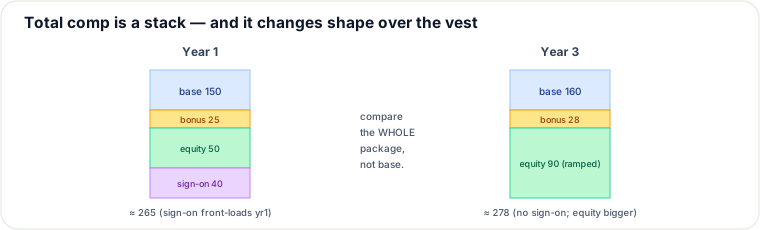
The comp stack
- Base salary — guaranteed, what raises/bonuses scale off.
- Bonus — % of base, performance/company dependent.
- Equity (RSUs) — the swing factor; vests over ~4 years (often a 1-yr cliff). Value = shares × price — risky (private/illiquid or volatile). Watch the vesting shape (even vs back-loaded).
- Sign-on bonus — one-time, front-loads year 1 (often to offset a cliff or a forfeited bonus).
Compare total comp over 4 years, not base — and discount equity for risk. levels.fyi gives real per-level numbers by company.
Leveling
Comp tracks level, not title. A rough ladder: L3 entry → L4 mid (owns features) → L5 senior (owns systems, the common target) → L6 staff (cross-team impact) → L7+ principal. Negotiating the level often beats negotiating the number — it sets the whole band and your trajectory.
Negotiation, briefly
- Have a BATNA — competing offers are the strongest leverage; even a credible alternative helps.
- Don't name a number first — "I want to make sure the level/scope is right; what range did you have in mind?"
- Negotiate the whole package — base, equity, sign-on, level, start date — not just base.
- Be collaborative, not adversarial; get the final offer in writing.
Pitfalls
- Accepting the first offer — there's almost always room.
- Comparing base only — equity + sign-on often dominate the difference.
- Over-valuing illiquid equity at face value — discount for risk.
Takeaways
- TC = base + bonus + equity (vesting) + sign-on; compare over 4 yrs, discount equity for risk.
- Negotiate the level — it sets the band and trajectory.
- BATNA + don't-go-first + whole-package + in-writing.
Re-authored for this guide; comp-stack diagram hand-authored as SVG. Informed by levels.fyi and standard engineering-leveling ladders. See also: Interviews, Personal Brand.
🤖 Don't fully get this? Learn it with Claude
Stuck on Compensation, Leveling & Negotiation? Open Claude, copy a block below, and it'll teach you this exact concept — visually and interactively.
Build the mental picture, not memorization.
I just read a lesson on **Compensation, Leveling & Negotiation** (Career & Job Search) and want to truly understand it. Explain Compensation, Leveling & Negotiation from first principles using ONE vivid real-world analogy and a visual mental model — draw it as ASCII art or a clear step-by-step diagram — with a concrete example using real numbers. Then ask me one question to check I got the mental picture, and wait for my reply. If you're unsure or a claim isn't standard, say so and reason from first principles instead of guessing.
Socratic — adapts to where you're stuck.
Teach me **Compensation, Leveling & Negotiation** interactively. Ask me ONE guiding question at a time, wait for my answer, and adapt to my confusion — build the idea with me step by step instead of explaining it all at once. If you're unsure or a claim isn't standard, say so and reason from first principles instead of guessing.
Active recall exposes what you missed.
Quiz me on **Compensation, Leveling & Negotiation** with 5 questions, easy to tricky, ONE at a time. Tell me if each answer is right; at the end, explain clearly what I got wrong and why. If you're unsure or a claim isn't standard, say so and reason from first principles instead of guessing.
Intuition + hook + flashcards for long-term memory.
Help me remember **Compensation, Leveling & Negotiation** for the long term: give the one-sentence intuition, a memorable hook/mnemonic, a tiny worked example, and 3 active-recall flashcards (Q -> A). If you're unsure or a claim isn't standard, say so and reason from first principles instead of guessing.