The System Design Interview — RESHADED + a Traced Mock
A framework so you never freeze on "design X"
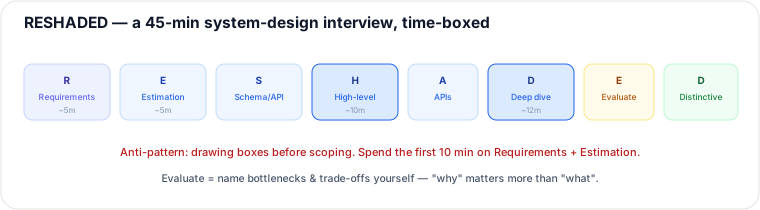
The system-design interview rewards a structured approach far more than a clever answer. RESHADED gives you a checklist and a time budget; the cardinal sin is drawing boxes before you've scoped the problem.
Traced mini-mock: "design a URL shortener"
- R — Requirements: shorten a URL, redirect; ~100M new URLs/month, 100:1 read:write; low latency redirect; links don't expire. (Functional + non-functional, agreed first.)
- E — Estimation (use the 5-step method): ~40 writes/s, ~4,000 reads/s; ~500 B/record × 5 yr ≈ ~3 TB. → read-heavy → cache + replicas. (Cross-link Capacity Estimation.)
- S/A — Schema & API:
POST /shorten {url} -> {short};GET /{short} -> 301. Table(short_code PK, long_url, created_at). - H — High-level: client → LB → app → cache (hot codes) → DB; key generation = base62 of a counter / Snowflake id (cross-link Unique ID generation).
- D — Deep dive: how to generate unique short codes without collisions; cache strategy for the hot read path; DB choice (KV store fits).
- E — Evaluate: bottleneck = the redirect read path → CDN/cache; single counter = SPOF → ranges per host. Name these yourself.
The bar
"Why" beats "what." Scope first (R+E ~10 min), keep the high-level simple, then go deep on 1–2 areas the interviewer steers to, and volunteer the bottlenecks and trade-offs. Simplicity is a virtue — don't add a queue/shard you can't justify.
Pitfalls
- Designing before scoping — the #1 mistake; spend the first ~10 minutes on R + E.
- No numbers — estimation is what justifies caching/sharding decisions.
- No trade-offs / bottlenecks — sta+ candidates surface these unprompted.
Takeaways
- RESHADED: Requirements → Estimation → Schema/API → High-level → Deep dive → Evaluate.
- Scope + estimate first; keep high-level simple; go deep where steered; name bottlenecks.
- This is where your whole System Design + Estimation track pays off.
Re-authored for this guide; RESHADED diagram hand-authored as SVG. Follows Educative's RESHADED and Hello Interview's time-boxed delivery. See also: the System Design subject, Capacity Estimation.
🤖 Don't fully get this? Learn it with Claude
Stuck on The System Design Interview — RESHADED + a Traced Mock? Open Claude, copy a block below, and it'll teach you this exact concept — visually and interactively.
🎨 Explain it visually
Build the mental picture, not memorization.
I just read a lesson on **The System Design Interview — RESHADED + a Traced Mock** (Career & Job Search) and want to truly understand it. Explain The System Design Interview — RESHADED + a Traced Mock from first principles using ONE vivid real-world analogy and a visual mental model — draw it as ASCII art or a clear step-by-step diagram — with a concrete example using real numbers. Then ask me one question to check I got the mental picture, and wait for my reply. If you're unsure or a claim isn't standard, say so and reason from first principles instead of guessing.
🤔 Walk me through it (interactive)
Socratic — adapts to where you're stuck.
Teach me **The System Design Interview — RESHADED + a Traced Mock** interactively. Ask me ONE guiding question at a time, wait for my answer, and adapt to my confusion — build the idea with me step by step instead of explaining it all at once. If you're unsure or a claim isn't standard, say so and reason from first principles instead of guessing.
🧪 Quiz me & fix my gaps
Active recall exposes what you missed.
Quiz me on **The System Design Interview — RESHADED + a Traced Mock** with 5 questions, easy to tricky, ONE at a time. Tell me if each answer is right; at the end, explain clearly what I got wrong and why. If you're unsure or a claim isn't standard, say so and reason from first principles instead of guessing.
🧠 Make it stick
Intuition + hook + flashcards for long-term memory.
Help me remember **The System Design Interview — RESHADED + a Traced Mock** for the long term: give the one-sentence intuition, a memorable hook/mnemonic, a tiny worked example, and 3 active-recall flashcards (Q -> A). If you're unsure or a claim isn't standard, say so and reason from first principles instead of guessing.