Key Profile Sections for Your Portfolio
LinkedIn offers several profile sections that let you highlight your professional strengths in different ways.
By strategically filling out these sections, you’ll create a strong, coherent narrative that resonates with recruiters, potential clients, or collaborators.
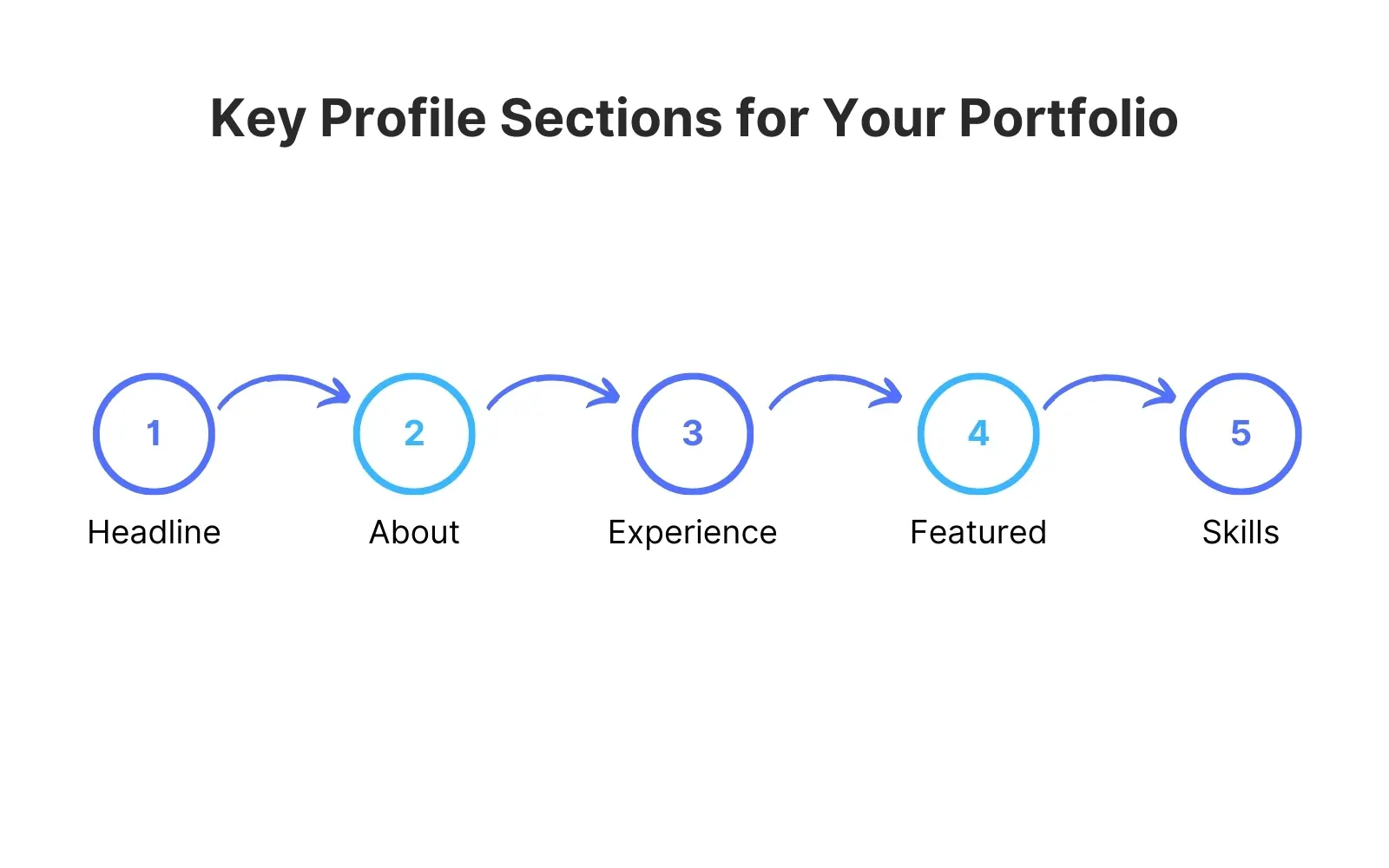
Below are the five main areas to focus on, along with tips for making each one shine.
1. Headline: Craft a Keyword-Rich, Impactful Title
Your headline is often the first thing people see. It appears under your name and sets the tone for how you’re perceived.
- Tips:
-
Incorporate Keywords: Use industry-specific terms (e.g., “Full-Stack Developer,” “Content Marketer”) so recruiters can find you easily.
-
Show Your Value: Include your primary skill, your role, or a short, punchy phrase about what you bring to the table—e.g., “Data Analyst | Business Intelligence & Visualization.”
-
Stay Concise: Aim for a headline that’s memorable and easy to skim.
-
2. About: Write a Compelling Personal Summary Highlighting Skills and Goals
The About section is your chance to give a fuller picture of your professional story. You can detail your motivations, work style, and what you’re aiming for next.
- Tips:
-
Hook Them Early: Start with a sentence that grabs attention—something about your passion for solving a specific type of problem.
-
Highlight Key Achievements: Mention notable projects or results that tie directly to your expertise.
-
Show Some Personality: It’s okay to be slightly conversational here. Recruiters often appreciate a glimpse of who you are beyond the job title.
-
3. Experience: Showcase Achievements with Measurable Impact
The Experience section details your work history, but it can do more than list roles—it can underscore your accomplishments.
- Tips:
-
Focus on Results: Instead of simply writing your duties, show what you achieved. For instance, “Reduced user onboarding time by 50% through process redesign.”
-
Use Bullet Points: This makes your achievements easier to scan and highlights your contributions quickly.
-
Be Specific: Whenever possible, include metrics, percentages, or tangible outcomes (e.g., cost savings, increased conversions).
-
4. Featured: Add Links to Your Portfolio, Projects, or Achievements
The Featured section lets you pin key samples at the top of your profile, making them immediately visible.
- Tips:
-
Select Your Best Work: Only showcase projects that truly represent your strengths or the direction you want your career to go.
-
Add Variety: Include diverse formats (e.g., articles, websites, videos) if they highlight different aspects of your skill set.
-
Keep Descriptions Brief: Let the content speak for itself but provide a short summary to pique interest.
-
5. Skills & Endorsements: Highlight Key Strengths
Listing your most relevant skills helps LinkedIn’s algorithm match you with suitable roles. Endorsements from colleagues further validate your expertise.
- Tips:
-
Prioritize the Top Skills: Pin the skills that matter most in your field (e.g., “SQL,” “Project Management,” “UI/UX Design”).
-
Encourage Endorsements: Politely ask peers or past clients to endorse you for specific skills they’ve seen you demonstrate.
-
Keep Them Updated: As you learn new tools or transition into new specialties, revise your skill list accordingly.
-
Putting It All Together
A well-structured LinkedIn profile acts as an online calling card, giving potential employers or collaborators an instant snapshot of who you are and what you do best.
By optimizing your Headline, About, Experience, Featured, and Skills & Endorsements sections, you’ll create a cohesive and powerful personal brand that stands out in the crowded professional landscape.
🤖 Don't fully get this? Learn it with Claude
Stuck on Key Profile Sections for Your Portfolio? Open Claude, copy a block below, and it'll teach you this exact concept — visually and interactively.
Build the mental picture, not memorization.
I just read a lesson on **Key Profile Sections for Your Portfolio** (Career & Job Search) and want to truly understand it. Explain Key Profile Sections for Your Portfolio from first principles using ONE vivid real-world analogy and a visual mental model — draw it as ASCII art or a clear step-by-step diagram — with a concrete example using real numbers. Then ask me one question to check I got the mental picture, and wait for my reply. If you're unsure or a claim isn't standard, say so and reason from first principles instead of guessing.
Socratic — adapts to where you're stuck.
Teach me **Key Profile Sections for Your Portfolio** interactively. Ask me ONE guiding question at a time, wait for my answer, and adapt to my confusion — build the idea with me step by step instead of explaining it all at once. If you're unsure or a claim isn't standard, say so and reason from first principles instead of guessing.
Active recall exposes what you missed.
Quiz me on **Key Profile Sections for Your Portfolio** with 5 questions, easy to tricky, ONE at a time. Tell me if each answer is right; at the end, explain clearly what I got wrong and why. If you're unsure or a claim isn't standard, say so and reason from first principles instead of guessing.
Intuition + hook + flashcards for long-term memory.
Help me remember **Key Profile Sections for Your Portfolio** for the long term: give the one-sentence intuition, a memorable hook/mnemonic, a tiny worked example, and 3 active-recall flashcards (Q -> A). If you're unsure or a claim isn't standard, say so and reason from first principles instead of guessing.