Join Algorithms — Nested Loop, Hash & Sort-Merge
Three ways to combine two tables
A JOIN isn't one operation — the optimizer picks one of three algorithms based on table
sizes, indexes, and whether sorted output is needed. Knowing them turns a mysterious slow join into an obvious
"wrong algorithm / missing index" diagnosis.
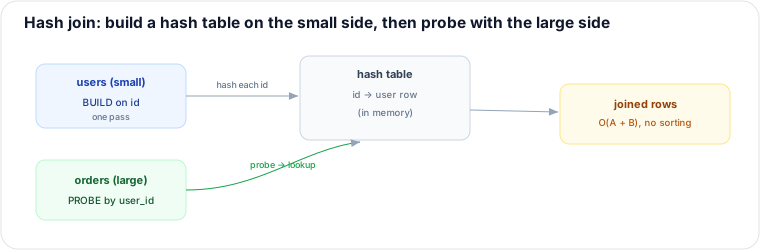
The three algorithms
| Algorithm | How it works | Cost | Chosen when |
|---|---|---|---|
| Nested loop | for each row in A, find matches in B | O(A×B), or O(A×log B) with an index on B | A is small and B has an index on the join key |
| Hash join | build a hash table on the smaller side's key, probe with the larger | O(A+B), needs memory | large equi-join, no useful index, order not needed |
| Sort-merge join | sort both by the join key, then merge in one pass | O(A log A + B log B), or O(A+B) if pre-sorted | inputs already sorted (an index), or sorted output wanted |
The trap to recognise in EXPLAIN
A Nested Loop over two large tables with no index on the join key is the classic catastrophe — millions × millions. The fix is almost always: add an index on the join column, or let the planner pick a hash join (check your stats are fresh).
EXPLAIN ANALYZE SELECT * FROM orders o JOIN users u ON o.user_id = u.id;
--  Hash Join  (hash table on users; probe with orders)          <- good for big o, small u
--  vs  Nested Loop -> Index Scan on users_pkey                   <- good when o is small
--  vs  Merge Join  (both already ordered by the join key)
The Sort-Merge Join Duplicate Key Trap (Backtracking)
A standard sort-merge join operates in $O(N \log N + M \log M)$ to sort, followed by a linear $O(N + M)$ pass using two cursors to merge the rows. However, a naive two-cursor linear pass fails when duplicate keys exist on both sides.
Imagine joining two sorted lists on their key values:
- List A:
[1, 2, 2, 3](cursorptr_A) - List B:
[2, 2, 4](cursorptr_B)
ptr_Apoints to1,ptr_Bpoints to2. Since $1 < 2$, we advanceptr_A.ptr_Apoints to the first2,ptr_Bpoints to the first2. We have a match! We output the joined row.- The Trap: If we simply advance one cursor (say,
ptr_Bto the second2), we match the first2ofAwith the second2ofB. But if we then advanceptr_Ato the second2,ptr_Bis already past the first2ofB, and we miss the match between the second2ofAand the first2ofB. - The Backtracking Solution: The database engine sets a
mark_Bpointer at the start of the matching run on the right side (the first2inB). It advancesptr_Bto output all matches for the first2ofA. Whenptr_Breaches the end of the duplicates (value4),ptr_Ais incremented to the second2, andptr_Bbacktracks to themark_Bposition to scan the duplicates again.
A and $Y$ times in B, the algorithm performs $X \times Y$ local comparisons. If the join key has extremely high cardinality of duplicates, the merge phase degrades from linear $O(N+M)$ to local quadratic $O(N \times M)$ complexity.
Equality vs theta: who can run which algorithm
Hash join and sort-merge join require an equality (equi-join) predicate on the join keys: ON a.k = b.k (or a conjunction of equalities). They hash or sort on those keys. A theta join uses a non-equality comparison — ON a.score > b.threshold, ON a.ts BETWEEN b.start AND b.end, band joins, etc. Those force nested loop (possibly with an index range scan on the inner side if one exists). Seeing Nested Loop on a huge join is not always a bug: if the predicate is not equi, the planner has no hash/merge option.
-- Equi-join: hash or merge eligible
SELECT * FROM orders o JOIN users u ON o.user_id = u.id;

-- Theta / non-equi: nested loop only (index on inner may still help)
SELECT * FROM events e JOIN windows w
  ON e.ts >= w.start_ts AND e.ts < w.end_ts;
Hash spill mechanism: grace / hybrid hash join
"Spills to disk" is not a single sequential dump. When the build side does not fit in work_mem, engines use a partitioned (grace / hybrid) hash join:
- Partition pass. Hash each build row by the join key into P partitions (batches) written to temp files so each partition is aimed to fit in memory. Probe-side rows are partitioned with the same hash function into matching files.
- Per-partition join. For each partition i: load build partition i into an in-memory hash table; scan probe partition i and probe. Output matching pairs. Discard the table; move to i+1.
- Recursive spill. If a single partition still exceeds memory (skew: one popular key hashes alone into a huge bucket), the engine re-partitions that partition with another hash (or falls back to nested loop for that slice). Heavy skew is why "raise work_mem" alone sometimes fails.
In Postgres EXPLAIN ANALYZE, Batches > 1 (and growing Batches mid-execution) signals this path. Cost becomes multi-pass disk I/O proportional to data size × number of partition rounds — far more than an in-memory O(A+B) hash join.
-- Healthy: Batches=1 (fits in work_mem)
-- Hash  (Batches=1  Memory Usage=8192kB)
-- Unhealthy spill:
-- Hash  (Batches=32  Memory Usage=4096kB)  -- 32 partition pairs hit disk
When-NOT summary
- Do not expect hash/merge for non-equality joins — nested loop is the only general algorithm.
- Do not hash-join a huge build side hoping memory appears; filter first, or ensure the smaller input is the build side (planner usually swaps, but wrong stats prevent it).
- Do not use nested loop on two large unindexed inputs for equi-joins — add an index or let hash win after
ANALYZE.
Pitfalls
- Hash join spills via grace partitioning if the build side exceeds
work_mem— watch Batches; raise memory, shrink the build side, or fix key skew. - The optimizer's choice depends on row-count estimates — stale stats → wrong join
algorithm.
ANALYZE. - Join order matters as much as algorithm; for many-table joins the planner searches orderings (and can get it wrong on skewed data).
- Sort-Merge Backtracking: High duplicate cardinality on the join key forces extensive cursor backtracking, increasing CPU time due to cache-unfriendly pointer resets.
- Theta join misread: Nested Loop on a large join may be mandatory because the predicate is not equi — rewrite to equi when possible (e.g. precompute buckets) rather than only adding indexes.
Takeaways
- Nested loop (small + indexed, or any theta join) · hash join (big equi-join) · sort-merge (sorted/ordered equi-join).
- Hash and sort-merge need equality; non-equi predicates force nested loop.
- Spill = grace/hybrid partition-to-disk, not a vague slowdown; Batches>1 is the tell.
- Nested loop on two big unindexed equi-tables = the disaster; index the join key.
- The planner chooses by cost from stats — verify with
EXPLAIN, keep stats fresh.
Re-authored for this guide; hash-join diagram hand-authored as SVG. Follows CMU 15-445 and DDIA ch. 3. See also: How a Query Executes, How Indexes Work.
🤖 Don't fully get this? Learn it with Claude
Stuck on Join Algorithms — Nested Loop, Hash & Sort-Merge? Open Claude, copy a block below, and it'll teach you this exact concept — visually and interactively.
Build the mental picture, not memorization.
I just read a lesson on **Join Algorithms — Nested Loop, Hash & Sort-Merge** (Databases) and want to truly understand it. Explain Join Algorithms — Nested Loop, Hash & Sort-Merge from first principles using ONE vivid real-world analogy and a visual mental model — draw it as ASCII art or a clear step-by-step diagram — with a concrete example using real numbers. Then ask me one question to check I got the mental picture, and wait for my reply. If you're unsure or a claim isn't standard, say so and reason from first principles instead of guessing.
Socratic — adapts to where you're stuck.
Teach me **Join Algorithms — Nested Loop, Hash & Sort-Merge** interactively. Ask me ONE guiding question at a time, wait for my answer, and adapt to my confusion — build the idea with me step by step instead of explaining it all at once. If you're unsure or a claim isn't standard, say so and reason from first principles instead of guessing.
Active recall exposes what you missed.
Quiz me on **Join Algorithms — Nested Loop, Hash & Sort-Merge** with 5 questions, easy to tricky, ONE at a time. Tell me if each answer is right; at the end, explain clearly what I got wrong and why. If you're unsure or a claim isn't standard, say so and reason from first principles instead of guessing.
Intuition + hook + flashcards for long-term memory.
Help me remember **Join Algorithms — Nested Loop, Hash & Sort-Merge** for the long term: give the one-sentence intuition, a memorable hook/mnemonic, a tiny worked example, and 3 active-recall flashcards (Q -> A). If you're unsure or a claim isn't standard, say so and reason from first principles instead of guessing.