medium Single Number II
Single Number II
Same shape as Single Number, one number changed: now every value appears exactly three times, except one
value that appears once. Find the loner, in O(n) time and O(1) space. Example:
[3, 3, 3, 5] → 5.
The plain XOR fold is dead here, and it's worth saying why: XOR's magic was that v ^ v = 0 —
pairs cancel. But three copies XOR to v ^ v ^ v = 0 ^ v = v. Three copies do not cancel; they
leave one copy behind. Fold the whole array and you get the loner XORed with one copy of every tripled value —
noise, not the answer. We need a counter that resets every third time, not every second. Two ways to
build one.
Naive baseline & its cost
A hash map from value → count, then return the key whose count is 1: O(n) time, O(n) space. Perfectly correct, and it's what you'd write in production. The exercise is to keep the O(n) time but crush space to O(1).
Approach 1 — count each bit column mod 3 (the intuitive one)
The idea, from nothing. Forget the numbers as wholes; look at one bit position at a time, say bit 0,
across the entire array. Every value that appears three times contributes its bit-0 value three times to that column.
The loner contributes its bit-0 value once. So the total number of 1s in column 0 is
3×(something) + (loner's bit 0). Take that count mod 3 and the tripled contributions vanish
(any multiple of 3 is 0 mod 3), leaving exactly the loner's bit for that column. Do this for all 32 bit positions and
you have reconstructed the loner bit by bit.
Why it's airtight: addition of the per-number bit values is done independently per column, and
(3k + b) mod 3 = b for b ∈ {0,1}. Every column recovers its true loner bit, so the
assembled 32-bit word is exactly the loner. This generalizes for free: "appears m times except one"
becomes count mod m.
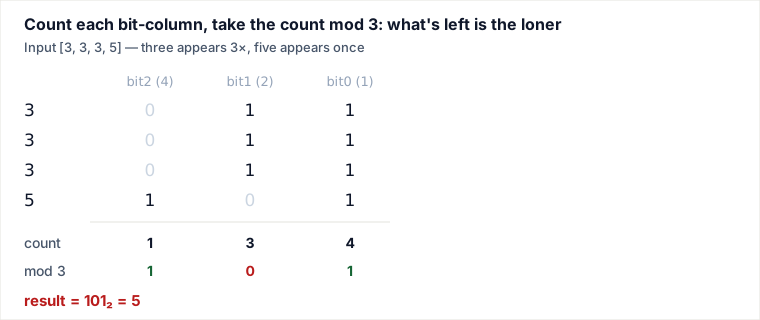
Traced example (counting) — [3, 3, 3, 5]
3 = 011₂, 5 = 101₂. Tally each column, then reduce mod 3:
| column | bits down the array (3,3,3,5) | count of 1s | count mod 3 | loner's bit |
|---|---|---|---|---|
| bit 0 (value 1) | 1, 1, 1, 1 | 4 | 1 | 1 |
| bit 1 (value 2) | 1, 1, 1, 0 | 3 | 0 | 0 |
| bit 2 (value 4) | 0, 0, 0, 1 | 1 | 1 | 1 |
Assemble from the "loner's bit" column, high to low: bit2 bit1 bit0 = 1 0 1 = 101₂ = 5. The three
3s piled up to counts of 4, 3, 0 in the columns; mod 3 those tripled contributions dissolved, exposing
5. (Bit 1 shows why mod-3 — not "count == 1" — is required: its count is 3, which is not 1,
yet it correctly reduces to 0.)
Java: count bits mod 3
class Solution {
    public int singleNumber(int[] nums) {
        int result = 0;
        for (int i = 0; i < 32; i++) {   // Java int is exactly 32 bits
            int sum = 0;
            for (int x : nums) {
                sum += (x >> i) & 1;    // bit i of x, 0 or 1
            }
            if (sum % 3 != 0) {
                result |= (1 << i);      // loner has this bit set
            }
        }
        return result;                   // bit 31 lands in the sign slot, so negatives reconstruct correctly
    }
}
Go: count bits mod 3
package main

import "fmt"

func singleNumber(nums []int) int {
    // Go's int is 64-bit here, so accumulate into an int32 to make bit 31
    // the sign bit exactly as Java's int does; otherwise a negative loner
    // would come back as a large positive (its low 32 bits).
    var result int32 = 0
    for i := 0; i < 32; i++ {
        sum := 0
        for _, x := range nums {
            sum += int((int32(x) >> uint(i)) & 1)
        }
        if sum%3 != 0 {
            result |= 1 << uint(i)
        }
    }
    return int(result)
}

func main() {
    fmt.Println(singleNumber([]int{3, 3, 3, 5})) // 5
}
Approach 2 — the ones/twos state machine (the classic trap)
The counting version does 32 passes conceptually. Can we do it in one pass with two registers? Yes — but this is the version people memorize wrong, so we derive it instead of reciting it.
Think of each bit position as a tiny counter that must cycle 0 → 1 → 2 → 0 as copies
arrive, i.e. a mod-3 counter. Two bits of state can represent three values {0,1,2}. Track them across all
positions at once with two ints:
ones= the set of bit positions currently seen 1 time (mod 3),twos= the set of bit positions currently seen 2 times (mod 3).
A position is never in ones and twos simultaneously (a counter is in exactly one state),
and being in neither means "seen 0 times mod 3". When a new number x arrives, each position it touches
should advance one step. The update that implements the 0→1→2→0 cycle is:
ones = (ones ^ x) & ~twos;   // step positions into/out of "seen once"...
twos = (twos ^ x) & ~ones;   // ...then into/out of "seen twice", using the JUST-updated ones
Why this cycles correctly. Consider a single bit where x has a 1:
- State 0 (not in ones, not in twos):
onesbecomes(0^1)&~0 = 1; thentwosbecomes(0^1)&~1 = 0. Now in ones — state 1. ✓ - State 1 (in ones):
onesbecomes(1^1)&~0 = 0; thentwosbecomes(0^1)&~0 = 1. Now in twos — state 2. ✓ - State 2 (in twos):
onesbecomes(0^1)&~1 = 0; thentwosbecomes(1^1)&~0 = 0. Back to neither — state 0, the third copy erased. ✓
And where x has a 0 at that bit, both updates XOR with 0 and mask, leaving the state unchanged —
exactly right, an absent bit shouldn't advance the counter. After the whole array, every tripled value's bits have
cycled back to state 0; the loner's bits, seen once, sit in ones. Return ones.
The trap: the order matters. twos must use the already-updated ones. Swap the
two lines, or compute both from the old values, and the third-copy reset breaks. This ordering is the single most
common bug people reproduce from memory — derive it, don't recall it.
Traced example (state machine) — [3, 3, 3, 5]
All values in 3-bit binary; ~ shown only over the low 3 bits for readability (the high bits stay 0):
| x | ones before | twos before | ones = (ones^x)&~twos | twos = (twos^x)&~ones |
|---|---|---|---|---|
| 3 = 011 | 000 | 000 | (000^011)&~000 = 011 | (000^011)&~011 = 011&100 = 000 |
| 3 = 011 | 011 | 000 | (011^011)&~000 = 000 | (000^011)&~000 = 011 |
| 3 = 011 | 000 | 011 | (000^011)&~011 = 011&100 = 000 | (011^011)&~000 = 000 |
| 5 = 101 | 000 | 000 | (000^101)&~000 = 101 | (000^101)&~101 = 101&010 = 000 |
After the three 3s, both registers are back to 000 (the triple fully erased). The lone
5 lands in ones = 101₂ = 5. Return ones → 5. Same answer as the
counting method, in one pass.
Java: ones/twos state machine
class Solution {
    public int singleNumber(int[] nums) {
        int ones = 0, twos = 0;
        for (int x : nums) {
            ones = (ones ^ x) & ~twos;   // order matters: update ones first...
            twos = (twos ^ x) & ~ones;   // ...then twos, using the new ones
        }
        return ones;                     // positions seen exactly once (mod 3)
    }
}
Go: ones/twos state machine
package main

import "fmt"

func singleNumber(nums []int) int {
    ones, twos := 0, 0
    for _, x := range nums {
        ones = (ones ^ x) &^ twos // &^ is Go's "AND NOT" (bit clear): ones & ~twos
        twos = (twos ^ x) &^ ones
    }
    return ones
}

func main() {
    fmt.Println(singleNumber([]int{3, 3, 3, 5})) // 5
}
Complexity — both approaches
- Counting mod 3: outer loop 32 (constant number of bit positions), inner loop
n. Time = 32×n = O(32n) = O(n) with a 32× constant factor; space = O(1) (the accumulator). - State machine: a single pass of
niterations, each doing a handful of O(1) bit ops. Time = O(n) with a tiny constant; space = O(1) (two ints). This is the tighter constant — one pass, no per-bit loop.
Both are O(n)/O(1). The state machine is faster in practice (no 32× factor) but harder to get right and to read; the counting method is slower by a constant but self-evidently correct and trivially generalizes to "appears k times."
Judgment layer — which to reach for
- In an interview, lead with counting mod 3. You can derive and defend it on the spot, it obviously generalizes ("for k copies, count mod k"), and it's hard to get wrong. State its O(32n) cost honestly.
- Offer the state machine as the optimization when asked to shave the constant or do it in one pass — but
only if you can derive the update rule live. Reciting it from memory and fumbling the
ones-before-twosordering is worse than not offering it. Deriving it is a strong staff-level signal. - vs. the hash map: if O(n) space is fine, the frequency map is the most readable and the most robust to changing constraints (counts, k copies, multiple loners) — the same judgment as in Single Number I. The bit tricks are the right call specifically when O(1) space is demanded.
- vs. plain XOR: do not reach for the single-XOR fold here — it only cancels pairs. Three copies survive as one copy, so the fold returns noise. Recognizing that XOR fails the moment copies aren't even-counted is the insight this problem is testing.
Edge cases & traps
- Negative loner & integer width. This is the sharp edge. In Java,
intis exactly 32 bits, so loopingi = 0..31and settingresult |= (1 << i)places bit 31 in the sign position — a negative loner reconstructs correctly. In Go,intis 64-bit on modern platforms; the naive 32-bit loop would return a negative loner as its low-32-bit positive image (e.g.-5→4294967291). The fix shown accumulates into anint32so bit 31 is the sign bit, matching Java. The state machine has no such issue — it operates on the full native width uniformly. - Ordering in the state machine. As proven above,
twosmust consume the freshly-updatedones. Reversing the lines silently breaks the third-copy reset. - Overflow in the count.
sumper column is at mostn; for any realisticnit fits anint. No overflow concern here (unlike sum-based approaches to Missing Number).
Takeaways
- XOR cancels pairs, not triples — the moment copies aren't even-counted, you need a mod-k counter.
- Counting bits mod 3 is the derive-on-the-spot answer: O(32n)/O(1), generalizes to any k.
- The ones/twos state machine is the one-pass optimization — correct only if you keep the update order; derive it, never recite it.
- Mind integer width: Java's 32-bit
intreconstructs negatives for free; Go's 64-bitintneeds anint32accumulator.
Both approaches derived from the mod-3 per-column argument; all four samples compiled and hand-traced on [3,3,3,5] → 5, with the negative-loner width trap verified separately ([3,3,3,-5] → -5).
Recognize it: Presence / pairing / parity with XOR and masks → think in bits.
🤖 Don't fully get this? Learn it with Claude
Stuck on Single Number II? Open Claude, copy a block below, and it'll teach you this exact concept — visually and interactively.
Progressively stronger hints — you still solve it.
I'm working on the problem **Single Number II** (DSA). Give me a HINT LADDER: start with the tiniest nudge, then wait. Only reveal the next, stronger hint when I ask. Do NOT show the full solution unless I type 'show solution'. Keep me doing the thinking. If you're unsure or a claim isn't standard, say so and reason from first principles instead of guessing.
See the technique, not just code.
Explain the optimal approach to **Single Number II** with a VISUAL walkthrough: trace it on a small concrete example using ASCII art / a step-by-step diagram, narrate what changes each step, then give time & space complexity with a one-line derivation. If you're unsure or a claim isn't standard, say so and reason from first principles instead of guessing.
Catch bugs, edge cases, sub-optimality.
I'll paste my solution to **Single Number II**. Review it for correctness, missed edge cases, and time/space complexity, then coach me toward the optimal — don't just rewrite it. Ask me to paste my code now. If you're unsure or a claim isn't standard, say so and reason from first principles instead of guessing.
Lock in recognition with look-alikes.
Give me 2 problems that use the SAME underlying pattern as **Single Number II**. For each, let me attempt first, then review my answer and name the trigger signal that reveals the pattern. If you're unsure or a claim isn't standard, say so and reason from first principles instead of guessing.