medium Single Number III
Single Number III
Third turn of the screw. In Single Number one value was unpaired; in Single Number II the
duplicates came in threes. Here we are back to duplicates in pairs, but two values appear exactly once
instead of one: every value appears exactly twice, except two values that each appear once. Return those
two (order doesn't matter), in O(n) time and O(1) space. Example:
[1, 2, 1, 3, 2, 5] → [3, 5].
A single XOR fold got us the loner last time. Fold this array and you don't get an answer — you get
a ^ b, the two loners smeared together (every doubled value still cancels). That is not nothing:
it is half the solution, and the other half is a trick you already have — x & -x to
isolate one bit. This page is where XOR cancellation and lowest-set-bit isolation click together.
Naive baseline & its cost
A hash map from value → count, then return the two keys whose count is 1: O(n) time, O(n) space. Correct, obvious, and exactly what you'd ship. The whole exercise is keeping the O(n) time while crushing space to O(1) — and doing it without knowing the two answers up front.
The insight, in two moves
Move 1 — fold to a ^ b. XOR the entire array into one accumulator. Every value that
appears twice contributes v ^ v = 0 and vanishes; the two loners a and b
each appear once and survive. What's left is exactly xorAll = a ^ b. We can't read a
and b out of their XOR directly — but this combined value is a map of where they differ:
recall a XOR is 1 in exactly the bit positions where its two operands disagree.
Move 2 — find one bit where they differ, and use it to separate them. The two loners are distinct
(a ≠ b), so xorAll ≠ 0: it has at least one set bit, and every set bit marks a
position where a and b have opposite values. Pick any one such bit. The cleanest
choice is the lowest set bit, isolated with the two's-complement identity from the tricks page:
diff = xorAll & -xorAll // keeps only the lowest set bit of xorAllWhy x & -x isolates the lowest set bit (the proof, compact): -x = ~x + 1.
Below the lowest set bit, x is all zeros, so ~x is all ones there; the +1
ripples through those ones, flipping them back to zero and carrying into the lowest-set-bit position, which
becomes 1. Every bit above is ~x's inversion, untouched by the carry — so it is the opposite of
x there. AND-ing x with -x keeps only the one position where both are 1:
the lowest set bit. Nothing else survives.
Why splitting on that bit finishes the job
Partition the array into two groups: numbers with diff's bit set, and numbers without it. Two
facts make this a clean win:
- The two loners land in different groups. At the
diffbit,aandbdisagree (that's why the bit is set ina ^ b) — so exactly one of them has the bit, the other doesn't. They are separated. - Every doubled value stays whole inside one group. A value's two identical copies have identical bits,
so they test the same on the
diffbit and fall in the same group — where they XOR to 0 and disappear.
So within each group, all the pairs cancel and exactly one loner remains. XOR-fold each group and you read off
a and b separately. In code you only need to fold one group to get a; the
other is free, because b = xorAll ^ a (we already know a ^ b).
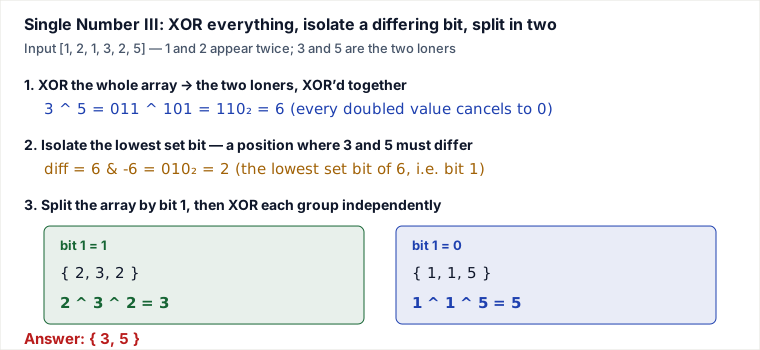
Traced worked example — [1, 2, 1, 3, 2, 5]
Pass 1 — XOR everything into xorAll (3-bit binary; start at 0):
| step | element | element (bin) | xorAll after (bin) | (dec) |
|---|---|---|---|---|
| start | — | — | 000 | 0 |
| 1 | 1 | 001 | 001 | 1 |
| 2 | 2 | 010 | 011 | 3 |
| 3 | 1 | 001 | 010 | 2 |
| 4 | 3 | 011 | 001 | 1 |
| 5 | 2 | 010 | 011 | 3 |
| 6 | 5 | 101 | 110 | 6 |
xorAll = 110₂ = 6 = 3 ^ 5. The two 1s and two 2s cancelled along the
way; only 3 ^ 5 is left.
Isolate the low bit: diff = 6 & -6. In bits, 6 = 110 and
-6 = …11111010, so 110 & …010 = 010₂ = 2 — bit 1.
Pass 2 — partition on bit 1 (x & 2) and fold the group where the bit is set:
| element | bin | x & 2 | group | running a (bit-set group) |
|---|---|---|---|---|
| 1 | 001 | 0 | bit 1 = 0 | — |
| 2 | 010 | 2 | bit 1 = 1 | 0 ^ 2 = 2 |
| 1 | 001 | 0 | bit 1 = 0 | — |
| 3 | 011 | 2 | bit 1 = 1 | 2 ^ 3 = 1 |
| 2 | 010 | 2 | bit 1 = 1 | 1 ^ 2 = 3 |
| 5 | 101 | 0 | bit 1 = 0 | — |
The bit-set group is {2, 3, 2}; its two 2s cancel, leaving a = 3. Then
b = xorAll ^ a = 6 ^ 3 = 5. (Sanity check: the other group {1, 1, 5} XORs to
1 ^ 1 ^ 5 = 5 — same b, confirming the shortcut.) Answer [3, 5].
Java: XOR fold, isolate, split
class Solution {
    public int[] singleNumber(int[] nums) {
        int xorAll = 0;
        for (int x : nums) xorAll ^= x;   // pass 1: collapses to a ^ b

        int diff = xorAll & -xorAll;      // lowest set bit: a and b differ here

        int a = 0;
        for (int x : nums) {
            if ((x & diff) != 0) a ^= x;  // pass 2: fold only the bit-set group
        }
        int b = xorAll ^ a;               // the other loner falls out for free
        return new int[]{a, b};
    }
}
Go: XOR fold, isolate, split
package main

import "fmt"

func singleNumber(nums []int) []int {
    xorAll := 0
    for _, x := range nums {
        xorAll ^= x // pass 1: collapses to a ^ b
    }

    diff := xorAll & -xorAll // lowest set bit: a and b differ here

    a := 0
    for _, x := range nums {
        if x&diff != 0 {
            a ^= x // pass 2: fold only the bit-set group
        }
    }
    b := xorAll ^ a // the other loner falls out for free
    return []int{a, b}
}

func main() {
    fmt.Println(singleNumber([]int{1, 2, 1, 3, 2, 5})) // [3 5]
}
Complexity — derived from the code
Two passes over n elements, each iteration a couple of O(1) bit ops; the diff
computation is O(1). Total time = O(n) (two linear passes, no nesting). We hold four ints
(xorAll, diff, a, b) regardless of input size, so
space = O(1). That matches the hash map on time and beats it on space (O(1) vs O(n)), and beats a
sort (O(n log n)).
Judgment layer — when this trick, and when the hash map
- Reach for the XOR +
x & -xsplit when the structure is exactly "all values twice except two" and O(1) space is demanded. It is the canonical staff-signal answer: it shows you can chain XOR cancellation with lowest-set-bit isolation, the two ideas the whole module has been building toward. - Prefer the hash map / frequency count when the constraints are fuzzier or likely to shift: more than two loners, or values that repeat a variable number of times, or you must also report the counts, or the inputs aren't XOR-able integers. The map handles every variant with a trivial edit; this trick handles none of them — it is exquisitely tuned to the "twice-except-two" promise and breaks the instant that promise weakens. In an interview, state the map baseline first ("O(n) space, obviously correct"), then offer this as the O(1)-space refinement and explain why the split works — that reasoning is the actual signal.
- The trade you are making: the bit approach buys O(1) space and elegance at the cost of being brittle and needing a careful correctness argument; the hash map costs O(n) space but is general, readable, and robust. Match the tool to how firm the "twice-except-two" guarantee really is.
- vs. plain single-XOR (Single Number I): one fold isn't enough here — it only yields
a ^ b. Recognizing that the fold is a starting point, not the answer, and that a differing bit re-splits the problem into two independent Single-Number-I subproblems, is exactly what this problem tests.
Edge cases & traps
xorAllcan never be 0. The two loners are distinct, soa ^ b ≠ 0anddiffalways isolates a real bit. If the problem allowed the two uniques to be equal, the split would have no bit to key on — but then they'd be a pair, contradicting the premise.- Any differing bit works; lowest is just convenient.
x & -xpicks the lowest set bit, but partitioning on any set bit ofxorAllseparatesaandbcorrectly. The lowest is chosen only because it is a one-liner to isolate. - Negative numbers are fine. XOR and
x & -xoperate on the raw two's-complement bits, so negative loners split and reconstruct correctly — the group membership testx & diffonly inspects a single bit and never cares what the value "means". The one pedantic corner isxorAll == Integer.MIN_VALUE(bit 31 alone set):-xorAlloverflows back to itself, butx & -xthen equalsx, which is that single set bit — so it still isolates correctly. - Return order is immaterial. Which loner is called
adepends on which one carries thediffbit; the problem accepts the pair in either order. - Don't fold the wrong group into
b. Usingb = xorAll ^ ais the clean move; if you instead fold the second group explicitly, make sure you test(x & diff) == 0, not a re-use of the first condition.
Takeaways
- Fold the array →
xorAll = a ^ b: the doubles cancel, the two loners smear together. xorAllmarks every bit where the loners differ;diff = xorAll & -xorAllgrabs one such bit (the lowest).- Splitting on that bit sends
aandbto different groups while keeping each pair intact, turning the problem into two independent Single-Number-I folds — andb = xorAll ^ asaves the second fold. - O(n) time, O(1) space. Reach for it only when "twice-except-two" is guaranteed and O(1) space matters; otherwise the hash map is the more robust engineering call.
Authored from the XOR-cancellation and two's-complement x & -x proofs; both samples
compiled and hand-traced on [1,2,1,3,2,5] → [3,5] (xorAll=6, diff=2, groups
{2,3,2}→3 and {1,1,5}→5).
Recognize it: Presence / pairing / parity with XOR and masks → think in bits.
🤖 Don't fully get this? Learn it with Claude
Stuck on Single Number III? Open Claude, copy a block below, and it'll teach you this exact concept — visually and interactively.
Progressively stronger hints — you still solve it.
I'm working on the problem **Single Number III** (DSA). Give me a HINT LADDER: start with the tiniest nudge, then wait. Only reveal the next, stronger hint when I ask. Do NOT show the full solution unless I type 'show solution'. Keep me doing the thinking. If you're unsure or a claim isn't standard, say so and reason from first principles instead of guessing.
See the technique, not just code.
Explain the optimal approach to **Single Number III** with a VISUAL walkthrough: trace it on a small concrete example using ASCII art / a step-by-step diagram, narrate what changes each step, then give time & space complexity with a one-line derivation. If you're unsure or a claim isn't standard, say so and reason from first principles instead of guessing.
Catch bugs, edge cases, sub-optimality.
I'll paste my solution to **Single Number III**. Review it for correctness, missed edge cases, and time/space complexity, then coach me toward the optimal — don't just rewrite it. Ask me to paste my code now. If you're unsure or a claim isn't standard, say so and reason from first principles instead of guessing.
Lock in recognition with look-alikes.
Give me 2 problems that use the SAME underlying pattern as **Single Number III**. For each, let me attempt first, then review my answer and name the trigger signal that reveals the pattern. If you're unsure or a claim isn't standard, say so and reason from first principles instead of guessing.