Design a Distributed Rate Limiter
Design a Distributed Rate Limiter
You already built a rate limiter that is correct on one box: a single lock guards a single token bucket, and the tests prove it holds under concurrency. Ship that exact class to a fleet of app servers behind a load balancer and it quietly stops doing its job — each instance enforces the limit against its own traffic only, and the limit you promised the business ("100 requests/second per client") turns into something nobody agreed to. This is the escalation every senior candidate is expected to make unprompted: local correctness does not imply global correctness the moment you have more than one process. This lab is the HLD worksheet version of that escalation — no code kata, a design workshop with a model answer and a rubric, exactly like the room you'll sit in.
1. The Trap — per-node limits don't add up to the number you promised
Take the token-bucket class from the LLD kata and deploy 10 identical copies, one per app server, each configured with "100 requests/second per client." A load balancer round-robins each client's requests evenly across the 10 nodes. Trace what actually happens to one client hammering the API as fast as it can for one second:
- Node 1 sees ~1/10th of that client's traffic — comfortably under its local 100/s cap, so it admits all of it.
- Nodes 2 through 10 each see the same — and each, independently, has no idea the other nine exist.
- Every node admits up to 100/s of its own share. Summed across the fleet: up to 10 × 100 = 1,000 requests/second reach the backend for a single client — ten times the limit you designed for, with every individual node behaving exactly as coded and every individual test passing.
Nothing is "broken" in the code sense — the bug is architectural. A limit enforced independently by N cooperating-but-unaware processes is not a global limit; it's N separate local limits that happen to share a number. The trap widens with fleet size: at 200 nodes the same "100/s" config now permits ~20,000/s. This is the gap between an LLD kata (prove one process is correct) and an SD lab (prove a system of processes is correct) — and it's exactly the "what changes when there's more than one machine" question interviewers use to separate junior from senior answers.
2. Scope it like a senior
Before reaching for Redis, pin down what "correct" means here — the wrong assumption on any of these silently reshapes the whole design:
- Global or per-node? If the product requirement really is "100/s per node is fine," you're done — ship the LLD kata as-is. Assume the interviewer means a true fleet-wide, per-client limit (the interesting case, and the one asked for here).
- Exact or approximate? Does the business care if a client occasionally gets 105/s instead of 100/s during a failover, or is this a hard contractual/billing quota that must never be exceeded? This single answer decides between "centralized exact" and "local + approximate" later.
- Granularity. Per API key? Per user? Per IP? Per (user, endpoint) pair? Each is a different key in the data model — ask before designing the schema.
- Latency budget. A synchronous network hop to a shared store adds real latency (~0.5–2ms same-datacenter, much more cross-region). Is that acceptable on the hot path, or does the limiter need to be effectively free?
- Fail-open or fail-closed? If the shared state store is unreachable, do you let all traffic through (protect availability, risk overload) or block all traffic (protect the backend, risk a false outage)? This can differ per endpoint.
- Scale. What's peak fleet-wide QPS, and how many distinct client keys? This drives the BOTE math in movement 4 — don't skip asking it.
- Multi-region? Is the fleet in one datacenter or spread globally? (Flag it now, defer the full answer to Multi-Region Rate Limiting in movement 7 — don't let it derail the core design first.)
For the rest of this lab: global exact-enough limit, per-client-key granularity, a shared network hop is acceptable, fail-open for general endpoints, fail-closed for sensitive ones, single-region first (multi-region is the movement-7 escalation).
3. Reason to the design
Simplest thing that could work: keep the per-node token bucket from the LLD kata, unchanged. It fails immediately — that's the trap in movement 1. The bug isn't in the bucket; it's that N independent buckets can never sum to one global number without talking to each other.
Next idea: sticky routing. Hash each client key to exactly one node (consistent hashing at the load balancer), so that client's whole quota lives on one bucket again. This actually works for the accuracy problem — but it trades one bug for three new ones: (a) a hot client key now overloads exactly one node instead of spreading load, (b) that node restarting or being redeployed silently resets or loses the bucket's state, and (c) it doesn't survive a multi-region fleet, where "one node" might not even be reachable from every region. Good instinct, wrong layer — the state needs to live somewhere shared, not be pinned to a single compute node.
Centralize the state. Move the counter out of the app process entirely into a fast shared store all nodes can reach — Redis is the standard choice (sub-millisecond, single-threaded execution model, built-in TTL). Every node, on every request, does one round trip: "increment this client's counter, tell me if it's still under the limit."
The race that centralizing alone doesn't fix. Naively that round trip looks like GET count; if count < limit: SET count+1; allow — two separate Redis calls with a decision made by the app in between. Two requests for the same client arriving within microseconds of each other can both GET the same count (say 99, with limit 100), both decide "under limit," and both SET — two requests admitted when only one slot remained. Centralizing the state didn't remove the race, it just moved it from "across nodes" to "across concurrent connections to the same node's data." This is a classic check-then-act (TOCTOU) bug.
The core mechanism: make the check-and-increment one atomic operation. Redis is single-threaded for command execution, so any single command — or any Lua script run via EVAL — runs to completion with no other client's command interleaved. Do the increment and the comparison inside one EVAL, and the race in the previous paragraph becomes structurally impossible: there is no gap between "read" and "write" for another request to land in. That one property — one atomic round trip per request — is the entire design. Everything from here (movement 4) is about making that round trip cheap enough and available enough at real scale. (Background on the algorithm menu — token bucket vs sliding window vs fixed window — is covered in Rate Limiting Algorithms; this lab assumes you know the algorithms and focuses on the distributed-systems problem of sharing one.)
4. Build it — the design worksheet
This is the movement an LLD kata would spend on dual Java+Go code. A distributed-systems design lab spends it on a worksheet instead: pin the requirements, do the arithmetic, sketch the API and data model, draw the path, then show the one artifact that has to be exactly right — the atomic script.
a) Requirements (from movement 2)
- Functional: given a client key and a cost (default 1), atomically decide allow/reject against a fleet-wide limit; support independent limits per client key.
- Non-functional: add <5ms p99 to the request path; survive a single Redis node failure with no more than a few seconds of degraded (not incorrect) behavior; scale to the traffic BOTE below without re-architecting.
- Non-goals (say these out loud): per-request billing reconciliation, exact accounting across region failover, and supporting more than ~2× burst above the steady limit — those get named as future extensions, not solved here.
b) Back-of-envelope estimation — arithmetic visible
- Scale target: 1,000,000 requests/second peak, fleet-wide, across 5,000,000 distinct client keys.
- Naive Redis ops/sec: one
EVALper request, unbatched → 1,000,000 ops/sec. - Redis single-shard capacity: a Lua
EVALcosts more than a bareGET/SET(script dispatch overhead) — plan for ~60,000 ops/sec per shard, not the ~100k–150k you'd budget for plain commands. - Shards needed (unbatched): 1,000,000 ÷ 60,000 ≈ 17 → round up to 20 shards for headroom, each with a primary + replica → 40 Redis nodes.
- Memory: 5,000,000 keys × ~80 bytes (key + integer counter + TTL bookkeeping) ≈ 400MB total — ~20MB/shard. Trivial; this design is CPU/ops-bound, not memory-bound.
- Cut the ops with local batching: instead of one
EVALper request, each node claims a local mini-budget from Redis every N requests (e.g. "give me 20 tokens for this client") and spends it locally between claims. At a batch size of 20: real Redis load drops to 1,000,000 ÷ 20 = 50,000 ops/sec — now a single well-provisioned shard could carry it, though you still keep several shards for hot-key isolation and HA (movement 4d, 4g).
Batching is the lever every strong answer reaches for once the naive number looks too big — and it's exactly what the "how many Redis ops at 1M QPS" pushback in movement 7 is testing whether you'll find unprompted.
c) API sketch
This is an internal middleware/library call, not a client-facing endpoint. Two levels worth sketching:
// Library-level, called from the app-node request pipeline
boolean allow(String clientKey, int cost)   // cost > 1 for expensive endpoints

// Wire-level, if the limiter is its own service (mirrors Envoy's ext_authz-style shape)
POST /v1/ratelimit:check
{ "domain": "api-gateway", "descriptors": [{ "key": "client_id", "value": "abc123" }] }
→
{ "overallCode": "OK" | "OVER_LIMIT", "limitRemaining": 42, "resetAfterSeconds": 1 }
d) Data model & partitioning
- Key:
rl:{clientKey}:{windowId}wherewindowId = floor(unixTimeSeconds / windowSeconds)— a fixed window per client per time bucket. - Value: a single integer counter, set with a TTL of
windowSecondson first increment so the key self-expires exactly at the window boundary — no cleanup job needed. - Partitioning: shard by
hash(clientKey)across Redis Cluster hash slots. Every operation for a given key is a single-keyEVAL, so there's never a cross-slot multi-key transaction to worry about — this data model was chosen specifically so partitioning is free.
e) High-level diagram
The path every request takes, and the one artifact — the Lua script — that makes it correct under concurrency:
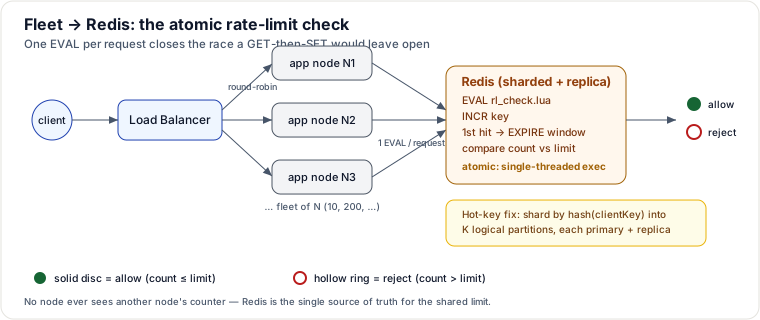
f) The atomic artifact — the Lua script
This is the piece that closes the race from movement 3. It is not "a nice-to-have" — it is the entire design:
-- KEYS[1] = rl:{clientKey}:{windowId}
-- ARGV[1] = limit          e.g. 100
-- ARGV[2] = windowSeconds  e.g. 1

local count = redis.call("INCR", KEYS[1])
if count == 1 then
    -- first hit in this window: arm the TTL so the key self-expires
    redis.call("EXPIRE", KEYS[1], ARGV[2])
end

if count > tonumber(ARGV[1]) then
    return 0   -- reject
else
    return 1   -- allow
end
INCR and the comparison happen inside one EVAL, which Redis's single-threaded execution model runs to completion with zero interleaving from any other client's command. There is no separate GET, so there is no gap for a second request to read a stale count — the exact bug traced in movement 3 and re-run as a failing test in movement 5. (An INCR+EXPIRE pair called as two separate commands would reopen a smaller race — a crash between them leaves a key with no TTL. The script is the unit of atomicity, not the individual commands.)
g) Bottlenecks & scaling
- Hot key / SPOF. One viral client key hashes to exactly one shard — that shard now carries a disproportionate share of the fleet's traffic no matter how many shards you provision. See Rate-Limit Hot Keys for the full treatment; the two levers are (1) the local-batching trick from 4b, which cuts that key's Redis traffic by the batch factor, and (2) splitting one logical counter into K physical sub-counters summed at read time, trading a small amount of over-admission for spreading the write load.
- Replication for HA. Every shard is primary + replica; on primary failure, promote the replica. There is a short window where a few writes during failover may be lost (replica lag), meaning the counter briefly under-counts — acceptable for abuse protection, not acceptable if this were a hard billing quota (flagged as a non-goal in 4a for exactly this reason).
- Redis unreachable entirely. Wrap the call in a circuit breaker. Fail-open with a tightened local per-node fallback budget (roughly
globalLimit / fleetSize, biased conservative) for general endpoints — protect availability. Fail-closed for endpoints where under-protection is the worse outcome (password reset, payment initiation).
Rubric — what a strong answer hits
- States the trap explicitly and quantifies the overshoot with real numbers (not "it might not work right").
- Picks one shared source of truth for the counter and justifies why (exactness requirement from movement 2), rather than jumping straight to "just use Redis" with no reasoning.
- Names the atomic primitive (Lua
EVAL/ a single-commandINCR) and can explain precisely which race it closes — not just "atomic operations are safer." - Runs a real BOTE: QPS → Redis ops/sec → shard count → memory, with the arithmetic visible, the way movement 4b does.
- Identifies hot-key and SPOF as the two real bottlenecks (not "just add more Redis") and gives concrete, named mitigations.
- Produces a trade-off table against at least one named alternative — not a vague "it depends."
- Has an explicit, justified fail-open vs fail-closed decision, and knows it can differ per endpoint.
- Names what changes at 10× and 100× scale rather than assuming the movement-4 design is the final answer forever (movement 7).
Model answer: compare your worksheet against Designing an API Rate Limiter, the existing guide page that walks the full RESHADED treatment for this exact problem — use it to check what you missed, not as a first read.
5. Break it — run the design as a test and watch it fail
Design flaw 1 — the naive per-node counters (movement 1), as a test. Fire 1,000 requests for one client key in one second, round-robin across a 10-node fleet, each node locally capped at 100/s. Expected result if the limit were real: ≤100 admitted. Actual result with independent per-node buckets: each node sees ~100 of its own share and admits all of it before any node individually hits its cap — up to 1,000 admitted, 10× over budget. Every node's unit test still passes; the fleet-level test is the one that catches it. This is the design-lab equivalent of "remove the lock and watch the concurrency test fail" from the LLD kata — except here the missing ingredient isn't a mutex, it's shared state.
Design flaw 2 — the non-atomic GET-then-SET, even with centralized state. Centralizing the counter in Redis is necessary but not sufficient. Trace two concurrent requests for the same client at count=99, limit=100:
- Request A:
GET count→ 99. Checks 99 < 100 → decides "allow." - Request B arrives microseconds later, before A's
SETlands:GET count→ still 99 (A hasn't written yet). Checks 99 < 100 → also decides "allow." - Both A and B now
SET count = 100. Two requests admitted when exactly one slot remained — an immediate overshoot of 1, and under real concurrency at the boundary (thousands of near-simultaneous requests for a popular key), this compounds into a meaningful overshoot, not just an off-by-one.
The fix, traced against the same scenario: replace the two-call GET-then-SET with the single EVAL from movement 4f. Request A's INCR runs to completion (count → 100, allowed) before Redis's single-threaded loop even looks at Request B's command. B's INCR then sees count → 101, which is > limit → rejected. Same two concurrent requests, same timing — correct outcome, because there is no longer a gap between the read and the write for B to sneak into.
6. Optimise — with trade-offs
The Lua-EVAL design in movement 4 is the "centralized exact" point on a spectrum. A strong answer names the neighboring points and says explicitly why it picked one:
| Approach | Accuracy | Added latency | State cost | Best for |
|---|---|---|---|---|
Centralized exact (Redis INCR+EXPIRE via Lua) | Exact, fleet-wide | +1 round trip (~0.5–2ms same-DC) | O(1) per key | Hard quotas, abuse protection where exactness matters, this lab's baseline |
| Local-approximate (per-node token bucket + periodic global-budget sync) | Approximate, error bounded by fleet-size × sync-interval | 0 — fully local | O(1) per node per key | QPS too high for a synchronous round trip; slight overshoot tolerable (general DoS protection) |
Sliding-window-log (Redis sorted set: ZADD+ZREMRANGEBYSCORE+ZCARD) | Exact, no fixed-window boundary burst | Higher — 3 ops vs 1 | O(requests in window) per key — expensive at high per-key rate | Strict smoothing requirements, moderate per-key QPS |
| Token-bucket-in-Redis (GCRA / redis-cell) | Exact, smooth, burst-aware | Similar to the Lua fixed-window script | O(1) per key — single timestamp, no counter reset logic | Production APIs wanting burst tolerance and centralized exactness — often the real production answer once you'd otherwise reach for fixed-window |
| In-memory gossip / no central store (e.g. Envoy local limits + periodic peer sync) | Eventually-consistent, approximate | 0 — synchronous cost is zero | O(1) per node | Scale where even a sharded Redis can't keep up (see "100×" in movement 7) |
The fixed-window Lua script earns its place on this page because it's the simplest thing that teaches the atomicity requirement cleanly — in a real production system, GCRA/token-bucket-in-Redis is usually the better default once you'd otherwise reach for fixed-window, because it removes the fixed-window boundary-burst problem (up to 2× limit right at a window edge) for the same O(1) state cost.
7. Defend under drilling
Q1 — "What happens when Redis is down?"
A circuit breaker trips after N consecutive failures/timeouts. For general endpoints: fail-open onto a conservative local per-node budget (globalLimit / fleetSize, biased down) — some accuracy is lost but the service stays up. For sensitive endpoints (auth, payments): fail-closed — reject rather than risk unbounded load with zero protection. This is a per-endpoint policy decision, not one global answer, and saying so is the point.
Q2 — "One client key just went viral and every check for it hits the same shard — now what?"
That's the hot-key bottleneck from 4g. Two concrete levers: local batching (claim a mini-budget of tokens per Redis call instead of one call per request, cutting that key's Redis load by the batch factor) and splitting the logical counter into K physical sub-counters summed at read time, trading a bounded amount of over-admission for spreading the write load off a single shard. See Rate-Limit Hot Keys for the full derivation.
Q3 — "Does clock skew across nodes break this?"
No — and that's a direct consequence of centralizing the state. Redis is the sole authority on "which window is this," computed server-side inside the Lua script; app nodes never need synchronized clocks because none of them decide the window boundary locally. Clock skew only becomes a live concern if you fall back to the local-approximate design (movement 6), where each node's own clock drives its local bucket — there, skew affects how evenly each node's share of the budget refills, not global correctness.
Q4 — "When is exact wrong to insist on?"
When the QPS math (4b) says exact costs more round trips than you can afford, and the business impact of a client occasionally getting 105/s instead of 100/s is negligible — abuse protection and DoS mitigation, not billing. Insisting on exact everywhere is itself a design smell if it forces an architecture (a synchronous call on every single request) that can't hit the latency or throughput target.
Q5 — "At 1M QPS fleet-wide, how many Redis operations per second, and how do you keep that from being a wall?"
Naively: 1M ops/sec, one EVAL per request (4b, step 2). Batching tokens locally in groups of 20 cuts that to 50,000 ops/sec (4b, step 6) — well within one well-provisioned shard's headroom, with several shards kept anyway for hot-key isolation and HA rather than raw throughput.
Escalation — what breaks at 100× (100M QPS)? Even with 20:1 batching that's 5,000,000 Redis ops/sec — on the order of 100 shards just for throughput, which starts to make cross-shard hot-key skew and replica-lag-during-failover materially worse, not just theoretically possible. At this scale the honest answer shifts: stop insisting on synchronous-exact everywhere and move the bulk of enforcement to the local-approximate or gossip model (movement 6's rightmost rows), reserving the centralized-exact Redis path only for the subset of endpoints (Q4) that actually need it. This is also where multi-region enters for real — a single Redis Cluster stops being "just add shards" once nodes span regions with real network latency between them; see Multi-Region Rate Limiting for how that changes the design (per-region local limiters with async global reconciliation, rather than one global synchronous store).
The pairs_with move: if you're asked this cold in an interview, say the LLD-to-HLD escalation out loud — "single-process token bucket (build it first) is correct but doesn't survive more than one machine; here's what changes and why" — that's exactly the arc this lab walked movements 1 through 4.
8. You can now defend
- You can state — with real numbers — exactly why independent per-node limits multiply instead of summing to the intended global limit, instead of hand-waving "it might not be consistent."
- You can design and defend the atomic primitive (a single Redis
EVAL) and trace precisely which race a naive GET-then-SET leaves open, even after the state is already centralized. - You can run a real back-of-envelope from target QPS through Redis ops/sec, shard count, and memory, with every step's arithmetic visible — and find the batching lever that turns an infeasible number into a comfortable one.
- You can name concrete bottleneck mitigations (hot-key sharding, replica failover, per-endpoint fail-open/closed policy) and produce a trade-off table against named alternatives (local-approximate, sliding-window-log, GCRA, gossip) instead of "it depends."
Re-authored/Deepened for this guide.
🤖 Don't fully get this? Learn it with Claude
Stuck on Design a Distributed Rate Limiter? Open Claude, copy a block below, and it'll teach you this exact concept — visually and interactively.
Build the mental picture, not memorization.
I just read a lesson on **Design a Distributed Rate Limiter** (Hands-On Builds) and want to truly understand it. Explain Design a Distributed Rate Limiter from first principles using ONE vivid real-world analogy and a visual mental model — draw it as ASCII art or a clear step-by-step diagram — with a concrete example using real numbers. Then ask me one question to check I got the mental picture, and wait for my reply. If you're unsure or a claim isn't standard, say so and reason from first principles instead of guessing.
Socratic — adapts to where you're stuck.
Teach me **Design a Distributed Rate Limiter** interactively. Ask me ONE guiding question at a time, wait for my answer, and adapt to my confusion — build the idea with me step by step instead of explaining it all at once. If you're unsure or a claim isn't standard, say so and reason from first principles instead of guessing.
Active recall exposes what you missed.
Quiz me on **Design a Distributed Rate Limiter** with 5 questions, easy to tricky, ONE at a time. Tell me if each answer is right; at the end, explain clearly what I got wrong and why. If you're unsure or a claim isn't standard, say so and reason from first principles instead of guessing.
Intuition + hook + flashcards for long-term memory.
Help me remember **Design a Distributed Rate Limiter** for the long term: give the one-sentence intuition, a memorable hook/mnemonic, a tiny worked example, and 3 active-recall flashcards (Q -> A). If you're unsure or a claim isn't standard, say so and reason from first principles instead of guessing.