Introduction (2)
Structural Patterns
Structural Design Patterns are the type of design patterns that help to combine small objects and entities to create complex and larger structures. Thus making the entities flexible and efficient. By using an adapter pattern, you can:
- Simplify the complex structures.
- Promotes the reusability of code
- Improves flexibility by decoupling classes and objects
- The clear structure and entity relationships enhance maintainability and simplify modification.
Types of Structural Design Patterns
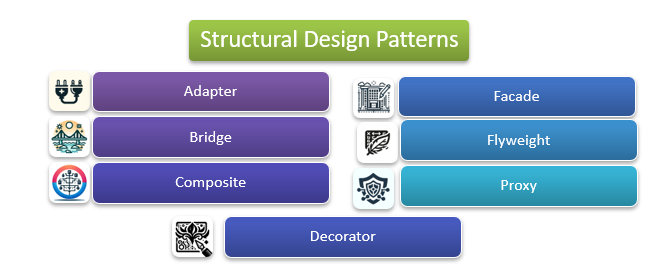
When it comes to types of structural design patterns, there are many types, but some of the common ones that developers frequently use are:
- Adapter
- Bridge
- Composite
- Decorator
- Facade
- Flyweight
- Proxy
🤖 Don't fully get this? Learn it with Claude
Stuck on Introduction (2)? Open Claude, copy a block below, and it'll teach you this exact concept — visually and interactively.
🎨 Explain it visually
Build the mental picture, not memorization.
I just read a lesson on **Introduction (2)** (OO & Low-Level Design) and want to truly understand it. Explain Introduction (2) from first principles using ONE vivid real-world analogy and a visual mental model — draw it as ASCII art or a clear step-by-step diagram — with a concrete example using real numbers. Then ask me one question to check I got the mental picture, and wait for my reply. If you're unsure or a claim isn't standard, say so and reason from first principles instead of guessing.
🤔 Walk me through it (interactive)
Socratic — adapts to where you're stuck.
Teach me **Introduction (2)** interactively. Ask me ONE guiding question at a time, wait for my answer, and adapt to my confusion — build the idea with me step by step instead of explaining it all at once. If you're unsure or a claim isn't standard, say so and reason from first principles instead of guessing.
🧪 Quiz me & fix my gaps
Active recall exposes what you missed.
Quiz me on **Introduction (2)** with 5 questions, easy to tricky, ONE at a time. Tell me if each answer is right; at the end, explain clearly what I got wrong and why. If you're unsure or a claim isn't standard, say so and reason from first principles instead of guessing.
🧠 Make it stick
Intuition + hook + flashcards for long-term memory.
Help me remember **Introduction (2)** for the long term: give the one-sentence intuition, a memorable hook/mnemonic, a tiny worked example, and 3 active-recall flashcards (Q -> A). If you're unsure or a claim isn't standard, say so and reason from first principles instead of guessing.