Applications of Bloom Filters
Applications of Bloom Filters
Imagine your database holds 500 million records and 90% of the lookups your service receives are for keys that don't exist — bots probing random usernames, cache-miss floods, requests for deleted rows. Each of those doomed lookups still pays the full cost: a disk seek, an index walk, maybe a network round-trip to a storage node. You burn expensive I/O just to learn "nope, not here."
A Bloom filter is a tiny, probabilistic gatekeeper that answers one narrow question extremely cheaply: "is this key definitely not in the set, or possibly in it?" It never says a false "no." It sometimes says a false "yes." That asymmetry is the whole trick — you use it to skip work you can prove is pointless, and only fall back to the real, expensive check when the filter says "possibly." It trades a small, tunable error rate for enormous savings in memory and I/O.
How it works, precisely
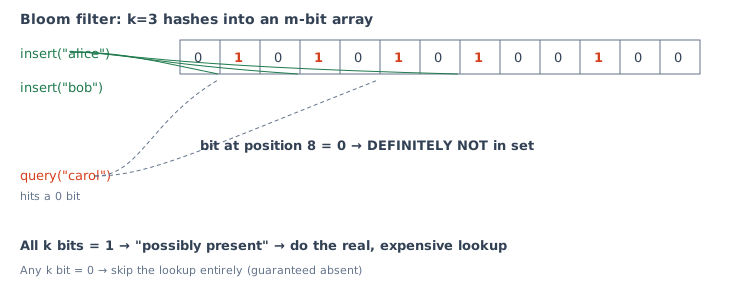
A Bloom filter is a bit array of length m (all zeros initially) plus k independent hash functions, each mapping a key to a position in [0, m).
- Insert(x): compute
h1(x), h2(x), … hk(x)and set thosekbits to 1. - Query(x): compute the same
kpositions. If any bit is 0,xis definitely not in the set (no false negatives — you can never have set the bit and then read it as 0). If allkbits are 1,xis probably in the set — but those bits may have been set by other keys colliding, giving a false positive.
There are no per-element buckets and no stored keys, so it can't enumerate its contents and (in the classic form) can't delete. The false-positive probability after inserting n items is approximately (1 − e^(−kn/m))^k. For a target error rate p, the optimal sizing is m = −(n · ln p) / (ln 2)² and k = (m/n) · ln 2. The headline result: about 9.6 bits per element for a 1% false-positive rate, and roughly 4.8 more bits for each 10× reduction in p — independent of how large the keys themselves are.
A concrete scenario: LSM-tree databases
This is the killer application, used in Cassandra, RocksDB, LevelDB, HBase, and Bigtable. An LSM-tree stores data in many immutable, sorted files on disk called SSTables. A single key could live in any of them, so a naive point-read for a missing key would have to touch every SSTable — each touch being a disk seek. With 10 SSTables, a missing key costs ~10 seeks.
The fix: each SSTable ships with a Bloom filter over the keys it contains, held in RAM. On a read, the engine checks the in-memory filter first. If it says "definitely not here," the SSTable is skipped with zero disk I/O. Only the filters that say "possibly" trigger an actual seek.
Numbers. Say each SSTable has 5,000,000 keys and you size for p = 1%. Memory: 5M × 9.6 bits ≈ 6 MB per filter — trivial to keep resident. On a workload where 95% of reads are for absent keys (very common: existence checks, upserts), the filters eliminate ~99% of the wasted seeks. At 50,000 QPS, that's the difference between drowning in ~475,000 pointless seeks/sec and serving nearly all misses from a sub-microsecond RAM check. Latency drops from disk-seek territory (~1–10 ms) to memory territory (tens of ns) for the common miss.
Other production uses: Chrome / Google Safe Browsing once used a Bloom filter of malicious URLs so the browser could locally rule out safe URLs and only phone home on a "maybe"; Akamai / CDN caches use "one-hit-wonder" filters to avoid caching URLs seen only once; Bitcoin SPV wallets (BIP 37) used them to request only relevant transactions; and Medium uses them to avoid recommending articles a user already read.
Trade-offs and when to use — vs. the alternatives
Use a Bloom filter when all of these hold: (1) the real membership check is much more expensive than a few hash computations (disk, network, remote DB); (2) a false positive is merely wasteful, not incorrect — you'll do a follow-up authoritative check anyway; (3) you need to store membership for a huge set in a tiny, fixed memory footprint; and (4) you can tolerate no deletions (or switch to a variant that supports them).
Versus a hash set / hash table: a hash set gives exact answers and supports deletion and iteration, but stores the actual keys — often 50–100+ bytes each. The Bloom filter is ~10× to 100× smaller because it stores no keys, at the cost of false positives and no enumeration. Choose the hash set when the set fits in memory and you need exactness or the values themselves.
Versus a Cuckoo filter: Cuckoo filters support deletion, offer better lookup locality, and beat Bloom filters on space below roughly p ≈ 3%. Prefer them when you must delete items or want lower error at low FPR — at the cost of more complex inserts (which can fail/require resizing).
Versus a Counting Bloom filter: replaces each bit with a small counter so you can delete (decrement on remove), at ~4× the memory. Use it when deletion is required but you want to stay in the Bloom family.
When NOT to use it: when you need exact answers with zero false positives; when you must delete from a plain Bloom filter; when you need to list or count elements; when n is small enough that a hash set is trivially cheap; or when the downstream "real" check is also cheap — then the filter is pure overhead.
Pitfalls an interviewer probes
- "Which direction can it be wrong?" Only false positives. Never false negatives. If someone claims a Bloom filter might miss a present element, they've misunderstood it — that's an instant red flag.
- "What happens as it fills up?" The false-positive rate is not fixed — it climbs as
napproaches capacity because more bits saturate to 1. You must sizemandkfor the expectednup front. Overfill it and it degrades toward always saying "maybe." You cannot resize a standard filter without rebuilding. - "Why not just crank up k?" Too many hashes set too many bits per insert, saturating the array faster and raising the FPR. There's an optimal
k ≈ (m/n)·ln 2; more is worse. - "How do you delete?" You can't in the classic form — clearing a bit could unset a bit shared with another key, creating false negatives. Answer: use a Counting Bloom filter or a Cuckoo filter.
- "Do you need k independent hash functions?" No — the standard trick (Kirsch–Mitzenmacher) is
gi(x) = h1(x) + i·h2(x), deriving allkindices from just two base hashes with no loss in FPR. - "How does this compose in a distributed system?" Filters are just bit arrays, so you can union two filters (bitwise OR) if they share
mand the hash functions — useful for merging SSTables or shipping compact membership summaries between nodes.
Key takeaways
- A Bloom filter is a space-cheap probabilistic set that returns "definitely not present" or "possibly present" — false positives happen, false negatives never do — so it's used to skip expensive work (disk seeks, network calls) before an authoritative check.
- The canonical application is LSM-tree storage engines (Cassandra, RocksDB, HBase): per-SSTable filters in RAM eliminate the vast majority of pointless disk seeks for absent keys, at roughly 10 bits/element for a 1% FPR.
- Reach for it only when a false positive is merely wasteful (not wrong), the set is large, and you don't need deletion or enumeration; otherwise prefer a hash set (exact), a Cuckoo filter (deletion + lower FPR), or a Counting Bloom filter (deletion).
- Size
mandkfor the expected element count — the error rate silently worsens as the filter fills, and a standard filter can neither be resized nor have elements removed.
🤖 Don't fully get this? Learn it with Claude
Stuck on Applications of Bloom Filters? Open Claude, copy a block below, and it'll teach you this exact concept — visually and interactively.
Build the mental picture, not memorization.
I just read a lesson on **Applications of Bloom Filters** (System Design) and want to truly understand it. Explain Applications of Bloom Filters from first principles using ONE vivid real-world analogy and a visual mental model — draw it as ASCII art or a clear step-by-step diagram — with a concrete example using real numbers. Then ask me one question to check I got the mental picture, and wait for my reply. If you're unsure or a claim isn't standard, say so and reason from first principles instead of guessing.
Socratic — adapts to where you're stuck.
Teach me **Applications of Bloom Filters** interactively. Ask me ONE guiding question at a time, wait for my answer, and adapt to my confusion — build the idea with me step by step instead of explaining it all at once. If you're unsure or a claim isn't standard, say so and reason from first principles instead of guessing.
Active recall exposes what you missed.
Quiz me on **Applications of Bloom Filters** with 5 questions, easy to tricky, ONE at a time. Tell me if each answer is right; at the end, explain clearly what I got wrong and why. If you're unsure or a claim isn't standard, say so and reason from first principles instead of guessing.
Intuition + hook + flashcards for long-term memory.
Help me remember **Applications of Bloom Filters** for the long term: give the one-sentence intuition, a memorable hook/mnemonic, a tiny worked example, and 3 active-recall flashcards (Q -> A). If you're unsure or a claim isn't standard, say so and reason from first principles instead of guessing.