hard TCP Incast: Congestion Collapse Under Fan-In
A synchronized burst of replies overflows a switch buffer, and TCP's own timeout makes it catastrophic
Inside a datacenter, a common pattern is partition-aggregate (scatter-gather): one aggregator asks N workers for a piece of an answer, then waits for all N replies before it can respond. Because the workers do similar work in similar time, their replies land at the aggregator's switch port at almost the same instant. That port's output buffer is finite — a burst of N simultaneous replies can exceed it, so some packets are dropped. Dropping a packet is normal for TCP; what turns it into a collapse is how long recovery takes versus how fast the network actually is.
The killer: microsecond network, 200 ms timeout
TCP has two ways to notice and recover from a loss: fast retransmit (triggered by 3 duplicate
ACKs from packets that arrived after the lost one) or, if there's nothing after the loss to generate those
duplicate ACKs — common when the lost packet is the last one of a small reply — a full
retransmission timeout (RTO). RTO has a floor, RTO_min, standardized at
~200 ms (RFC 6298) — a value sized for wide-area internet round trips of hundreds of milliseconds.
Datacenter RTTs are tens to low hundreds of microseconds. So one lost reply, on a network fast
enough to finish the whole exchange in a fraction of a millisecond, stalls that one flow for 200 ms anyway — and
the aggregator can't respond until every flow, including the stalled one, arrives.
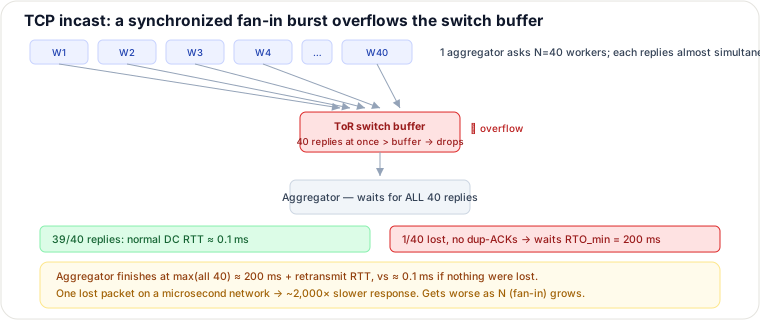
Traced example: 40 workers, one lost reply
| Step | What happens | Time |
|---|---|---|
| Fan-out | Aggregator asks 40 workers; all reply at ~the same instant | t = 0 |
| Burst vs. buffer | 40 simultaneous replies exceed the ToR switch's output buffer for that port | — |
| Loss | 1 of 40 replies is dropped; it was the flow's last packet, so no duplicate ACKs follow to trigger fast retransmit | — |
| 39 flows | Arrive normally at the datacenter's usual RTT | ≈ 0.1 ms |
| 1 flow | Waits the full minimum retransmit timeout, then retransmits and succeeds | 200 ms + ≈0.1 ms ≈ 200.1 ms |
| Aggregator response | Bounded by the slowest of all 40 (it must wait for every reply) | ≈ 200.1 ms |
Against an ideal ≈ 0.1 ms round trip with no loss, that single lost packet costs roughly a ~2,000× slowdown (≈200.1 ms ÷ ≈0.1 ms) — on a network that, by every other measure, is working fine. And it gets worse as N grows: more simultaneous repliers means a higher chance the burst exceeds the buffer, so throughput actually collapses as fan-in degree increases — this is TCP incast.
This is the same fan-out math as tail-latency amplification (see Tail Latency & Fan-out Amplification): the aggregator's response is bounded by the worst of N. Incast is what happens when that "worst of N" isn't just a slow backend — it's a ~2,000× timeout triggered by ordinary buffer contention.
Fixes
- Lower RTO_min: tune the retransmit floor down from 200 ms toward the network's real RTT (microseconds to a few milliseconds). Directly shrinks the blast radius of any loss that still happens.
- ECN + DCTCP: switches mark packets (Explicit Congestion Notification) once queue occupancy crosses a threshold, before the buffer actually overflows. DCTCP's sender reacts to the fraction of marked packets and shrinks its window smoothly — preventing the loss (and therefore the RTO) from happening at all.
- Staggered / jittered replies: have workers add a small random delay before replying so the burst spreads out in time instead of landing on the switch in the same instant — an application-level fix that needs no kernel or switch changes.
- Larger buffers / smaller request units: a deeper switch buffer absorbs a bigger burst (at the cost of money and bufferbloat elsewhere); splitting each worker's reply into smaller chunks reduces the peak burst size per round at the cost of more round trips.
- Application-level request windowing: cap how many workers are asked at once (e.g. 8 at a time instead of 40) instead of full parallel fan-out, trading some parallelism for a burst small enough to never overflow the buffer.
Selection & trade-offs
DCTCP/ECN is the "fix the root cause" option: it prevents the buffer from overflowing in the first place, so no flow ever needs the RTO path. Best when you control both endpoints and the switches — the normal case for an internal storage or microservice fan-in fabric. It does not help against traffic you don't control (third-party dependencies, the public internet) because it needs ECN support on the whole path.
Lowering RTO_min is cheap insurance that reduces the cost of a loss but does not prevent the loss — pair it with DCTCP rather than treating it as a full fix. Tune it too aggressively and you risk spurious retransmits when an ACK is merely delayed, not actually lost, wasting bandwidth on duplicate work.
Application-level staggering or request windowing is the fallback when you don't control the transport stack at all (calling a service you don't own, or a stack where DCTCP isn't available). It works anywhere, but you pay for it directly in added average-case latency — you are deliberately de-synchronizing or throttling a burst you could otherwise let run in full parallel.
Why this is datacenter-specific
The public internet almost never sees incast: RTTs there are already 10–100+ ms, so a 200 ms RTO is a 2–20× penalty, not the ~2,000× catastrophe it is against a 100 µs baseline. It also needs the specific traffic shape of synchronized fan-in (scatter-gather reads, distributed storage writes, search/aggregation queries) that is common inside a datacenter and rare in front of it.
Takeaways
- Incast = a synchronized reply burst overflowing a switch buffer, made catastrophic by RTO_min (~200 ms) on a microsecond-scale network.
- One lost packet can cost ~2,000× the ideal response time because the aggregator waits for the slowest of all N.
- DCTCP/ECN prevents the overflow; lower RTO_min shrinks the damage from any loss that still occurs; staggering / request windowing is the app-level fallback when you don't control the transport.
- It worsens as fan-in degree N grows, and it is a datacenter-specific failure driven by microsecond RTTs meeting a millisecond-scale timeout floor.
Re-authored for this guide; incast diagram hand-authored as SVG. Follows Vasudevan et al., "Safe and Effective Fine-Grained TCP Retransmissions for Datacenter Communication" (SIGCOMM 2009) and Alizadeh et al., "Data Center TCP (DCTCP)" (SIGCOMM 2010); RTO_min per RFC 6298. See also: Tail Latency & Fan-out Amplification, Back-pressure & Flow Control.
🤖 Don't fully get this? Learn it with Claude
Stuck on TCP Incast: Congestion Collapse Under Fan-In? Open Claude, copy a block below, and it'll teach you this exact concept — visually and interactively.
Build the mental picture, not memorization.
I just read a lesson on **TCP Incast: Congestion Collapse Under Fan-In** (System Design) and want to truly understand it. Explain TCP Incast: Congestion Collapse Under Fan-In from first principles using ONE vivid real-world analogy and a visual mental model — draw it as ASCII art or a clear step-by-step diagram — with a concrete example using real numbers. Then ask me one question to check I got the mental picture, and wait for my reply. If you're unsure or a claim isn't standard, say so and reason from first principles instead of guessing.
Socratic — adapts to where you're stuck.
Teach me **TCP Incast: Congestion Collapse Under Fan-In** interactively. Ask me ONE guiding question at a time, wait for my answer, and adapt to my confusion — build the idea with me step by step instead of explaining it all at once. If you're unsure or a claim isn't standard, say so and reason from first principles instead of guessing.
Active recall exposes what you missed.
Quiz me on **TCP Incast: Congestion Collapse Under Fan-In** with 5 questions, easy to tricky, ONE at a time. Tell me if each answer is right; at the end, explain clearly what I got wrong and why. If you're unsure or a claim isn't standard, say so and reason from first principles instead of guessing.
Intuition + hook + flashcards for long-term memory.
Help me remember **TCP Incast: Congestion Collapse Under Fan-In** for the long term: give the one-sentence intuition, a memorable hook/mnemonic, a tiny worked example, and 3 active-recall flashcards (Q -> A). If you're unsure or a claim isn't standard, say so and reason from first principles instead of guessing.