Quorum Arithmetic — Why R + W > N
The one inequality that makes quorums tunable
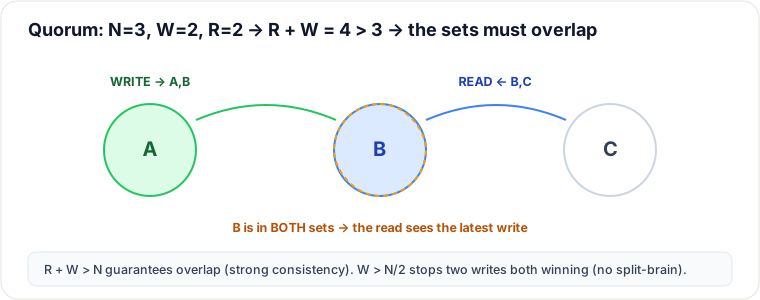
With N replicas, a write acked by W and a read from R:
If R + W > N, the read set and write set must overlap on at least one replica — so every read sees the latest acknowledged write. That overlap is strong consistency. And W > N/2 stops two concurrent writes both reaching quorum (no split-brain).
Try every R/W setting
Flip between quorum configs (balanced, fast, eventual, read-optimized) and predict whether a worst-case read is guaranteed to see the latest write. The rule R+W>N is the pigeonhole made visual — the read and write quorums must share a node.
Tuning (N=3)
| W | R | R+W>N? | Behaviour |
|---|---|---|---|
| 3 | 1 | ✓ | Fast reads, slow/fragile writes |
| 1 | 3 | ✓ | Fast writes, slow reads |
| 2 | 2 | ✓ | Balanced strong consistency (common default) |
| 1 | 1 | ✗ | Fastest/most-available, but eventually consistent |
Bigger W = stronger durability, slower writes; bigger R = fresher, slower reads. R=W=1 (R+W≤N) = max speed/availability, eventual consistency — Dynamo-style. Sloppy quorum + hinted handoff writes to the next available node when a target is down, trading strict membership for availability.
Takeaways
- R + W > N ⇒ strong consistency; W > N/2 ⇒ no split-brain.
- Tuning (W,R) dials the consistency–latency trade-off per operation.
- Raft’s commit is just a write quorum (majority ack).
Re-authored from-scratch; diagram hand-authored (SVG) for this guide.
🤖 Don't fully get this? Learn it with Claude
Stuck on Quorum Arithmetic — Why R + W > N? Open Claude, copy a block below, and it'll teach you this exact concept — visually and interactively.
Build the mental picture, not memorization.
I just read a lesson on **Quorum Arithmetic — Why R + W > N** (System Design) and want to truly understand it. Explain Quorum Arithmetic — Why R + W > N from first principles using ONE vivid real-world analogy and a visual mental model — draw it as ASCII art or a clear step-by-step diagram — with a concrete example using real numbers. Then ask me one question to check I got the mental picture, and wait for my reply. If you're unsure or a claim isn't standard, say so and reason from first principles instead of guessing.
Socratic — adapts to where you're stuck.
Teach me **Quorum Arithmetic — Why R + W > N** interactively. Ask me ONE guiding question at a time, wait for my answer, and adapt to my confusion — build the idea with me step by step instead of explaining it all at once. If you're unsure or a claim isn't standard, say so and reason from first principles instead of guessing.
Active recall exposes what you missed.
Quiz me on **Quorum Arithmetic — Why R + W > N** with 5 questions, easy to tricky, ONE at a time. Tell me if each answer is right; at the end, explain clearly what I got wrong and why. If you're unsure or a claim isn't standard, say so and reason from first principles instead of guessing.
Intuition + hook + flashcards for long-term memory.
Help me remember **Quorum Arithmetic — Why R + W > N** for the long term: give the one-sentence intuition, a memorable hook/mnemonic, a tiny worked example, and 3 active-recall flashcards (Q -> A). If you're unsure or a claim isn't standard, say so and reason from first principles instead of guessing.