Quorum in Practice — The Two Inequalities, Conflict Resolution, Read-Repair, Partitions & Tail Latency (Deep Dive)
Two inequalities, not one — and they guard different things
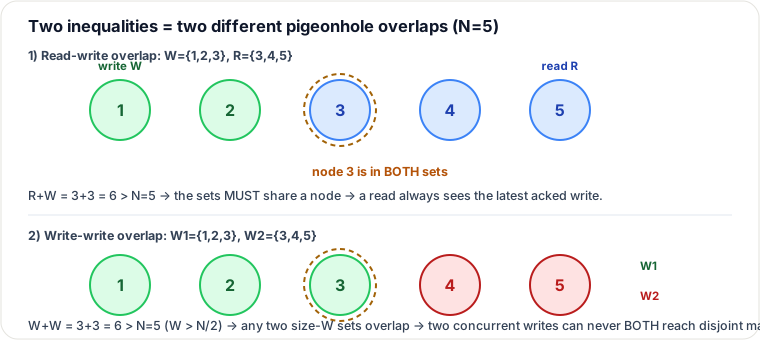
Both quorum rules are the same pigeonhole principle, applied to two different pairs of sets drawn from the same pool of N replicas. A set of size R and a set of size W, both drawn from N, are guaranteed to share at least one element exactly when R+W > N — if they didn't overlap, they'd need R+W distinct slots, and only N < R+W exist. Apply that same counting argument to two write sets instead of a read set and a write set — W+W > N, i.e. W > N/2 — and you get a second, independent guarantee: any two size-W quorums must also overlap.
R+W > N guarantees read–write overlap: a read quorum always contains at least one replica holding the latest acknowledged write. W > N/2 guarantees write–write overlap: two concurrent writes can never both land on fully disjoint majorities. The first is about freshness for readers; the second is about preventing two writers from each believing they "won" on a split set of replicas. A system can satisfy one without the other — e.g.R=1, W=1withN=5satisfies neither;R=5, W=1satisfies R+W>N but not W>N/2, so reads see the latest ack, yet two size-1 "writes" on different nodes can both "succeed" with no shared replica at all.
Quorums are not linearizable
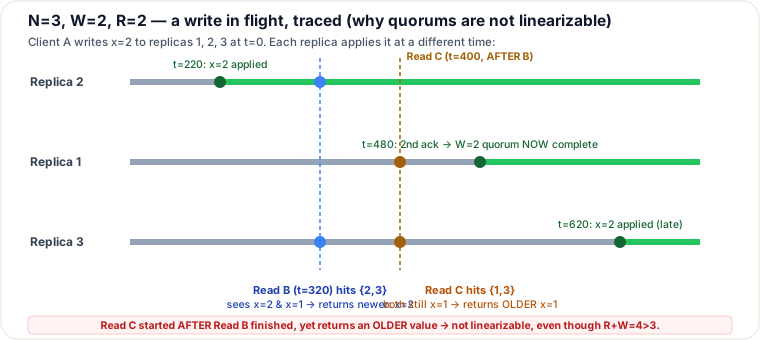
R+W > N only promises that a read overlaps the set of replicas holding the latest acknowledged write — it says nothing about what happens while a write is still in flight, before the coordinator has collected its W acks. During that window, replicas apply the new value at different real times (network jitter, disk fsync, GC pauses), so two reads issued back-to-back can query different subsets and disagree — even though each individually satisfies R.
Trace it with N=3, W=2, R=2. Client A starts writing x=2 to replicas 1, 2, 3 at t=0. Replica 2 is fast and applies it at t=220. Replica 1 is slower and applies it at t=480 — that second ack is what actually completes the W=2 quorum, so the coordinator can't tell the client "success" before t=480. Replica 3 lags furthest, applying it only at t=620 (maybe via read-repair or anti-entropy, see below).
Now watch two reads that race ahead of that quorum-ack:
- Read B fires at
t=320, hitting replicas{2,3}. Replica 2 already hasx=2; replica 3 still hasx=1. Comparing versions, Read B correctly returns the newer value,x=2. - Read C fires at
t=400— strictly after Read B already returned — hitting replicas{1,3}. Att=400, replica 1 hasn't applied the write yet (that happens att=480), and replica 3 hasn't either. Both queried replicas still holdx=1, so Read C returnsx=1.
Read C started later in real time than Read B, yet returned an older value. That is a linearizability violation — a linearizable system guarantees that once any read observes a value, no later-starting read can observe an earlier one. Quorum systems don't offer that; they offer "eventually every read sees the latest ack," not "every read after a given wall-clock moment sees at least what came before it." This is exactly the trade Dynamo and Cassandra make deliberately: availability and low latency over Herlihy-style linearizability.
Concurrent writes still need an ordering rule
W > N/2 guarantees that two concurrent writes share at least one replica — but that shared replica now holds two values with no inherent order between them (no synchronized global clock says which "really" happened first). The overlap forces a decision; it doesn't make one. Two mechanisms make that decision:
Version vectors — detect concurrency, keep both
Each value is tagged with a map of {replica_id: counter}. A client reads a key, gets back its current vector, writes a new value that increments its own counter in that vector. Two vectors are compared component-wise:
- If vector A is ≥ vector B in every component (and > in at least one), A is a descendant of B — B is safely discarded.
- If neither dominates the other, the writes are concurrent siblings — both are kept and returned together on the next read, and the application (or a CRDT merge function) reconciles them.
Worked example: key starts with vector {}. Client X reads it, writes v1 with vector {X:1}. Client Y, without seeing v1, also writes concurrently with vector {Y:1}. Neither {X:1} nor {Y:1} dominates the other — true concurrency, both v1 and v2 are kept as siblings (this is Dynamo's shopping-cart example: both carts are unioned, not one discarded).
Last-write-wins (LWW) — pick a timestamp, drop the loser
Each write carries a wall-clock (or hybrid-logical) timestamp; on conflict, the higher timestamp wins and the other write is silently discarded. Simple and requires no app-level merge logic — Cassandra defaults to this per-column. The cost: under clock skew across nodes, a write that happened earlier in real wall-clock time on a node with a fast clock can carry a later timestamp and incorrectly "win," silently dropping a causally-later write with no signal to the application that data was lost.
| Version vectors | LWW timestamps | |
|---|---|---|
| Data loss on true conflict | None — both siblings kept | Silent — loser is dropped |
| App complexity | Must merge siblings on read | None — transparent |
| Sensitive to clock skew | No | Yes — can pick the wrong winner |
| Used by | Dynamo, Riak | Cassandra (default), DynamoDB (simplified) |
Read-repair and anti-entropy — healing the divergence
Read-repair happens inline, on the read path: the coordinator queries R replicas, compares their versions, and if any queried replica is stale it pushes the winning value to it (synchronously before replying, or asynchronously right after). It heals only the keys that are actually read — a hot key self-heals quickly; a cold key that nobody reads can stay divergent indefinitely.
Anti-entropy is the background safety net: nodes periodically compare their entire key ranges using a Merkle tree — a hash tree where each leaf hashes a small key range and each parent hashes its children's hashes. Two replicas exchange just the top-level hash first; if it matches, that whole range is in sync and comparison stops. If it differs, they recurse into the mismatched subtree, halving the search space each level, until only the specific divergent key ranges are identified — then only those ranges are shipped, not the full dataset. This bounds sync bandwidth to the actual amount of drift, however large the total dataset is.
Partitions: only the quorum side writes, plus hinted handoff
When a network partition splits N replicas into two groups, only the side that can still assemble a quorum (W for writes, R for reads) may complete operations. The minority side simply cannot reach enough distinct replicas and rejects the request. Because W > N/2, at most one side of any partition can ever hold a write quorum — so this is the same overlap guarantee as before, now enforced as a hard availability cost during a real partition rather than just a race between two concurrent clients.
Hinted handoff relaxes this within the majority side: if a write's natural replica is unreachable but a substitute node (next one along the preference list) can still make up the quorum, the coordinator writes to the substitute along with a "hint" recording the true owner. Lifecycle: (1) target replica down → (2) write lands on a fallback node tagged with a hint → (3) target replica rejoins → (4) the fallback replays the hinted write to the true owner → (5) the hint is deleted from the fallback. Until step 4 completes there is a real inconsistency window: a read whose quorum happens to include the true (recovering) owner but not the hint-holder can miss the write entirely, and if the hint-holder itself crashes before handoff, that "acknowledged" write can be lost unless it was also durably captured by a true quorum elsewhere.
Tail latency: fastest-of-N vs slowest-of-the-required-set
A quorum operation only waits for the fastest W (writes) or R (reads) replicas out of N to respond — it does not wait for stragglers, which is precisely why quorums beat "wait for all N" schemes on tail latency. But this benefit shrinks as W or R approaches N: with N=3, W=1 needs only the single fastest replica to answer; W=3 needs literally the slowest of the three. Every increment of W or R toward N trades consistency strength for exposure to whichever replica is having a bad millisecond — GC pause, disk hiccup, network blip — that day. Systems mitigate this with hedged/speculative requests: send to more replicas than strictly required and accept the first R/W responses, treating the rest as backup for stragglers rather than waiting on a fixed subset.
Judgment layer — tunable quorum vs single-leader synchronous replication
Both approaches want durable, multi-replica writes with survivable reads. They resolve the CAP tension in opposite directions:
- Tunable quorum (Dynamo/Cassandra-style) — choose when write availability matters more than a single global order: multi-datacenter active-active writes, workloads where writes rarely conflict (per-user keys) or where a merge is natural (counters, CRDT sets, shopping carts), and you can afford app-level conflict resolution or accept LWW's small silent-loss risk. Every request can independently dial its own R/W trade-off. Cost: no linearizability, conflict resolution is your problem, and pushing R/W toward N to compensate directly worsens tail latency (previous section).
- Single-leader synchronous replication (traditional RDBMS sync replicas, or a Raft/Paxos-elected leader) — choose when you need real linearizable ordering with zero app-level conflict handling: financial ledgers, inventory counts, anything where "which write won" must be unambiguous and total. The leader imposes a single order, so there are never siblings to merge. Cost: write availability is capped by the leader — during leader failure or election, writes pause; there is no multi-region active-active story without cross-region synchronous latency on every write.
Pitfalls
- Treating
R+W > Nas "the system is linearizable" — it isn't; see the in-flight trace above. - Satisfying
R+W > NwhileW ≤ N/2(e.g.N=5, R=5, W=1): reads see the latest ack, but two disjoint size-1 "writes" can both succeed — the two inequalities are independent, and dropping either one reopens a different failure mode. - LWW silently drops a causally-later write whenever clocks skew across nodes — no error, no signal, just gone.
- A hinted-handoff write can momentarily exist on zero of the natural replicas — only on hint-holders — so if the hint-holder dies before replay, an already-"acknowledged" write can vanish.
- Pushing W or R up toward N "for extra safety" quietly regresses p99 latency toward the slowest replica in the required set.
Takeaways
R+W > N(read/write overlap = freshness) andW > N/2(write/write overlap = no split-brain) are the same pigeonhole argument applied twice — and neither implies the other.- Quorums guarantee eventual, not linearizable, consistency: reads racing an in-flight write can disagree, and a later read can return an older value than an earlier one.
- Overlap only forces a shared replica to see both writes; version vectors (keep siblings, no loss) and LWW (pick one, silent loss under skew) are the two standard ways to actually order them — read-repair and Merkle-tree anti-entropy are what heal the replicas that missed out.
- Raising W/R toward N buys consistency strength at a direct, quantifiable cost in tail latency — the same dial in the opposite direction from the CAP trade-off tunable quorums are famous for.
Related pages
- What is Quorum — the foundational definition of R, W, N this deep dive builds on.
- Quorum Arithmetic — Why R + W > N — the base derivation of the two inequalities traced in depth here.
- Quorum is not Linearizability — companion page on why quorum overlap doesn't guarantee linearizable ordering.
- Failure Under Scale: Hinted Handoff & Sloppy Quorum — deeper look at hinted handoff during partitions.
- What Are Read Repair, Hinted Handoff, And Anti‑entropy Merkle Trees In Eventually Consistent Systems — companion piece on healing replica divergence.
Re-authored/Deepened for this guide.
🤖 Don't fully get this? Learn it with Claude
Stuck on Quorum in Practice — The Two Inequalities, Conflict Resolution, Read-Repair, Partitions & Tail Latency (Deep Dive)? Open Claude, copy a block below, and it'll teach you this exact concept — visually and interactively.
Build the mental picture, not memorization.
I just read a lesson on **Quorum in Practice — The Two Inequalities, Conflict Resolution, Read-Repair, Partitions & Tail Latency (Deep Dive)** (System Design) and want to truly understand it. Explain Quorum in Practice — The Two Inequalities, Conflict Resolution, Read-Repair, Partitions & Tail Latency (Deep Dive) from first principles using ONE vivid real-world analogy and a visual mental model — draw it as ASCII art or a clear step-by-step diagram — with a concrete example using real numbers. Then ask me one question to check I got the mental picture, and wait for my reply. If you're unsure or a claim isn't standard, say so and reason from first principles instead of guessing.
Socratic — adapts to where you're stuck.
Teach me **Quorum in Practice — The Two Inequalities, Conflict Resolution, Read-Repair, Partitions & Tail Latency (Deep Dive)** interactively. Ask me ONE guiding question at a time, wait for my answer, and adapt to my confusion — build the idea with me step by step instead of explaining it all at once. If you're unsure or a claim isn't standard, say so and reason from first principles instead of guessing.
Active recall exposes what you missed.
Quiz me on **Quorum in Practice — The Two Inequalities, Conflict Resolution, Read-Repair, Partitions & Tail Latency (Deep Dive)** with 5 questions, easy to tricky, ONE at a time. Tell me if each answer is right; at the end, explain clearly what I got wrong and why. If you're unsure or a claim isn't standard, say so and reason from first principles instead of guessing.
Intuition + hook + flashcards for long-term memory.
Help me remember **Quorum in Practice — The Two Inequalities, Conflict Resolution, Read-Repair, Partitions & Tail Latency (Deep Dive)** for the long term: give the one-sentence intuition, a memorable hook/mnemonic, a tiny worked example, and 3 active-recall flashcards (Q -> A). If you're unsure or a claim isn't standard, say so and reason from first principles instead of guessing.