hard Failure Under Scale: Hinted Handoff & Sloppy Quorum
The choice: stay writable, or stay correct?
A Dynamo-style quorum store keeps N copies of each key and calls a write successful once W replicas ack and a read successful once R replicas answer; picking R + W > N forces every read set to overlap every write set by at least one node, so a read always sees the latest write. The problem is what to do when some of those N home nodes are unreachable: a strict quorum refuses the operation (choosing consistency, becoming unavailable), while a sloppy quorum writes to whatever healthy nodes it can reach — even ones outside the key’s home list — to stay available, at the price of temporarily breaking the R+W>N intersection guarantee.
Sloppy quorum: available, but reads can go stale
Each key has a fixed preference list — the N nodes that should hold it (say {A,B,C} for N=3). A strict quorum only ever reads and writes within that list, so R+W>N is a real guarantee. A sloppy quorum relaxes it: if the home nodes are down, the coordinator writes to the next healthy nodes on the ring instead, just to collect W acks. Durability and availability are preserved — but now the W nodes that hold the newest value may lie outside the preference list, so a later read that queries the (now-recovered) home list can completely miss it. As Kleppmann puts it: even when w + r > n, you cannot be sure to read the latest value, because it may have been written to nodes outside of n.
Traced example: N=3, W=2, R=2 — the stale read
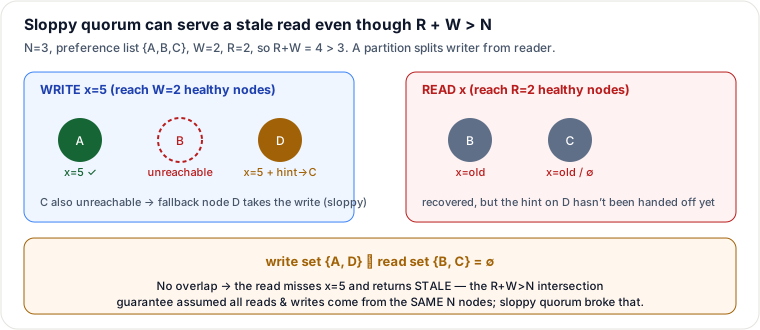
Key x has preference list {A, B, C}. R+W = 4 > 3, which looks airtight. A network partition splits the cluster so the write coordinator and the read coordinator see different halves.
- Write x=5. From the writer’s side, B and C are unreachable; only A is. To still reach W=2, the sloppy quorum writes to A and to a fallback node D (next healthy on the ring). D stores the value tagged with a hint: “this really belongs to C.” The write is acked (2 acks: A, D).
- Partition partly heals. The read coordinator can now reach B and C. C has recovered but D has not yet handed the hint back.
- Read x. With R=2 the read queries B and C. Neither ever received x=5 → both return the old value (or “not found”). The read is stale.
The arithmetic held (R+W = 4 > 3) yet the read was wrong, because the write set {A, D} and the read set {B, C} are disjoint. R+W>N only guarantees intersection when both sets are drawn from the same N nodes. Sloppy quorum pulled the write onto D, outside that set, and the guarantee evaporated. The staleness is temporary — it lasts until hinted handoff or anti-entropy reconciles C — but during that window the store is only eventually consistent, not quorum-consistent.
Hinted handoff, and the recovery storm
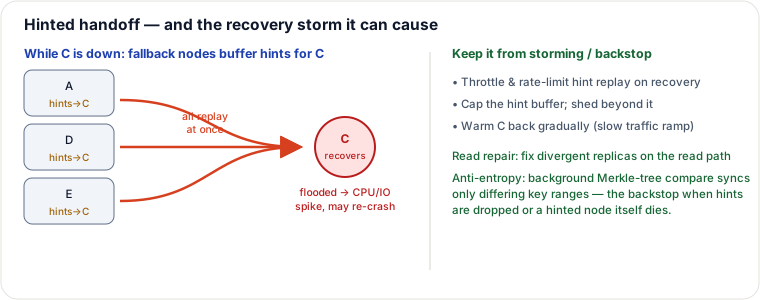
The fallback node D didn’t just absorb the write — it recorded a hint: metadata saying “this data belongs to C; deliver it when C is back.” That is hinted handoff: D periodically checks whether C has recovered, and when it has, D replays the buffered writes to C and then deletes its local copy. This is what makes the temporary staleness self-healing — once the handoff completes, C holds x=5 and reads through the home list are correct again.
The failure mode is what happens on recovery. If C was down for a while, many nodes (A, D, E, …) accumulated hints destined for C. The instant C rejoins, they all try to replay their buffered hints at once — a flood of catch-up writes landing on a node that is also cold (empty caches, JIT not warmed) and simultaneously being handed live traffic again. The result is a recovery storm: CPU and I/O spike, latency blows out, and the just-recovered node can fall over again — a self-inflicted thundering herd. The fixes are to throttle hint replay, cap the hint buffer (shed beyond it rather than store unboundedly), and ramp traffic back to a recovered node gradually.
Reconciliation: the layer that makes eventual consistency actually converge
Hinted handoff is best-effort — hints can be dropped (buffer capped, or the hinted node D itself dies before handing off). So two other mechanisms guarantee replicas eventually agree:
- Read repair. On a read, if the coordinator sees divergent versions across the R replicas, it writes the newest version back to the stale ones inline. Cheap and immediate — but it only fixes keys that are actually being read. Rarely-read keys stay divergent.
- Anti-entropy with Merkle trees. A background process compares replicas pairwise using a Merkle tree (a hash tree over key ranges): if two roots match, the whole range is identical and nothing ships; where hashes differ, it walks down to find just the divergent ranges and syncs only those. This finds and repairs the cold keys read repair never touches, using bandwidth proportional to the differences, not the dataset. Anti-entropy is the real backstop behind sloppy quorum + hinted handoff.
Pitfalls
- Assuming R+W>N means consistency. Under sloppy quorum it does not, during failures. If you need read-your-writes, sloppy quorum alone won’t give it to you.
- Unbounded hint buffers. A long outage of a popular node can let hints grow until the fallback nodes run out of disk — turning one node’s failure into several.
- Un-throttled handoff on recovery. The recovery storm above; a recovering node needs a gentle ramp, not the full backlog at once.
- Relying on read repair alone. It never touches cold keys; without anti-entropy, rarely-read data can stay divergent indefinitely.
- Sibling explosion. Concurrent writes to different fallback sets create multiple versions (siblings) that the application must later merge (via vector clocks / CRDTs); ignoring reconciliation silently loses writes.
Judgment: how a senior engineer decides
Sloppy quorum + hinted handoff vs strict quorum
This is a direct CAP choice. Sloppy quorum + hinted handoff chooses availability under partition/failure: writes keep succeeding by spilling onto healthy fallback nodes, and durability is preserved. The cost is that R+W>N stops guaranteeing fresh reads until reconciliation catches up — you can read stale data, and you must run read-repair + anti-entropy to converge. This is the default in Cassandra, Riak, and DynamoDB-lineage stores because for their target workloads (high write volume, always-on) a brief stale read beats a rejected write.
Strict quorum chooses consistency: it only reads/writes within the preference list, so R+W>N is a genuine guarantee — but if it can’t reach W (or R) home nodes it fails the operation, i.e. it goes unavailable during failure. Choose strict when a stale read is unacceptable — uniqueness constraints, account balances, “did my write commit?” semantics — and you would rather return an error than a wrong answer.
When to accept stale reads
Accept them when the value is tolerant of brief divergence and availability dominates: shopping-cart contents, social counters, activity feeds, sensor/telemetry ingestion, product catalogs. Do not accept them where correctness is load-bearing: money, inventory decrement, unique-username registration, authorization decisions — there, use a strict quorum (or a linearizable store / a coordination service) and pay the availability cost. A common middle path: sloppy quorum for the write path (never drop a write) plus a strict/linearizable read for the few operations that truly need it.
The reconciliation alternative
Whether you run sloppy or strict, anti-entropy / read-repair / Merkle sync is not optional under replication — it is the mechanism that turns “eventually consistent” from a hope into a guarantee. Hinted handoff makes convergence fast in the common case; Merkle-tree anti-entropy makes it certain even when hints are lost.
Takeaways
- A sloppy quorum keeps you writable during failure by writing to fallback nodes outside the preference list — but then R+W>N no longer guarantees fresh reads, because the read and write sets can be disjoint.
- Hinted handoff heals that staleness by replaying buffered writes when the home node recovers; unthrottled, mass replay causes a recovery storm that can re-crash the node.
- Read repair (hot keys, inline) + Merkle-tree anti-entropy (cold keys, background) are the reconciliation backstop that makes eventual consistency actually converge.
- Choose sloppy quorum for availability-first, staleness-tolerant workloads; choose strict quorum when a wrong read is worse than an unavailable one.
Synthesized from the Amazon Dynamo paper (sloppy quorum, hinted handoff, Merkle-tree anti-entropy), Designing Data-Intensive Applications (Kleppmann, Ch. 5 — “Sloppy Quorums and Hinted Handoff”), and the Apache Cassandra / Riak operational literature on hint replay and read repair. Re-authored/Deepened for this guide.
🤖 Don't fully get this? Learn it with Claude
Stuck on Failure Under Scale: Hinted Handoff & Sloppy Quorum? Open Claude, copy a block below, and it'll teach you this exact concept — visually and interactively.
Build the mental picture, not memorization.
I just read a lesson on **Failure Under Scale: Hinted Handoff & Sloppy Quorum** (System Design) and want to truly understand it. Explain Failure Under Scale: Hinted Handoff & Sloppy Quorum from first principles using ONE vivid real-world analogy and a visual mental model — draw it as ASCII art or a clear step-by-step diagram — with a concrete example using real numbers. Then ask me one question to check I got the mental picture, and wait for my reply. If you're unsure or a claim isn't standard, say so and reason from first principles instead of guessing.
Socratic — adapts to where you're stuck.
Teach me **Failure Under Scale: Hinted Handoff & Sloppy Quorum** interactively. Ask me ONE guiding question at a time, wait for my answer, and adapt to my confusion — build the idea with me step by step instead of explaining it all at once. If you're unsure or a claim isn't standard, say so and reason from first principles instead of guessing.
Active recall exposes what you missed.
Quiz me on **Failure Under Scale: Hinted Handoff & Sloppy Quorum** with 5 questions, easy to tricky, ONE at a time. Tell me if each answer is right; at the end, explain clearly what I got wrong and why. If you're unsure or a claim isn't standard, say so and reason from first principles instead of guessing.
Intuition + hook + flashcards for long-term memory.
Help me remember **Failure Under Scale: Hinted Handoff & Sloppy Quorum** for the long term: give the one-sentence intuition, a memorable hook/mnemonic, a tiny worked example, and 3 active-recall flashcards (Q -> A). If you're unsure or a claim isn't standard, say so and reason from first principles instead of guessing.