What Are Sticky Sessions Session Affinity and When Should I Avoid Them
Sticky sessions, also known as session affinity, is a load balancing technique that ensures all requests from a specific user are consistently routed to the same backend server throughout that user's session.
In simpler terms, the load balancer “sticks” a user to one server so that their session data (like login status or shopping cart) remains intact on that server.
Understanding Sticky Sessions (Session Affinity)
In a typical web application deployed on multiple servers, a load balancer distributes incoming requests across the servers for efficiency.
However, HTTP is a stateless protocol, which means each request is independent and does not remember previous interactions. This can lead to problems if user-specific data is stored in a single server’s memory.
For example, if you’re shopping online and adding items to your cart, you might suddenly find yourself logged out or your cart emptied if a new request gets routed to a different server that doesn’t have your session information.
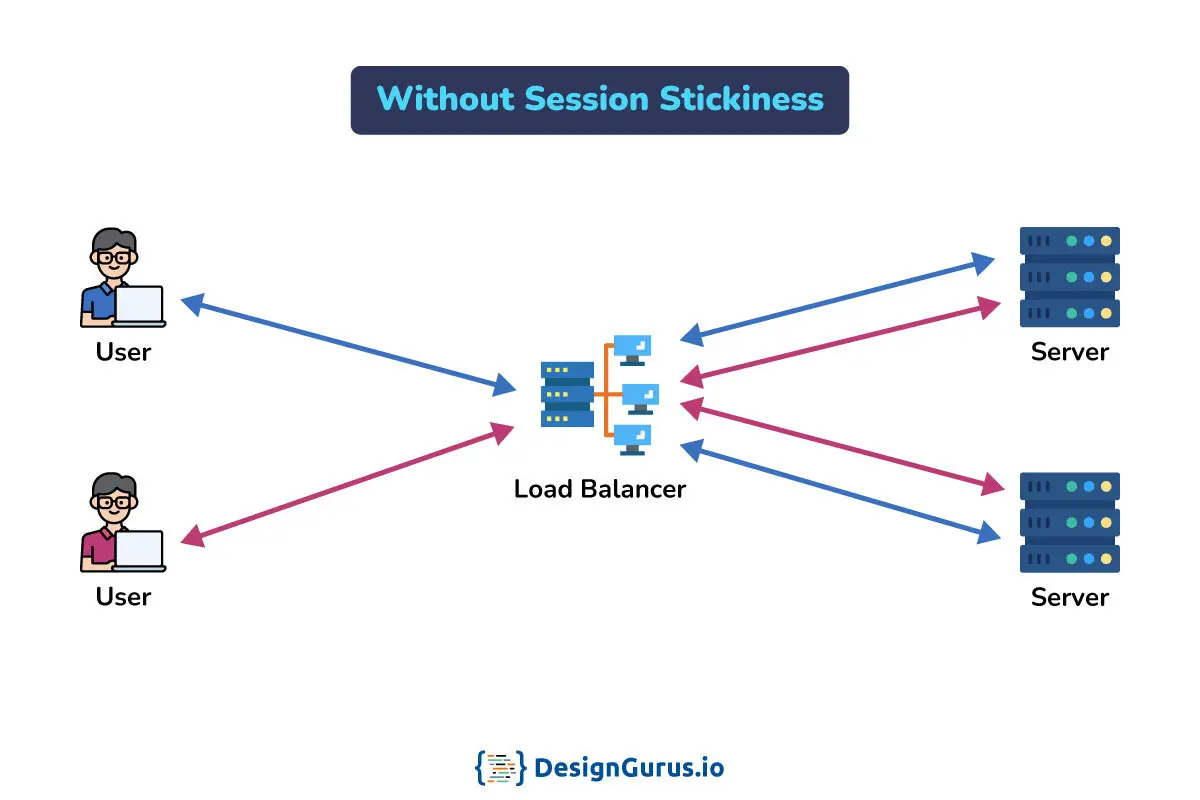
Sticky sessions solve this problem by binding a user’s session to one server, ensuring continuity of data and experience.
To achieve session affinity, the load balancer needs a way to identify and remember which server a user is tied to.
Typically, this is done by assigning an identifier to the user, often via a cookie in the user’s browser or by tracking the client’s IP address.
On the user’s first request, the load balancer might set a special session cookie that encodes which server handled the request.
Thereafter, the load balancer reads this cookie on each request and routes the user to the same server that served them initially. (IP-based sticky sessions are another method, but are less reliable if multiple users share an IP or if a single user’s IP changes.)
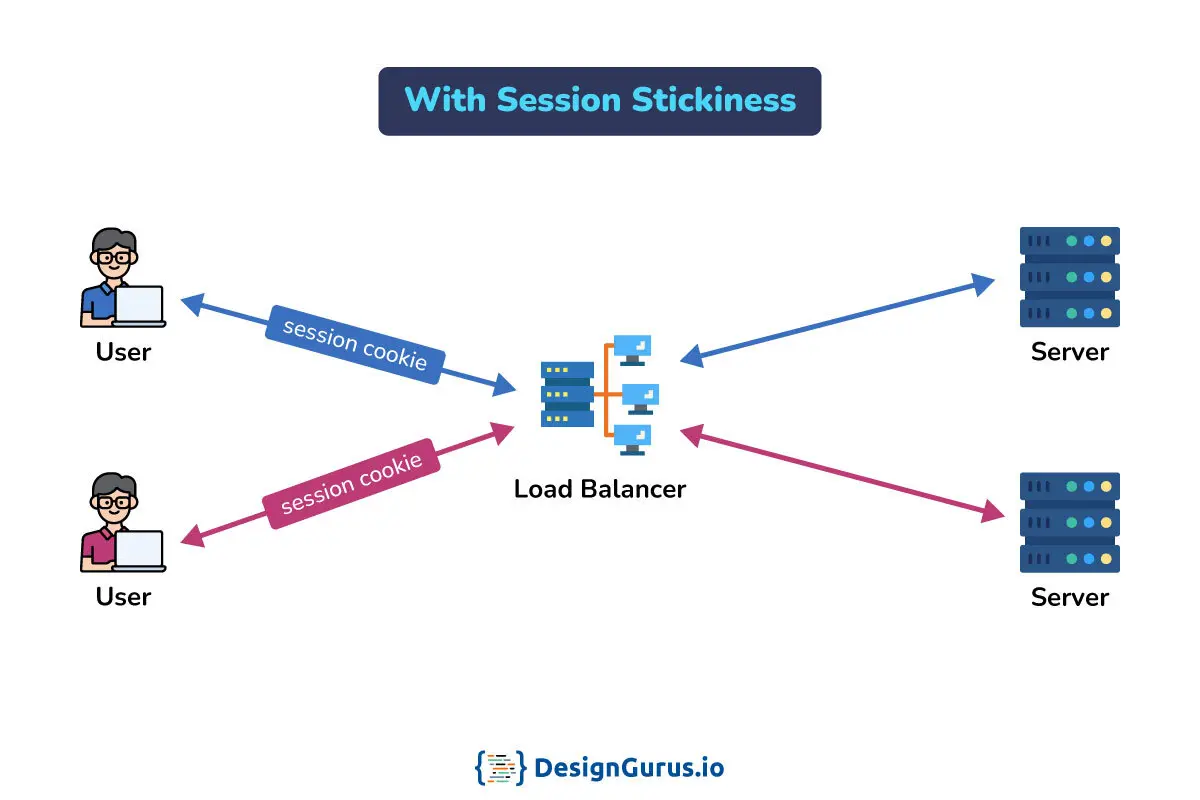
This way, all session data (like your login state or cart contents) stays on one server, and the application doesn’t need to constantly share session information between servers.
An easy way to understand sticky sessions is by analogy: it’s like having a favorite waiter at a restaurant who always serves you and remembers your order.
Just as that waiter can provide personalized, consistent service because they know you, a specific server can handle all of a user’s requests and “remember” their session data.
This improves user experience by avoiding scenarios where information might get lost due to bouncing between different servers.
Benefits of Sticky Sessions
Sticky sessions exist to address real needs in session management.
Some key benefits include:
-
Consistent Session Data / Simplicity: All of a user’s session data is kept on a single server, simplifying session management by removing the need to replicate or share session state across multiple servers. This consistency means a user’s experience (e.g. staying logged in, items remaining in cart) is uninterrupted because the server “remembers” their data.
-
Improved Performance with Caching: By sticking users to one server, you can take advantage of that server’s in-memory caches. For example, the server might cache user information or frequently accessed data in RAM; with affinity, subsequent requests from the same user hit the warm cache instead of starting fresh on another server. This avoids the overhead of transferring session data between servers and can lead to faster response times for the user.
-
Easy Implementation (No Code Changes): Enabling sticky sessions is usually as simple as a configuration change on the load balancer and requires no changes to application code. Most modern load balancers (NGINX, HAProxy, cloud load balancers, etc.) support session affinity out of the box. This makes it an attractive quick solution for session management, especially in legacy applications. You don’t have to redesign how sessions are stored, since the load balancer takes care of keeping a user’s traffic on the same server.
Drawbacks of Sticky Sessions
Despite their benefits, sticky sessions come with notable drawbacks that can impact scalability and reliability:
-
Scalability Limitations (Uneven Load): Session affinity can lead to uneven load distribution across servers. If many users happen to get “stuck” to one particular server, that machine can become overloaded while others remain underutilized. This imbalance means your application may not fully benefit from having multiple servers, defeating the purpose of load balancing. It also makes scaling out harder. For instance, when you add a new server to the pool, it won’t immediately receive traffic if existing users are all stuck to their current servers, slowing down the effectiveness of scaling.
-
Single Point of Failure (Session Loss on Crash): With sticky sessions, crucial session data lives only in one server’s memory by default. If that server goes down or restarts, all users tied to it will lose their sessions (e.g. they could be logged out or lose unsaved data). In a high-availability environment, this is problematic because it creates a single point of failure for those users’ experience. Without additional session replication, session affinity means a server crash can directly translate to a poor user experience as active sessions vanish.
-
Challenges in Dynamic or Distributed Environments: Modern cloud deployments often add or remove servers (or containers) on the fly to meet demand. Sticky sessions complicate this. As servers are dynamically added or removed, existing session affinities can become invalid or hard to maintain. For example, if a server instance is terminated (for auto-scaling or maintenance), all sessions on it are disrupted. If new instances start, they might stay mostly idle until new users connect, because existing users are still pinned to older instances. Managing session affinity in container orchestration (like Kubernetes) or multi-datacenter setups becomes complex, potentially requiring “stateful” load balancer configurations that counteract the fluid, stateless nature of cloud scaling.
-
Maintenance and Long Sessions: Because users are tied to specific servers, performing maintenance or updates on a server is harder. You might have to drain or wait for all sessions on that server to finish or expire. Long-lived user sessions can tie up resources on one machine for extended periods, making it difficult to take that server out of rotation for updates without disrupting those users. This rigidity is at odds with the flexibility needed for seamless deployments and upgrades.
-
Limited Fault Tolerance for Heavy Users: In some cases, a single user’s session might generate a very high load (imagine a user performing many complex operations). With sticky sessions, all of that load hits one server, potentially slowing down that user’s experience if the server maxes out, whereas a truly stateless setup might allow spreading requests across multiple servers. In general, if one user’s traffic is extreme enough to matter, it highlights that sticky sessions prevent distributing even a single user’s workload across the cluster.
When Should You Avoid Sticky Sessions?
Given the above drawbacks, when is it better not to use sticky sessions?
In modern web architecture, the default approach is to design systems that don’t require session affinity unless absolutely necessary. You should consider avoiding sticky sessions in the following scenarios:
-
High Availability Requirements: If your application is mission-critical and cannot afford to lose user session data due to a server crash, avoid sticky sessions. Relying on affinity means a single server’s failure can wipe out all sessions on it, so applications that need robust failover and zero session loss should use a different approach (like external session storage) to survive crashes.
-
Horizontal Scalability and Auto-Scaling: If you need to scale your application seamlessly or handle sudden traffic spikes, sticky sessions can hinder you. Avoid them when you want load to be evenly distributed at all times. In auto-scaling environments (Kubernetes pods, cloud auto-scaling groups), new server instances should share the load immediately, and old ones should be removable without incident. Session affinity works against this by anchoring users to specific servers, so it’s best avoided in elastic cloud scenarios.
-
Globally Distributed or Microservices Architectures: For applications distributed across multiple regions or composed of many microservices, managing state on individual servers becomes complex. If you have a global user base that might be served from different data centers, or if your architecture involves calling multiple backend services, sticking a user to one server can introduce latency or imbalance. It’s usually better to avoid sticky sessions and use a strategy that allows any server or service instance to serve the user, which simplifies traffic management in distributed systems.
-
Modern Stateless Application Design: If you have the option to redesign or configure your application to be stateless (not relying on in-memory server sessions), do so instead of using sticky sessions. Following twelve-factor app principles, storing session state externally (or not at all) is a best practice for cloud-native apps. In cases where you can use a token-based authentication (JWT) or a shared database/cache for sessions, you should avoid sticky sessions because these alternatives provide better scalability and resilience.
In summary, avoid session affinity unless you have a specific requirement for it in a stateful legacy application.
Many organizations initially use sticky sessions for convenience, but later discover it’s better to remove that dependency as they scale.
Alternatives to Sticky Sessions
If you decide to avoid sticky sessions, how do you maintain user session state across a cluster of servers?
Here are some alternative approaches that address the same problem in a more scalable way:
-
Centralized Session Store: Instead of keeping session data in each server’s memory, store it in a centralized datastore that all servers can access. Popular choices are in-memory data grids or caches like Redis or Memcached, or dedicated session databases. With this approach, it doesn’t matter which server handles a request. It can always retrieve the user’s session data from the central store. This enables true load balancing and failover, since any server can pick up where another left off.
-
Stateless Tokens (JWT): Use a stateless authentication mechanism, such as JSON Web Tokens, where the session information (like user ID and claims) is encoded into a token that the client carries. The server doesn’t need to remember anything about the user between requests, because each request includes the token that proves the user’s identity and session data. This eliminates the need for server-side sessions altogether, meaning no affinity is required. Any server can serve any request as long as it can validate the token.
-
Database-Backed Sessions: Store session state in a shared database. For example, web frameworks often allow using an SQL or NoSQL database for session storage. This way, even if a user’s subsequent request goes to a different server, that server can load the session data from the database. This method introduces a bit of read/write latency, but ensures sessions persist beyond a single server’s memory. It also provides durability; if a server crashes, the session isn’t lost since it lives in the database.
Each of these alternatives allows you to maintain user state without pinning users to a single server, thereby improving the overall scalability and fault tolerance of your application.
They require more initial setup than flipping on sticky sessions, but they are considered best practice for large-scale systems.
Cookie affinity vs IP-hash, and the load-skew trap
The two common ways a load balancer implements affinity fail in different ways. Cookie-based affinity sets a balancer-owned cookie (for example SERVERID=b3) on the first response and reads it on every later request; it is per-browser and precise, but it breaks when a client strips cookies, and the cookie should be marked Secure/HttpOnly so it cannot leak which backend a user is pinned to. IP-hash affinity needs no cookie — it hashes the client IP to a backend — but it collapses every user behind a corporate NAT or carrier-grade NAT (CGNAT) onto a single backend, and it re-pins a mobile client the moment its IP changes.
That NAT collapse is the concrete scalability risk. If a single enterprise or CGNAT egress IP accounts for, say, 15% of all requests, IP-hash pins that entire 15% to one backend; added to that node's fair share of the remaining traffic it can run well over 2× the load of its peers — and adding more backends does not rebalance it, because the hash still maps that one IP to one node. Cookie affinity avoids this because each browser is pinned independently.
Affinity also complicates deploys and scale-in. To remove a backend without dropping carts you must drain it: stop routing new sessions to it, keep serving already-pinned clients until their sessions expire or an affinity timeout elapses, then retire it. Long-lived connections (WebSockets, SSE) make this worse — a client can stay pinned for hours — so at fleet scale you need an explicit drain plan plus an affinity timeout. The combination to never ship is sticky sessions + in-memory-only session state + aggressive auto-scale-in: every scale-in event then silently drops the sessions on the retired node.
Scale-in, traced
4 backends, 100,000 active sessions (~25,000 pinned to each), and node b3 must retire. What happens depends entirely on the affinity mode and where the state lives:
- (a) Cookie affinity + external session store: drain
b3— new sessions go tob1/b2/b4; existingb3cookies keep routing tob3until a drain timeout T (say 300 s) elapses; after T, the load balancer rewrites or ignores the stale cookie and re-pins those clients to a healthy node. Sessions survive because the state is in Redis, not onb3. Zero lost carts; the cost is keepingb3alive for T seconds. - (b) Cookie affinity + in-memory state: the same 300 s drain protects only the sessions that end within T. The ~25,000 sessions still active at retirement lose their carts the instant
b3dies — this is exactly why in-memory state + aggressive auto-scale-in is the never-ship combination above. - (c) IP-hash: removing
b3changes the modulus, so with naivehash(IP) mod Nroughly (N−1)/N = 75% of ALL sessions re-pin to a different node — not justb3's 25% — because almost every IP now hashes to a new slot. Unless the balancer uses consistent hashing, which limits re-pinning to ~1/N (only the retired node's share moves).
The rule: the affinity mode determines the blast radius of one node's removal — external-store cookie affinity contains it to zero, in-memory contains the damage to one node's sessions but loses them, and naive IP-hash spreads the disruption to the whole fleet.
Drill ladder
L1 — Failure: The LB health check marks a sticky node unhealthy for 30 s, then healthy again. What did the users pinned there experience?
Trap: “Nothing — it came back.”
Bar: During the unhealthy window the LB re-routed them to nodes without their session (logged out / empty cart), and depending on the LB either re-pinned them there or bounced them back afterward — affinity converts a node blip into a user-visible state loss unless state is external.
L2 — Scale: A single CGNAT egress IP carries 15% of your traffic under IP-hash affinity. You add four more backends. What changes?
Trap: “More backends means the hot node's load spreads out.”
Bar: Nothing changes for the hot node's pinned share: the hash still maps that one IP to exactly one backend, so the 15% stays put — adding capacity cannot rebalance a hot NAT IP. The fixes are cookie affinity (per-browser pinning) or removing affinity entirely.
L3 — Cost/Simplicity: Why not just replicate every session to all nodes and skip both affinity and the external store?
Trap: “Session replication solves it.”
Bar: All-node replication is O(N) memory per session and a write-fanout on every session mutation — at fleet scale you pay N copies and N network writes for state that one node reads. An external store is O(1) per session with one network hop; replication only wins for tiny fleets or when that store hop dominates your latency budget.
🤖 Don't fully get this? Learn it with Claude
Stuck on What Are Sticky Sessions Session Affinity and When Should I Avoid Them? Open Claude, copy a block below, and it'll teach you this exact concept — visually and interactively.
Build the mental picture, not memorization.
I just read a lesson on **What Are Sticky Sessions Session Affinity and When Should I Avoid Them** (System Design) and want to truly understand it. Explain What Are Sticky Sessions Session Affinity and When Should I Avoid Them from first principles using ONE vivid real-world analogy and a visual mental model — draw it as ASCII art or a clear step-by-step diagram — with a concrete example using real numbers. Then ask me one question to check I got the mental picture, and wait for my reply. If you're unsure or a claim isn't standard, say so and reason from first principles instead of guessing.
Socratic — adapts to where you're stuck.
Teach me **What Are Sticky Sessions Session Affinity and When Should I Avoid Them** interactively. Ask me ONE guiding question at a time, wait for my answer, and adapt to my confusion — build the idea with me step by step instead of explaining it all at once. If you're unsure or a claim isn't standard, say so and reason from first principles instead of guessing.
Active recall exposes what you missed.
Quiz me on **What Are Sticky Sessions Session Affinity and When Should I Avoid Them** with 5 questions, easy to tricky, ONE at a time. Tell me if each answer is right; at the end, explain clearly what I got wrong and why. If you're unsure or a claim isn't standard, say so and reason from first principles instead of guessing.
Intuition + hook + flashcards for long-term memory.
Help me remember **What Are Sticky Sessions Session Affinity and When Should I Avoid Them** for the long term: give the one-sentence intuition, a memorable hook/mnemonic, a tiny worked example, and 3 active-recall flashcards (Q -> A). If you're unsure or a claim isn't standard, say so and reason from first principles instead of guessing.