What Is the Difference Between Rendezvous Hashing and Consistent Hashing, and When Should I Use Each
Both algorithms decide which server owns a given key while guaranteeing that adding or removing a server moves only a small fraction of keys — consistent hashing does it by placing servers and keys on one shared circular hash space and walking clockwise to the first server, while rendezvous hashing (Highest Random Weight, HRW) does it by hashing the key together with each server ID and picking the server with the highest score.
The thing they replace is server = hash(key) % N. Change N and almost every key remaps at once: a cold cache, a full storage reshuffle, an outage. Both techniques cut that churn to roughly 1/N of keys per membership change. The interesting question is not whether they minimize movement (both do) but how they behave when a node dies and what state you must run to use them — that is where the real engineering choice lives.
Consistent hashing: the ring
Hash every server ID onto a fixed-size circular space (say 0..2^32-1, shown here as 0..99). Hash each key onto the same circle. A key is owned by the first server found walking clockwise from the key's position. Because each server owns exactly the arc between itself and the previous server, adding or removing one server only disturbs that one arc — its neighbours are untouched.
The catch: with one token per server the arcs are wildly uneven (a server can randomly own 3× its fair share), so real implementations give each physical server 100–200 virtual nodes (vnodes) — many tokens scattered around the ring. More vnodes means smoother load and, critically, means a failed server's tokens are interleaved with many others, so its keys spread instead of dumping on a single neighbour. Vnodes are also how you weight capacity: a beefier box simply gets more tokens.
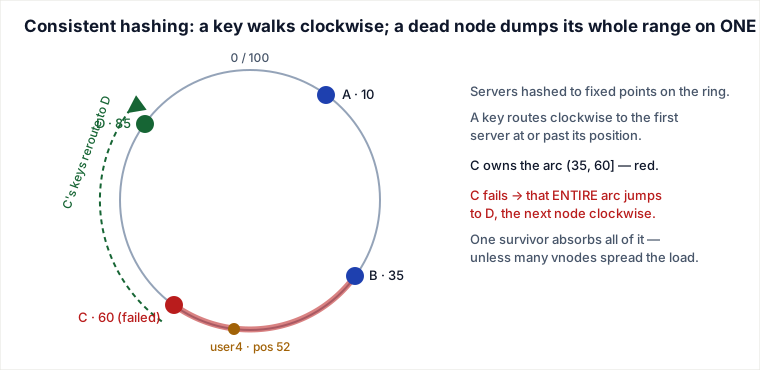
Worked trace — 4 servers, one fails (consistent hashing)
Servers hash to ring positions A=10, B=35, C=60, D=85. Six keys hash to the positions below; each is owned by the first server clockwise.
| Key | Ring pos | First server clockwise | Owner |
|---|---|---|---|
| user1 | 5 | 10 (A) | A |
| user2 | 28 | 35 (B) | B |
| user3 | 40 | 60 (C) | C |
| user4 | 52 | 60 (C) | C |
| user5 | 72 | 85 (D) | D |
| user6 | 95 | wrap → 10 (A) | A |
Now C fails. Every key in C's arc (35, 60] re-routes to the next token clockwise, which is D at 85. So both user3 and user4 land on D. D now holds user3, user4, and its own user5 — three keys while A and B are untouched. With a single token per server, a dead node's entire range is inherited by one neighbour. This is the classic post-failure hotspot, and the reason production rings run hundreds of vnodes.
Rendezvous hashing (HRW): score every server, take the max
No ring, no tokens, no stored structure. For a key k and the current server list, compute score = hash(k, serverID) for each server and assign k to the highest score. Every client that shares the hash function and the node list agrees on the winner with zero coordination.
Three properties fall out for free:
- Even by default. Each server is equally likely to be the top score, so keys spread uniformly without vnodes or tuning.
- k-ranking for replicas. Sorting the scores gives an ordered preference list per key — top-1 is primary, top-2/top-3 are replicas — and everyone agrees on the order. Getting an N-way replica set on the ring means walking to distinct successor nodes; with HRW it is just "take the top k of the sort."
- Weighting. To give a server more load, list it multiple times or fold a weight into the score. Same effect as vnodes, less bookkeeping.
The cost: a lookup computes N hashes and takes the max — O(N) — versus consistent hashing's single hash plus a binary search on the ring, O(log N). For tens to a few hundred nodes O(N) is noise; at thousands of nodes you would reach for a tree-structured (hierarchical) HRW variant to recover O(log N).
Worked trace — same failure, rendezvous hashing
Same 4 servers, same 6 keys. Each cell is the HRW score hash(key, server) (0–99; higher wins). Winner in bold.
| Key | A | B | C | D | Owner | If C fails |
|---|---|---|---|---|---|---|
| user1 | 91 | 40 | 12 | 55 | A | A (unchanged) |
| user2 | 33 | 88 | 20 | 61 | B | B (unchanged) |
| user3 | 31 | 52 | 88 | 47 | C | → B (next-highest 52) |
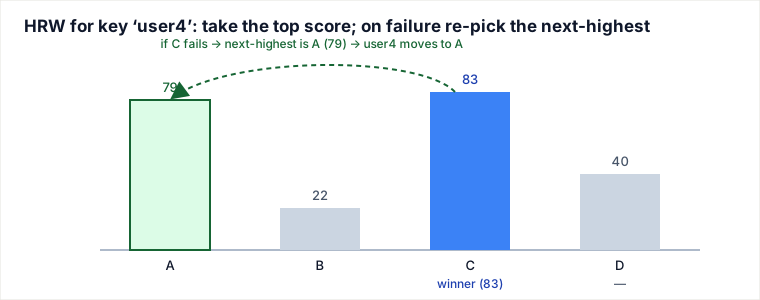
| user4 | 79 | 22 | 83 | 40 | C | → A (next-highest 79) |
| user5 | 18 | 44 | 27 | 90 | D | D (unchanged) |
| user6 | 70 | 30 | 15 | 66 | A | A (unchanged) |
When C fails, its two orphans re-score against the survivors independently: user3's next-best is B (52), user4's is A (79). They land on different servers and D never sees them. Compare the two failures directly: consistent hashing sent user3 + user4 to D (a 3-key hotspot); HRW fanned them to B and A (final load A:3, B:2, D:1). This is the single most important practical difference. Note the ring positions and HRW scores are unrelated numbers — they come from different hash inputs — which is expected.
Head to head
| Dimension | Consistent hashing | Rendezvous (HRW) |
|---|---|---|
| Model | Servers & keys on a shared ring; walk clockwise | Score key against every server; pick max |
| State to run | Sorted ring of tokens; coordinate updates on membership change | Stateless — just the current node list |
| Lookup cost | O(log N) (one hash + binary search) | O(N) (N hashes); O(log N) with tree variant |
| Even load | Needs 100–200 vnodes per server | Uniform by default, no vnodes |
| On node death | Range → one successor (spread only via vnodes) | Each orphan key independently fans out to survivors |
| Weighting | More tokens for bigger nodes | Repeat node / weight the score |
| Replica set | Walk to k distinct successors | Top-k of the score sort, everyone agrees |
A definitional subtlety worth knowing: it is often said that "consistent hashing is a special case of rendezvous hashing." In the formal sense this is true — generalized HRW allows an arbitrary two-place score function, and if you pick the score "negative clockwise distance from the key's ring position to the server's token" (score(k,s) = −((hash(s) − hash(k)) mod 2m), taking the minimum distance over a server's tokens when it has vnodes), then HRW's argmax picks the server with the smallest clockwise distance — exactly the ring's first-successor rule. In the practical sense the two are independent designs (Karger et al. 1997; Thaler & Ravishankar's HRW) with different operational profiles: standard HRW scores each (key, server) pair with an independent uniform hash, which is precisely what gives it even load and per-key fan-out on failure, while the ring's distance-based score couples every key to the same server token — which is why a dead node's arc spills to a single successor, and why the ring gets O(log N) lookup and token-level operator control in exchange. Neither behaves like the other as normally deployed; the "special case" claim is a statement about expressive power, not about interchangeability.
Pitfalls
- Consistent hashing with too few vnodes. One token per server gives lumpy arcs and — as the trace showed — a dead node's whole range piles onto one neighbour, which can then cascade (it fails too, dumps onto the next). Use 100+ vnodes; the hotspot is a design bug, not bad luck.
- Client node-list disagreement (both algorithms). Correctness depends on every client seeing the same server set. If two clients have stale, divergent lists, they disagree on the owner and you get split writes / duplicated cache entries. HRW's "statelessness" does not remove this — it just moves the shared state to the membership list.
- HRW with a weak or non-uniform hash. HRW's even distribution is only as good as
hash(key, server). A hash with poor mixing (or simple concatenation before hashing) skews scores and creates persistent hot servers you cannot tune away. - HRW at large N in the hot path. O(N) per lookup is fine at 50 nodes; at 5,000 nodes on a per-request path it becomes real CPU. Measure before assuming "hashing is free."
- Forgetting the added node is cold. Both algorithms migrate a slice of keys to a new server instantly, but that server's cache/data is empty. Without cache warming or replication you trade a rehash storm for a burst of misses.
- Single-key hotspots. Neither algorithm helps if one key is red-hot — it always maps to the same server. That needs a higher layer (replication of that key, request coalescing), not a different hash.
When to use which
Reach for consistent hashing when you need a mature, O(log N) lookup at very large scale, an existing ecosystem (Cassandra/DynamoDB-style partitioning, memcached Ketama clients, DHTs), or explicit operator control — you can hand-move tokens to drain a hot node or bias load without touching code. The price is running and coordinating the ring, plus getting vnode counts right.
Reach for rendezvous hashing when you want a stateless, few-lines-of-code chooser on the client side, uniform load with no tuning, graceful failure spread out of the box, or an agreed top-k replica list per key (client-side load balancing, sticky routing, replica placement, moderate microservice fleets). The price is O(N) lookups and no token-level control knob.
Against the alternatives:
- vs. naive
hash % N: both win decisively —% Nremaps ~everything on any change. Only use modulo when the node count truly never changes. - vs. Jump Consistent Hash (Lamping & Veach, 2014): Jump is faster (O(log N)) and needs zero memory, giving beautifully even buckets — but it only supports appending/removing the last bucket, not arbitrary named nodes joining and leaving. Choose Jump for stable numbered shards; choose the ring or HRW when membership is arbitrary and churny.
Decision rule: choose HRW when you value simplicity, stateless clients, automatic even rebalancing, and easy replica ranking at small-to-medium scale; prefer consistent hashing when you need O(log N) at thousands of nodes, want manual load control, or must fit an ecosystem already built on the ring.
Takeaways
- Same goal (≈1/N keys move per change), different failure behaviour: the ring hands a dead node's range to one successor; HRW fans each orphaned key to a different survivor.
- Cost model: consistent hashing is O(log N) but stateful (a ring + vnodes to coordinate); HRW is stateless and even-by-default but O(N) per lookup.
- HRW gives an agreed top-k ranking for free — the cleanest way to place replicas; the ring can do it too but less directly.
- Vnodes are not optional for consistent hashing in production; without them, the post-failure hotspot in the trace is real. And neither algorithm fixes a single hot key.
L0 · both cut re-mapping to ~1/N keys per membership change; they differ in how load spreads after a failure and what a lookup costs
L1 · ③ Scale — "at 10,000 nodes, why not just use rendezvous hashing everywhere — it's simpler?"
Trap: "HRW is O(N) which is basically free with a fast hash, so it scales fine too."
Bar: HRW computes N hashes and a max over N scores per lookup — at 10k nodes that's 10k hash calls per request versus the ring's O(log N) binary search over sorted tokens. Past a few hundred nodes you need a tree-structured (hierarchical) HRW variant to recover O(log N), which reintroduces the coordination structure HRW was supposed to avoid. See load-balancing algorithm cost trade-offs.
L2 · ② Failure — "walk me through exactly what happens to a dead node's keys, in each scheme."
Trap: "the keys get evenly redistributed across the remaining nodes in both cases."
Bar: On the ring, a dead node's entire arc is inherited by its single clockwise successor — in the worked trace, C dies and D alone absorbs user3+user4 on top of its own user5 — three keys on one node while A and B see nothing, a hotspot that can cascade to D next. Under HRW each orphaned key independently re-scores against the survivors and picks its own next-highest, so user3 goes to B and user4 goes to A — fanned out, not dumped. Vnodes exist specifically to patch the ring's single-successor problem by interleaving hundreds of tokens per server around the circle. See rebalancing strategies beyond consistent hashing.
L3 · ① Concurrency — "two nodes join near-simultaneously — can two clients disagree about who owns a key?"
Trap: "no — the hash function is deterministic, so everyone computes the same owner."
Bar: The function is deterministic but its input — the current membership/node list — isn't synchronized instantly; a client that has already learned about new node X and one that hasn't will hash against different node sets and disagree on the owner, causing split writes or duplicate cache entries until gossip/config converges. HRW's "no ring bookkeeping" removes the ring data structure, not the requirement that every client observe the same membership snapshot. See split-brain and fencing under membership change.
L4 · ⑤ Adversary/Edge — "I need 3 replicas of each key on independent physical nodes. How does ownership assignment change?"
Trap: "take the key's owner plus the next server in hash order — same mechanism either way."
Bar: On the ring, replicas are the next R distinct physical servers walking clockwise — you must skip vnodes owned by the same physical machine to avoid two "replicas" landing on one box. Under HRW, sort every server's score for that key and take the top-R; any client computing the same sort agrees on the identical ordered replica list with zero coordination, which is why HRW is the cleaner primitive for client-side replica selection. See data sharding and replica placement techniques.
L5 · ⑥ Cost/Simplicity — "on-call needs to drain one physical node for maintenance with zero user-visible hotspot — which scheme, and what's the actual runbook step?"
Trap: "either works — just remove the node from the list and let the hash function handle it."
Bar: Consistent hashing gives an explicit operator knob: migrate that node's specific vnode tokens onto several other servers ahead of time, gradually pre-draining load before the node is actually pulled. HRW has no partial-drain primitive — removing a node from the list is atomic and all-or-nothing, and you can't bias its score down gradually without effectively faking a temporary near-zero weight. See consistent hashing fundamentals.
The floor keeps dropping: now do it with two independent replication factors mid-migration — half your fleet still resolves keys against the old node list while the other half has already converged on the new one, and a client's replica set for the same key differs by which side it asked. Staff-level answer names the fix (versioned membership epochs / a two-phase view change) before naming the symptom.
Self-locate: died at L1 → mid-level; L4+ → staff signal.
Re-authored/Deepened for this guide. Sources: D. Karger et al., "Consistent Hashing and Random Trees" (MIT, STOC 1997); D. Thaler & C. Ravishankar, "A Name-Based Mapping Scheme for Rendezvous" (1998), the original HRW paper; J. Lamping & E. Veach, "A Fast, Minimal Memory, Consistent Hash Algorithm" (Google, 2014) for Jump hashing; production notes from Amazon Dynamo, Apache Cassandra, and Ceph CRUSH; and the standard treatments on Wikipedia (Rendezvous hashing, Consistent hashing) and High Scalability. Worked numbers and diagrams are hand-authored for this page.
🤖 Don't fully get this? Learn it with Claude
Stuck on What Is the Difference Between Rendezvous Hashing and Consistent Hashing, and When Should I Use Each? Open Claude, copy a block below, and it'll teach you this exact concept — visually and interactively.
Build the mental picture, not memorization.
I just read a lesson on **What Is the Difference Between Rendezvous Hashing and Consistent Hashing, and When Should I Use Each** (System Design) and want to truly understand it. Explain What Is the Difference Between Rendezvous Hashing and Consistent Hashing, and When Should I Use Each from first principles using ONE vivid real-world analogy and a visual mental model — draw it as ASCII art or a clear step-by-step diagram — with a concrete example using real numbers. Then ask me one question to check I got the mental picture, and wait for my reply. If you're unsure or a claim isn't standard, say so and reason from first principles instead of guessing.
Socratic — adapts to where you're stuck.
Teach me **What Is the Difference Between Rendezvous Hashing and Consistent Hashing, and When Should I Use Each** interactively. Ask me ONE guiding question at a time, wait for my answer, and adapt to my confusion — build the idea with me step by step instead of explaining it all at once. If you're unsure or a claim isn't standard, say so and reason from first principles instead of guessing.
Active recall exposes what you missed.
Quiz me on **What Is the Difference Between Rendezvous Hashing and Consistent Hashing, and When Should I Use Each** with 5 questions, easy to tricky, ONE at a time. Tell me if each answer is right; at the end, explain clearly what I got wrong and why. If you're unsure or a claim isn't standard, say so and reason from first principles instead of guessing.
Intuition + hook + flashcards for long-term memory.
Help me remember **What Is the Difference Between Rendezvous Hashing and Consistent Hashing, and When Should I Use Each** for the long term: give the one-sentence intuition, a memorable hook/mnemonic, a tiny worked example, and 3 active-recall flashcards (Q -> A). If you're unsure or a claim isn't standard, say so and reason from first principles instead of guessing.