How Do Snowflake‑Style IDs Work Timestamp, Worker, Sequence, and What Problems Do They Solve
Snowflake IDs are distributed, globally unique 64-bit identifiers that combine a timestamp, a machine (worker) ID, and a sequence counter to produce roughly time-ordered IDs.
In other words, each Snowflake ID embeds when (timestamp), where (which server or process), and which (sequence number) it was created, making it unique without a central coordinator.
This format was created by Twitter (X) for tweet IDs and is now used by systems like Discord and Instagram, solving the problem of generating unique identifiers at scale.
In practice, Snowflake IDs let each server or node in a distributed system generate its own IDs without conflict.
Because the timestamp portion is first, Snowflake IDs sort in time order and even allow you to extract the creation time from the ID. This solves a common challenge in distributed systems: how to generate unique, sortable IDs across many machines without a single bottleneck.
Structure: Timestamp, Worker, Sequence
Each Snowflake ID is a 64-bit number partitioned into fields.
A typical layout (Twitter’s original Snowflake) looks like this:
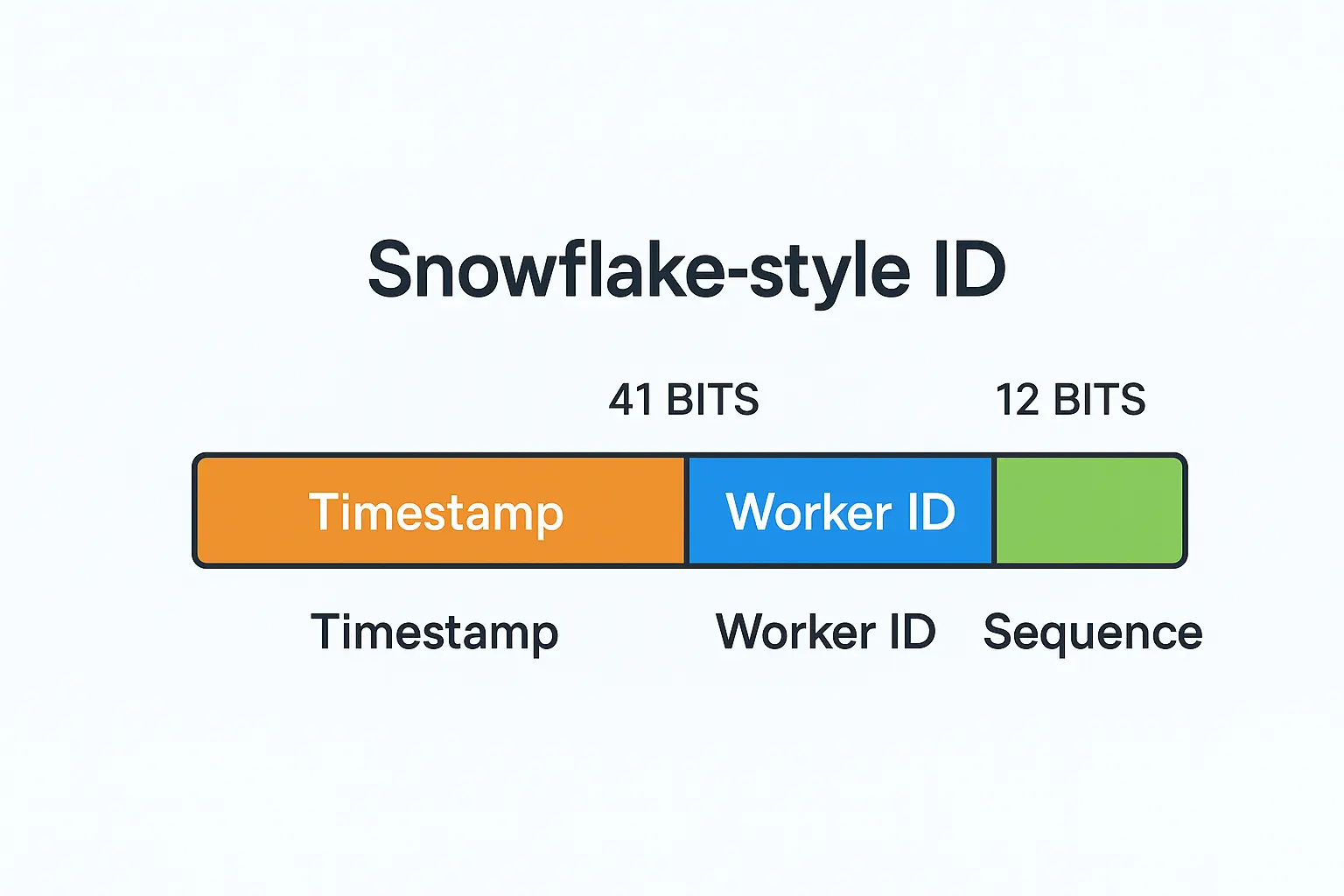
Snowflake ID Structure
Each Snowflake ID is a 64-bit integer split into a high-resolution timestamp, a worker (machine or node) ID, and a sequence number, as shown above.
In one common scheme, the first bit is 0 (sign bit), the next 41 bits hold the millisecond timestamp (since a custom epoch), the next 10 bits encode the worker or machine ID, and the last 12 bits are a sequence counter.
These fields work together as follows:
-
Timestamp (e.g. 41 bits): Records the creation time in milliseconds (usually since a custom epoch). This makes IDs time-ordered and allows systems to sort or filter items by when they were created. For example, Twitter’s epoch is Nov 04 2010, so the timestamp bits show milliseconds since then. Because the timestamp is the highest-order part of the ID, newer IDs are always larger than older ones.
-
Worker/Node ID (e.g. 10 bits): Identifies which machine or process generated the ID. In a cluster, each server has a unique worker (or machine) number. This field prevents different servers from creating the same ID. (Some Snowflake variants split these 10 bits into a 5-bit datacenter ID + 5-bit machine ID, as noted in Twitter’s design.)
-
Sequence (e.g. 12 bits): A counter that increments for each ID generated on the same worker within the same millisecond. If a node generates multiple IDs in one millisecond, the sequence bits step through 0, 1, 2, … up to their max (4095 with 12 bits) before moving to the next millisecond. This ensures that even rapid, concurrent ID requests on a single machine remain unique.
Because of this structure, Snowflake IDs are ordered by time and unique across machines.
One can decode a Snowflake ID to get its timestamp and worker ID, and the IDs naturally increment over time on each node.
Advantages and Problems Solved
Snowflake IDs solve several key problems in distributed systems by design:
-
Global Uniqueness (no collisions): By including a unique worker ID and sequence, two different servers or processes will never generate the same ID even if they act simultaneously. Each node’s ID space is disjoint, so there’s no need for a central ID service or database lock. This eliminates duplicate-ID bugs in distributed environments.
-
Time-Ordering: Since the timestamp is the most significant part, Snowflake IDs are approximately sorted by creation time. You can fetch “recent” records by looking at ID ranges. This solves the problem of needing a separate timestamp or sort key for chronological queries.
-
High Throughput: A Snowflake setup can handle very high ID generation rates. For example, with 12 sequence bits, one server can make up to 4,096 unique IDs per millisecond (over 4 million IDs/sec). The scheme automatically wraps to the next millisecond if the counter overflows, so systems rarely exhaust their ID rate.
-
No Central Bottleneck: Traditional auto-increment IDs or database sequences can become contention points under heavy load. Snowflake is stateless: each server generates IDs independently. This solves scalability issues by removing any single point of coordination.
-
Efficiency: A Snowflake ID is just a 64-bit integer, smaller than a 128-bit UUID. This saves storage and speeds up database indexing and joins.
In summary, Snowflake-style IDs provide a distributed, collision-free, and sortable way to assign identifiers at scale. They remove the need for a central ID issuer and ensure consistency even in large clusters.
Use Cases and Examples
Snowflake IDs are widely used where massive, distributed ID generation is needed. For example:
-
Social Media Posts: Twitter originally used Snowflake IDs for tweets. Each tweet’s ID encodes its post time. If two tweets occur at nearly the same moment, their sequence numbers differ so the IDs stay unique. This lets Twitter quickly order tweets by ID and derive timestamps from them. Discord and Instagram similarly use Snowflake-style IDs for messages and posts, so engineers can sort or shard data by ID.
-
Messaging and Events: In a chat app, each message might get a Snowflake ID. If two messages are sent at the same millisecond on different servers, the differing worker IDs keep the Snowflake IDs distinct. The sequence bits ensure that if one server sends several messages rapidly, each still has a unique ID.
-
Distributed Databases: When sharding databases, Snowflake IDs can serve as primary keys. Because IDs indicate the shard (via worker bits) and time, records are naturally grouped by time and location. Queries for recent records or time ranges become simple range scans on the key.
-
Logging and Data Pipelines: Systems that ingest events (logs, analytics, IoT readings) often need unique event IDs without coordination. Snowflake IDs let each sensor or process stamp its data with a globally unique ID that also tells when it was logged, aiding event ordering and deduplication.
Example Scenario
Imagine an e-commerce site with servers around the world. When customers place orders, each server generates a Snowflake ID for the order.
Because each server has a unique worker ID, no two orders will ever collide, even without talking to each other.
The order IDs are roughly increasing with time, so later orders have bigger IDs.
The business can sort orders by Snowflake ID to see recent ones first, and even decode the timestamp to see when each order was placed.
Compared to alternatives, Snowflake IDs strike a balance of features. Unlike random UUIDs, Snowflakes are time-ordered and compact.
Unlike a simple auto-increment sequence, they avoid a single point of failure or lock.
In short, Snowflake IDs solve the challenge of generating unique, meaningful IDs in large distributed systems.
🤖 Don't fully get this? Learn it with Claude
Stuck on How Do Snowflake‑Style IDs Work Timestamp, Worker, Sequence, and What Problems Do They Solve? Open Claude, copy a block below, and it'll teach you this exact concept — visually and interactively.
Build the mental picture, not memorization.
I just read a lesson on **How Do Snowflake‑Style IDs Work Timestamp, Worker, Sequence, and What Problems Do They Solve** (System Design) and want to truly understand it. Explain How Do Snowflake‑Style IDs Work Timestamp, Worker, Sequence, and What Problems Do They Solve from first principles using ONE vivid real-world analogy and a visual mental model — draw it as ASCII art or a clear step-by-step diagram — with a concrete example using real numbers. Then ask me one question to check I got the mental picture, and wait for my reply. If you're unsure or a claim isn't standard, say so and reason from first principles instead of guessing.
Socratic — adapts to where you're stuck.
Teach me **How Do Snowflake‑Style IDs Work Timestamp, Worker, Sequence, and What Problems Do They Solve** interactively. Ask me ONE guiding question at a time, wait for my answer, and adapt to my confusion — build the idea with me step by step instead of explaining it all at once. If you're unsure or a claim isn't standard, say so and reason from first principles instead of guessing.
Active recall exposes what you missed.
Quiz me on **How Do Snowflake‑Style IDs Work Timestamp, Worker, Sequence, and What Problems Do They Solve** with 5 questions, easy to tricky, ONE at a time. Tell me if each answer is right; at the end, explain clearly what I got wrong and why. If you're unsure or a claim isn't standard, say so and reason from first principles instead of guessing.
Intuition + hook + flashcards for long-term memory.
Help me remember **How Do Snowflake‑Style IDs Work Timestamp, Worker, Sequence, and What Problems Do They Solve** for the long term: give the one-sentence intuition, a memorable hook/mnemonic, a tiny worked example, and 3 active-recall flashcards (Q -> A). If you're unsure or a claim isn't standard, say so and reason from first principles instead of guessing.