What Is The Difference Between TLS And MTLS, And When Is MTLS Appropriate For Service‑to‑service Auth
TLS provides encrypted communication with one-way server authentication, whereas mTLS (mutual TLS) extends this by requiring both client and server to present and verify certificates, enabling two-way trust that is ideal for secure service-to-service authentication.
Transport Layer Security (TLS) is the standard protocol for encrypting data in transit and verifying a server’s identity in a client-server connection.
In practice, this means when you visit a secure website (HTTPS), your browser checks the server’s TLS certificate to ensure you’re talking to the legitimate server (not an impostor) and then encrypts the data exchanged so outsiders can’t read it.
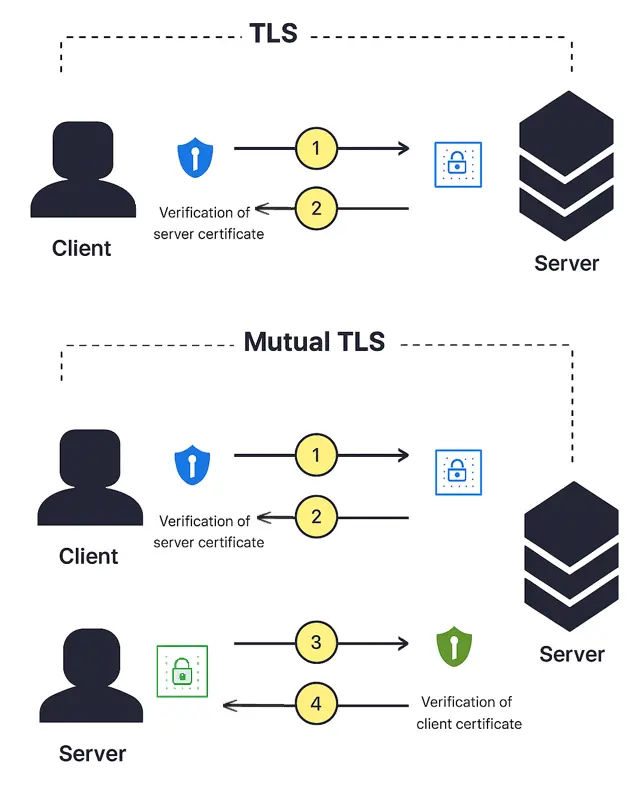
Mutual TLS (mTLS), on the other hand, builds on TLS by adding mutual authentication: not only does the client verify the server, but the server also authenticates the client’s identity via a certificate presented by the client.
In essence, TLS is like a security check where only the server shows ID, while mTLS is like both parties checking each other’s IDs before trusting each other.
Below, we’ll explore the differences in detail and explain when mTLS is appropriate, especially for service-to-service (machine-to-machine) authentication in modern systems.
Understanding TLS (Transport Layer Security)
TLS (successor to SSL) is an encryption protocol widely used on the Internet to secure web traffic, APIs, emails, and other communications.
It ensures that data exchanged between a client (like a web browser or another service) and a server is encrypted and protected from eavesdropping or tampering.
Importantly, TLS also involves server authentication: the server presents a digital certificate (issued by a trusted Certificate Authority) to prove its identity.
Your client (browser or app) verifies this certificate as part of the TLS handshake, which prevents you from unknowingly connecting to a fraudulent server.
This one-way authentication model (also called “one-way TLS” or “one-way SSL”) is very effective for public-facing services. It makes sure you are talking to the right server, but it does not require the client to have a certificate.
For example, when you connect to your bank’s website, your browser verifies the bank’s certificate, but the bank’s server doesn’t cryptographically verify your device’s identity during the handshake.
This simplicity is why TLS is the basis of HTTPS and secures most of the web: it strikes a good balance between security and usability.
However, standard TLS trusts the client by default (after the secure channel is established).
As long as the server’s identity is verified and the encrypted session is set up, the server will accept the connection and then typically rely on application-layer logins or API keys to know who the client is.
In many scenarios (like web browsing), this is sufficient. The encryption prevents snooping and the server’s identity is assured.
But if you need to verify the client’s identity at the connection level (for example, to ensure an API request is coming from an approved service and not an attacker), basic TLS alone has a gap: it doesn’t inherently prove which client is connecting.
What is mTLS (Mutual TLS)?
Mutual TLS (mTLS) is an enhanced TLS handshake that provides two-way authentication.
In an mTLS connection, both sides, the client and the server, present TLS certificates and each side verifies the other’s certificate as valid before any data flows.
In other words, mTLS adds a requirement for the client to also have a trusted certificate, effectively having each party “show credentials” to establish a secure connection.
Only when both the client and server can prove their identities to each other is the TLS connection established.
This mutual verification creates a much stronger trust model. It ensures the server is talking to an authenticated client, not just any anonymous user.
mTLS is often described as “two-way TLS” or “client certificate authentication”, because the client must present a certificate issued by a trusted authority.
The mTLS handshake has a few extra steps compared to the standard TLS handshake: after the server sends its certificate and the client verifies it, the server also requests the client’s certificate and verifies it before finalizing the secure session.
Essentially, the client proves its identity using public-key cryptography just like servers do in regular TLS.
This approach is foundational for environments that follow Zero Trust security principles.
In a Zero Trust model, nothing is implicitly trusted, and every connection (even from inside the network) must be authenticated and verified continuously.
mTLS fits perfectly here by requiring proof of identity from every client device or service that connects, thereby removing implicit trust.
Once set up, mTLS can prevent impersonation attacks and unauthorized access because a malicious actor would need a valid client certificate (issued by your organization) to even establish a connection.
This makes mTLS especially valuable for sensitive applications and internal communications where verifying who is on each end of a connection is critical.
TLS vs mTLS: Key Differences
While mTLS uses the same underlying encryption as TLS, there are important differences in authentication and usage:
-
Authentication Model: TLS uses a one-way authentication model . The client verifies the server’s identity only. mTLS uses two-way (mutual) authentication, each side validates the other’s certificate, so the server also ensures the client is who it claims to be. This two-way trust prevents client impersonation because an attacker can’t succeed without a valid client certificate.
-
Certificates Required: In a TLS setup, only the server needs a certificate (issued by a trusted CA), and clients typically rely on passwords, tokens, or other methods for login after the TLS tunnel is established. In mTLS, both parties need certificates. The client must obtain a certificate from a trusted authority (often the organization’s own Certificate Authority in internal use) and present it during the handshake. The server will trust and accept the connection only if the client’s cert is signed by the expected authority.
-
Use Case and Trust: TLS is ideal for public-facing services (websites, APIs open to third-parties, etc.) where you need encryption and assurance of server identity, but you cannot feasibly give every user a certificate. It provides sufficient protection for typical web scenarios. mTLS is suited for closed, high-trust environments where client identity verification matters, for example, service-to-service communication inside a company network, or connections involving sensitive data and strict access control. We often see mTLS in microservices architectures, internal APIs, and system-to-system integrations rather than on public websites.
-
Security Level: Both TLS and mTLS encrypt data strongly; the difference is in access control. mTLS effectively adds a built-in layer of client authentication at the connection level. This means that even if an attacker can reach your server, they cannot complete the TLS handshake or access any data without presenting a valid client cert. This helps defend against certain attacks (on-path attacks, credential theft, spoofing) because unauthenticated clients simply can’t talk to the server. In contrast, with standard TLS, an attacker who stole a user’s password could technically establish a TLS session (since any client is allowed to initiate the handshake). The server would only realize something is wrong when the stolen password is used, whereas with mTLS the attacker would also need a valid cert, significantly raising the bar for compromise.
-
Implementation Complexity: TLS is relatively easy to deploy for servers: you obtain a server certificate (e.g., via Let’s Encrypt or another CA) and configure your server to use it. Clients (browsers) already trust major CAs by default. There’s no need to manage certificates on the client side for one-way TLS, which makes it scalable and user-friendly for the open internet. mTLS adds complexity, because you must manage certificates for every client or service that connects. Organizations need a system to issue, distribute, and revoke client certificates and to ensure those certificates are present on the devices or services that need to connect. This usually means running a private Public Key Infrastructure (PKI) or using an internal CA. The overhead of handling potentially many client certs (for every microservice, application, or device) is non-trivial, which is why mTLS tends to be used only when the extra security is worth it (e.g. in enterprise or high-security environments).
-
Performance: The cryptographic operations in mTLS (verifying two certificates instead of one) introduce a slight performance cost, especially during the handshake. Standard TLS can be marginally faster and more scalable for very high traffic volumes since it only does server-side verification. mTLS has additional handshake steps and checks, which could impact performance if not managed well. That said, in modern practice the difference is minor, hardware and software optimizations, plus long-lived connections, mean mTLS overhead is usually negligible for most applications. Many service mesh and cloud platforms have optimized mTLS handshakes so that even busy microservice environments can use mTLS without a significant performance hit.
-
User Experience: For end-users, TLS is seamless. They just see a padlock in their browser. mTLS, if imposed on end-users, would require each user to install a client certificate in their browser or device, which is impractical for large public user bases. This is why mTLS is not used across the entire internet for normal web browsing: distributing and managing billions of client certificates would be nearly impossible. Instead, mTLS is confined to scenarios where the clients are known entities (like employees’ devices, partner systems, or microservice instances) that can be provisioned with certificates ahead of time.
When is mTLS Appropriate for Service-to-Service Authentication?
mTLS is particularly appropriate (and widely used) for service-to-service authentication, that is, when two servers or applications communicate with each other without a human in the loop.
In these cases, both “sides” of the connection are under some organization’s control, which makes managing client certificates feasible.
Here are some common scenarios where mTLS is the right choice:
-
Microservices and Internal APIs: In a microservices architecture (or any internal service-to-service communication), mTLS ensures that each service calls only trusted peers. For example, a payment service will only accept requests from an order service if that service presents a valid certificate. Modern microservice platforms and service meshes (like Istio) often enforce mTLS by default for all internal traffic, effectively creating an authenticated, encrypted mesh where every service trusts only calls from clients with the right certs. This stops attackers who might breach one server from impersonating that service to others, as they wouldn’t have the required certificate.
-
APIs for Partners or Sensitive Data: Companies sometimes expose APIs for use by specific partners or internal applications (such as banking APIs or healthcare data services). mTLS is appropriate here to lock down access so that only clients with a certificate your organization issued can connect. For instance, financial institutions use mTLS to ensure only authorized third-party applications or backend services can connect to their payment APIs. Even if an API key or password is leaked, an attacker still cannot connect without the client’s certificate, greatly enhancing security for sensitive integrations.
-
Zero Trust Networks: In enterprises adopting a Zero Trust security model, mTLS plays a key role in verifying devices and services. Rather than trusting a device because it’s on the corporate network, the device must present a valid certificate to prove its identity for every network connection. This is common in solutions like secure Wi-Fi, VPN access, or zero-trust application access gateways, where mTLS verifies the client device or agent before allowing access. It’s also used in container orchestration and cloud environments to authenticate nodes and services to each other continuously.
-
IoT and Device Authentication: For Internet of Things devices or other non-browser clients, mTLS can ensure that only genuine devices connect to the server. Each IoT device can be provisioned with a unique client certificate at manufacturing or deployment time. The server will reject connections from any device lacking a valid cert. This is important for, say, a smart home hub accepting camera feeds. The hub can use mTLS to confirm each camera is an approved device, thwarting unauthorized devices.
-
Closed User Groups and Client Applications: In some cases, mTLS is used for client apps in controlled environments, for example, an enterprise may issue certificates to employees’ applications or mobile devices. When those apps connect to company servers, they use mTLS so the server knows it’s an approved app instance. This can complement or even replace traditional login credentials in highly secure setups, providing passwordless authentication based on device identity.
In summary, mTLS is appropriate whenever you need strong assurance of the client’s identity in addition to the server’s.
Service-to-service and machine-to-machine scenarios are the prime examples, since you can equip each service or client with a certificate and manage them within your organization.
By contrast, for public user-facing services, mTLS is usually not appropriate because the overhead of managing certificates for every user is too high and unnecessary for the level of risk. One-way TLS plus application-level logins suffice for most public applications.
Importance and Benefits of mTLS in Service-to-Service Security
Using mTLS for internal or service-to-service authentication yields significant security benefits:
-
Defeating Impersonation and MitM Attacks: mTLS makes it extremely difficult for an attacker to impersonate a service or perform man-in-the-middle attacks. Without possessing a valid trusted certificate (which is hard to steal or forge due to strong cryptography), an attacker cannot fool a service into accepting its connection. Even if network traffic is intercepted, the mutual authentication means the interceptor can’t present a valid client cert, so the connection attempt fails.
-
Enforcing Tight Access Control: mTLS essentially whitelists which clients (services or devices) can talk to a given service. This is a powerful access control mechanism at the network level, even before any API-level authentication happens. For example, if only Service A and Service B should talk to each other, you can issue certificates to just those two and configure them to trust only each other (or certificates signed by your internal CA). No other service can successfully connect. This fine-grained control is vital in sensitive environments like banking, healthcare, or critical infrastructure.
-
Integrating with Zero Trust Architecture: mTLS supports zero trust by continuously validating identity for every request or session. It’s not a one-time check; every new connection requires the handshake. This means trust is never assumed based on network location. Every call between services re-establishes assurance. It complements other identity and access management measures to create a layered defense.
-
No Passwords to Steal or Phish: Because mTLS relies on cryptographic certificates, there are no user passwords or API keys being sent that could be phished or leaked. The private keys associated with certificates are stored securely (often in hardware or secure stores) and aren’t transmitted. This reduces the risk of common credential-based attacks; an attacker can’t simply steal a password database or trick someone into giving up a password to breach an mTLS-protected system.
On the flip side, keep in mind the operational considerations: you must handle certificate life cycles (expiration, renewal) and possibly deploy a certificate authority if you don’t use a third-party solution.
Thankfully, modern infrastructure has tools to manage this.
For instance, in Kubernetes clusters, service meshes like Istio or Linkerd can automatically issue and rotate mTLS certificates for your services.
Cloud providers and enterprise PKI solutions also offer certificate management to ease the burden.
With good tooling, the security gains of mTLS often far outweigh the setup effort for service-to-service scenarios.
🤖 Don't fully get this? Learn it with Claude
Stuck on What Is The Difference Between TLS And MTLS, And When Is MTLS Appropriate For Service‑to‑service Auth? Open Claude, copy a block below, and it'll teach you this exact concept — visually and interactively.
Build the mental picture, not memorization.
I just read a lesson on **What Is The Difference Between TLS And MTLS, And When Is MTLS Appropriate For Service‑to‑service Auth** (System Design) and want to truly understand it. Explain What Is The Difference Between TLS And MTLS, And When Is MTLS Appropriate For Service‑to‑service Auth from first principles using ONE vivid real-world analogy and a visual mental model — draw it as ASCII art or a clear step-by-step diagram — with a concrete example using real numbers. Then ask me one question to check I got the mental picture, and wait for my reply. If you're unsure or a claim isn't standard, say so and reason from first principles instead of guessing.
Socratic — adapts to where you're stuck.
Teach me **What Is The Difference Between TLS And MTLS, And When Is MTLS Appropriate For Service‑to‑service Auth** interactively. Ask me ONE guiding question at a time, wait for my answer, and adapt to my confusion — build the idea with me step by step instead of explaining it all at once. If you're unsure or a claim isn't standard, say so and reason from first principles instead of guessing.
Active recall exposes what you missed.
Quiz me on **What Is The Difference Between TLS And MTLS, And When Is MTLS Appropriate For Service‑to‑service Auth** with 5 questions, easy to tricky, ONE at a time. Tell me if each answer is right; at the end, explain clearly what I got wrong and why. If you're unsure or a claim isn't standard, say so and reason from first principles instead of guessing.
Intuition + hook + flashcards for long-term memory.
Help me remember **What Is The Difference Between TLS And MTLS, And When Is MTLS Appropriate For Service‑to‑service Auth** for the long term: give the one-sentence intuition, a memorable hook/mnemonic, a tiny worked example, and 3 active-recall flashcards (Q -> A). If you're unsure or a claim isn't standard, say so and reason from first principles instead of guessing.