What Is The Difference Between SLI, SLO, And SLA, And Can You Give Simple Examples
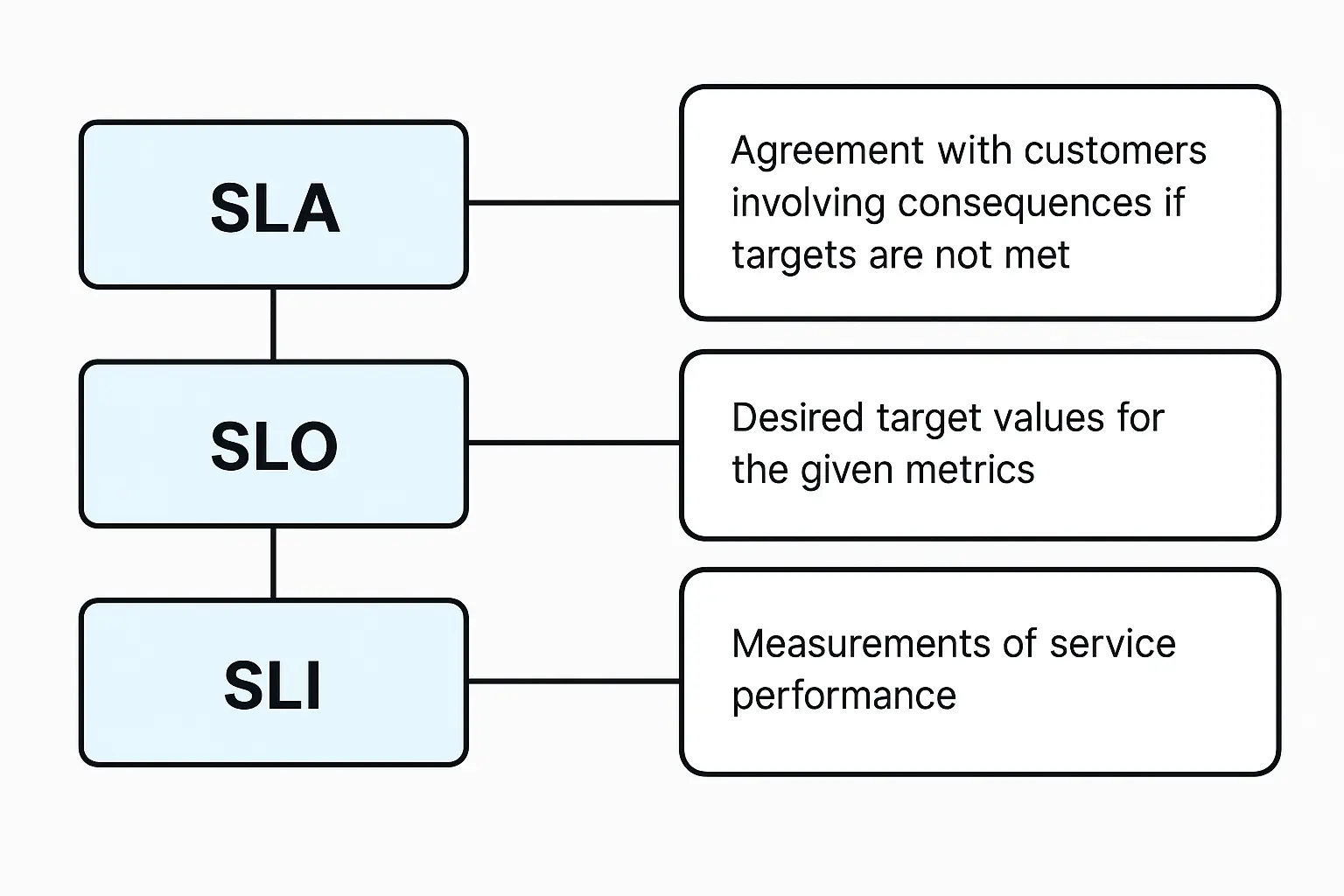
SLIs are the raw metrics measuring service performance (like latency or uptime); SLOs are the internal target values for those metrics (e.g. aiming for 99.9% uptime); and SLAs are formal agreements with customers that those targets will be met, often with penalties if they aren’t.
These three acronyms, SLI, SLO, and SLA, are fundamental in site reliability engineering (SRE) and IT service management, defining how we measure and guarantee the quality of a service.
In simple terms, SLIs tell you what you’re measuring, SLOs define how good it should be, and SLAs specify what happens if it isn’t met.
Understanding the difference between SLI, SLO, and SLA is crucial for beginners and interview prep, as it shows you know how reliability is quantified and maintained in real-world systems.
Below, we break down each term and explain why they matter.
Definition and Meaning of Service Level Indicator (SLI)
A Service Level Indicator (SLI) is a quantitative metric that indicates how a service is performing.
In other words, an SLI measures a specific aspect of the service’s level of performance or reliability. It’s essentially the one-word answer to “What are we measuring to judge the service?”, metrics.
A good SLI directly reflects the user’s experience of the service.
Common SLIs include metrics like:
-
Availability/Uptime: e.g. the percentage of successful requests (no errors) out of total requests, or the fraction of time the service is up. (“Can we respond to requests?”)
-
Latency/Response time: e.g. the 95th percentile of request latency (how long it takes for a response). “How fast is the service?”.
-
Error rate: e.g. the ratio of failed requests to total requests, often expressed as a percentage of errors (the inverse of success rate).
-
Throughput: e.g. number of requests processed per second or transactions per minute (overall capacity).
SLIs are measured continually (often via monitoring tools) to collect actual performance data.
For example, an SLI might be “99.2% of HTTP requests in the last 30 days returned a success status.”
This measured value is then used to evaluate against the objectives and agreements (SLOs and SLAs).
Key point: An SLI is just the measurement. By itself, it doesn’t say if the value is good or bad, it simply reports what’s happening. We interpret an SLI by comparing it to a target (SLO) or requirement (SLA).
Why SLIs Matter
SLIs provide actionable insights into system behavior.
By tracking SLIs over time, teams can spot performance trends and detect issues early.
In fact, SLIs are essential for determining whether SLOs are met. Without accurate SLIs, you can’t tell if you’re hitting your objectives.
It’s important to choose SLIs that truly matter to users (for example, measuring page load time is more user-centric than CPU load).
Too many metrics or irrelevant metrics can be noisy and unhelpful.
Focus on a handful of SLIs that capture user-facing quality (often called “key performance indicators” for service reliability).
| Aspect | SLI (Service Level Indicator) | SLO (Service Level Objective) | SLA (Service Level Agreement) |
|---|---|---|---|
| Definition | A measurable metric that reflects the performance of a service (e.g., uptime, latency, error rate). | A target or threshold set for an SLI that defines acceptable performance. | A formal contract between provider and customer defining service guarantees and consequences for failure. |
| Purpose | To quantify service performance. | To set internal reliability goals. | To formalize commitments and enforce accountability. |
| Example | “99.95% uptime” or “average latency of 120 ms.” | “Uptime should be at least 99.9% per month.” | “If uptime drops below 99.9%, refund 10% of the monthly fee.” |
| Focus Area | Measurement and monitoring. | Reliability targets and objectives. | Customer expectations and business commitments. |
| Owned By | Engineering / Operations teams. | Product / SRE teams. | Business / Legal teams. |
Definition and Purpose of Service Level Objective (SLO)
A Service Level Objective (SLO) is a specific target or goal for service performance on a given SLI, over a defined time period.
In essence, an SLO says “This is how we define acceptable performance”. It’s like an internal reliability goal that your team commits to.
An SLO combines an SLI with a threshold (and time window), answering “What values of the metric are good enough, and over what period?”.
For example, an SLO might be: “99.9% of requests will succeed over each calendar month”.
This means you’re aiming for no more than 0.1% of requests failing in any month.
Key Components of an SLO: a metric, a target value, and a time window.
For instance, uptime (metric) target 99.9% over a 30-day month is an SLO.
If in a given month the service is up 99.9% of the time or better, you met the objective; if it’s 99.0%, you missed it.
SLOs are usually set as the “minimum acceptable reliability” from the users’ perspective, not the ideal or maximum.
According to Google SREs, an SLO should define “the lowest level of reliability that you can get away with” and still keep users happy. This mindset prevents over-engineering for 100% perfection and allows some wiggle room for maintenance and innovation.
For example, aiming for 100% uptime might be unrealistic or extremely costly, so a realistic SLO might be 99.99% (allowing a tiny bit of downtime, known as an error budget).
SLOs are typically internal goals, used by engineering teams to guide their work.
They may or may not be directly disclosed to customers (often customers see the SLA, which is based on the SLOs).
By monitoring SLOs, teams can proactively address issues: if an SLO is in danger of being missed, engineers can be alerted and respond before it turns into an SLA breach that customers notice.
In this way, SLOs act as a safety buffer for SLAs, helping maintain reliability and avoid breaking promises to users.
Why SLOs Matter
SLOs are crucial for reliability management.
They serve as a shared goal for development, SRE, and product teams, ensuring everyone knows what “good enough” looks like.
By setting realistic SLOs, teams can balance reliability with new feature development, for instance, using the error budget (the portion of time you’re allowed to be below target) to decide when to pause and fix reliability issues versus when to roll out updates.
SLOs also provide a clear trigger for action: if an SLO is violated, it’s a signal to investigate and improve that aspect of the service.
In summary, SLOs turn vague promises into concrete, measurable targets that drive operational decisions and continuous improvement.
Service Level Agreement (SLA)
A Service Level Agreement (SLA) is a formal agreement or contract between a service provider and the customer (or user) that defines the expected level of service.
The SLA typically documents specific service commitments (often in line with certain SLOs) and importantly, the consequences or remedies if those commitments are not met.
In plain terms, an SLA says “We promise you this level of service; if we don’t deliver, here’s what happens (e.g. credits or penalties)”.
Key features of an SLA:
-
Defined Service Levels: The SLA spells out the metrics and targets the customer can expect. For example, an SLA might guarantee 99.9% uptime per month, or a response time for support requests under a certain limit (e.g. “critical tickets will be answered within 1 hour”). These targets in the SLA are usually the same or slightly lower than internal SLOs, to ensure the provider has a buffer. (If the team’s SLO is 99.9% uptime internally, they might promise 99.5% in the SLA, ensuring they’ll meet the contract if they meet their stricter internal goal.) Not all SLAs are the same. They can vary by service or customer tier, and often include multiple metrics/commitments in one agreement.
-
Consequences of Failure: The SLA outlines what happens if the provider fails to meet the agreed targets. Typically, this includes financial penalties or service credits to the customer. For example, the SLA might state that if uptime falls below 99.9% in a month, the customer will receive a credit of X% of their monthly fee. This makes the SLA a binding promise. There’s a real cost to not meeting it. In extreme cases, an SLA might allow contract termination if service levels are consistently not met.
-
Scope and Exclusions: An SLA will define the scope of services covered and any exceptions. For instance, an SLA might exclude downtime caused by scheduled maintenance or force majeure events. It also clarifies responsibilities (e.g. what “uptime” exactly includes, how it’s measured, etc.). This prevents misunderstandings about the commitments.
SLAs are usually drafted by a company’s business and legal teams (often in consultation with technical teams) because they are part of the contract with customers.
Only paid or formal service offerings typically have SLAs. For example, a cloud provider or an enterprise software vendor will have SLAs for their paying customers, whereas a free app or internal service might not have an official SLA.
Why SLAs Matter
An SLA is all about setting clear expectations and trust with customers. It gives the customer confidence in the service quality (or at least compensation if things go wrong).
For the provider, it’s a way to formally commit to reliability standards.
SLAs also create accountability. Because breaking an SLA has tangible consequences, it motivates organizations to invest in reliability and maintain the service levels promised.
In an interview or practical context, understanding SLAs shows that you grasp not just the technical side of reliability (SLIs/SLOs) but also the business/customer side; the promises and accountability that go along with those technical measures.
SLI vs SLO vs SLA (Key Differences)
Now that we’ve defined each term, let’s summarize the differences between SLI, SLO, and SLA. Though they are closely related (and even sound similar), each has a distinct role:
-
Definition: An SLI is a metric (indicator) that measures some aspect of service performance. An SLO is a target value or range for an SLI, defining what is considered acceptable performance. An SLA is an agreement that includes one or more SLOs as promises to the customer, typically with enforcement clauses.
-
Perspective (Internal vs External): SLIs and SLOs are usually internal to the organization. SLOs are used by the engineering/product teams as goals to ensure the service stays reliable for users. In contrast, SLAs are external; they are made with customers or users and form part of a service contract. In short, SLOs are the team’s reliability goals, whereas SLAs are the customer-facing promises.
-
Enforcement & Consequences: If an SLO is missed, it’s an internal issue. It might trigger alerts or a post-mortem, but there’s no legal penalty. The team will work to fix the problem to remain within error budgets and keep users happy. However, if an SLA is missed, there is a contractual consequence: the company might owe service credits, financial penalties, or other remedies to the customer. Repeated SLA violations can even lead to customers leaving or legal disputes. Thus, SLOs carry internal accountability, while SLAs carry external accountability (often legally binding).
-
Flexibility: SLIs (metrics) are most flexible. You can start or stop measuring something or change how you measure as needed (though you should choose stable, meaningful SLIs). SLOs (objectives) are somewhat flexible; teams can adjust SLO targets over time (for instance, you might tighten an SLO from 99% to 99.5% as you improve, or loosen it if it was found unattainable). SLAs are the least flexible once agreed upon, changing an SLA usually requires renegotiating the contract or service terms. This is why organizations carefully define SLOs first and only then commit to SLAs that they’re confident they can meet consistently.
-
Hierarchy/Relationship: You can think of SLI, SLO, and SLA as a hierarchical stack or chain. “SLIs inform SLOs, which guide SLAs”. In practice, the actual measured performance (SLI) is checked against the target (SLO), and the SLA is essentially achieved if the SLOs are met (or breached if they are not). Another way to see it: SLIs are the building blocks, SLOs are the objectives built on those metrics, and SLAs are the top-level commitments built on those objectives. Many teams use SLOs as a tool to ensure they don’t violate SLAs. By setting SLOs a bit stricter, they create a buffer (error budget) to catch issues early.
-
Analogy: For a non-technical analogy, imagine health and fitness goals: Say you track your daily step count as an indicator (SLI). You set a goal to walk 10,000 steps a day (SLO). Now, you make a pact with a friend that if you don’t hit that goal at least 5 days a week, you owe them a coffee (agreement with consequence; analogous to SLA). In this analogy, the step count is the metric (SLI), 10k steps daily is the objective (SLO), and the deal with your friend is like the SLA. It shows how these concepts layer: measure -> goal -> agreement.
Examples of SLI, SLO, and SLA in Practice
To make these concepts more concrete, let’s look at a couple of simple scenarios and identify the SLI, SLO, and SLA in each.
Example 1: Web Service Uptime and Performance
Scenario: You run an online service (e.g. a website or API), and you want to ensure it’s reliable for users.
-
SLI (Measurement): You decide to measure the service’s uptime as a key indicator. Using monitoring tools, you track the percentage of time the service is available (or the percentage of requests that succeed without errors). After a month, suppose the service uptime SLI is measured at 99.2%.
-
SLO (Internal Goal): Your team sets an SLO: 99.9% uptime over each month. This means out of all the minutes in a month, at most 0.1% downtime is acceptable (about 43.2 minutes of downtime per month). The SLO is stricter than the current measurement, so the team might need to improve infrastructure or fix bugs to hit this goal consistently. You also have a second SLO for performance, say, “95% of page requests should load in under 300ms over a week”. These objectives guide the team’s work and alerting. If uptime drops toward 99.9% or lower, engineers get notified to intervene.
-
SLA (External Agreement): To customers, you promise a slightly looser target in the service contract: for example, 99.5% uptime per month (this is the SLA). The SLA states that if monthly uptime falls below 99.5%, customers will get a certain credit or refund. In effect, the SLA includes the key SLOs (like uptime) as committed service levels. In our scenario, if one month you hit 99.2% uptime (SLI), you have failed the 99.9% SLO (internal goal missed) and also failed the 99.5% SLA (external promise broken). Customers would then be entitled to the compensation defined in the SLA. However, if you achieved, say, 99.96% uptime, that misses the SLO of 99.9 (since 99.96% < 99.99%) but still meets the SLA of 99.5%. In that case, your team uses the miss of the internal SLO as a warning to improve reliability (because you’ve used up most of your error budget), even though customers aren’t yet complaining.
In this web service example, the SLI is the measured uptime percentage, the SLO is the 99.9% target the team aims for, and the SLA is the 99.5% uptime guarantee you formally give to users with penalties if not met.
This layered approach helps ensure users get what they’re promised while giving the team a clear goal and a buffer to fix issues before customers are impacted.
Example 2: Pizza Delivery Guarantee (Everyday Analogy)
Scenario: A pizza delivery store promises “Pizza in 30 minutes or it’s free” to its customers.
-
SLA: The promise of “delivery within 30 minutes or the customer doesn’t pay” is the SLA. It’s a public guarantee (essentially a contract with the customer). It sets the expectation for service speed and defines a consequence (free pizza) if the promise is broken. This is customer-facing and is meant to ensure satisfaction.
-
SLI: The SLI here would be the actual delivery times. The store will track how long deliveries are actually taking. For example, on a given day, maybe 92% of orders were delivered within 30 minutes, while 8% took longer (and thus those customers got free pizza). Delivery time is the performance metric being monitored for each order.
-
SLO: The store’s management might set an internal SLO like “at least 95% of pizzas should be delivered in under 30 minutes per month.” This is a goal for the team (drivers, kitchen staff, etc.) to achieve high reliability. It’s not advertised to customers, but it’s used internally to maintain quality. If one week only 90% of pizzas met the 30-minute goal, that falls short of the SLO. The manager might investigate why (maybe there were not enough drivers or an oven breakdown) and fix the process. As long as they keep performance above, say, 90% on-time, the occasional late pizza (which triggers the SLA consequence of a free pizza) is manageable. They’ll aim to meet the 95% SLO to minimize how often they have to give out freebies and to keep customers happy.
In the pizza example, you can see the parallels: SLI = actual delivery time data, SLO = 95% on-time delivery target, SLA = 30-min promise with free pizza if late.
This everyday scenario shows that even outside of tech, the concept of measuring service, setting a goal, and having a promise/penalty for meeting or missing that goal is intuitive.
How SLI, SLO, and SLA Work Together (and Why They’re Important)
When used together, SLIs, SLOs, and SLAs create a framework for service reliability.
Here’s how they interact:
-
SLIs (metrics) provide the data. They measure what is actually happening in your service. For example, your monitoring might show an SLI like “average response time = 250 ms” or “uptime this week = 99.97%”.
-
SLOs (objectives) take those metrics and set targets for what should happen. They establish the performance goals your team wants to achieve (e.g. “99% of responses should be under 300 ms”). SLOs help teams stay proactive: by monitoring SLIs against SLO thresholds, you can take action before users are widely affected. In fact, SLOs are key to preventing SLA breaches. They are usually a bit more strict than the SLA, so if you keep SLOs green, your SLAs will almost certainly be met. As one source notes, setting realistic internal SLOs helps teams maintain reliability and address issues before they impact customers.
-
SLAs (agreements) formalize the expectations and accountability. They are built on the foundation of SLOs and SLIs, but add the customer commitment aspect. An SLA basically says “We agree to this level of service (as measured by these SLIs) with these SLO values, and here’s what we’ll do if we fail.” It’s the external layer that ensures the organization is aligned with customer expectations and trust.
Together, these three concepts ensure that everyone is on the same page: the ops/engineering team knows what to measure (SLI) and what to aim for (SLO), and the customers know what to expect (SLA).
By tracking SLIs and adhering to SLOs, a company can reliably meet its SLAs, thereby keeping users satisfied and avoiding penalties.
This alignment of expectations with actual performance is why SLI/SLO/SLA are so important in modern service management.
They enforce a culture of data-driven reliability: teams are always measuring, evaluating against goals, and aware of their commitments.
(In summary: SLAs set the customer’s expectations, SLOs set the team’s goals to meet those expectations, and SLIs provide the evidence of how the service is performing relative to those goals. By understanding and using SLI, SLO, and SLA, even junior engineers and students can better grasp how reliable systems are managed in real-world scenarios.)
🤖 Don't fully get this? Learn it with Claude
Stuck on What Is The Difference Between SLI, SLO, And SLA, And Can You Give Simple Examples? Open Claude, copy a block below, and it'll teach you this exact concept — visually and interactively.
Build the mental picture, not memorization.
I just read a lesson on **What Is The Difference Between SLI, SLO, And SLA, And Can You Give Simple Examples** (System Design) and want to truly understand it. Explain What Is The Difference Between SLI, SLO, And SLA, And Can You Give Simple Examples from first principles using ONE vivid real-world analogy and a visual mental model — draw it as ASCII art or a clear step-by-step diagram — with a concrete example using real numbers. Then ask me one question to check I got the mental picture, and wait for my reply. If you're unsure or a claim isn't standard, say so and reason from first principles instead of guessing.
Socratic — adapts to where you're stuck.
Teach me **What Is The Difference Between SLI, SLO, And SLA, And Can You Give Simple Examples** interactively. Ask me ONE guiding question at a time, wait for my answer, and adapt to my confusion — build the idea with me step by step instead of explaining it all at once. If you're unsure or a claim isn't standard, say so and reason from first principles instead of guessing.
Active recall exposes what you missed.
Quiz me on **What Is The Difference Between SLI, SLO, And SLA, And Can You Give Simple Examples** with 5 questions, easy to tricky, ONE at a time. Tell me if each answer is right; at the end, explain clearly what I got wrong and why. If you're unsure or a claim isn't standard, say so and reason from first principles instead of guessing.
Intuition + hook + flashcards for long-term memory.
Help me remember **What Is The Difference Between SLI, SLO, And SLA, And Can You Give Simple Examples** for the long term: give the one-sentence intuition, a memorable hook/mnemonic, a tiny worked example, and 3 active-recall flashcards (Q -> A). If you're unsure or a claim isn't standard, say so and reason from first principles instead of guessing.