hard What Is the Difference Between Soft TTL and Hard TTL, and Why Does It Matter
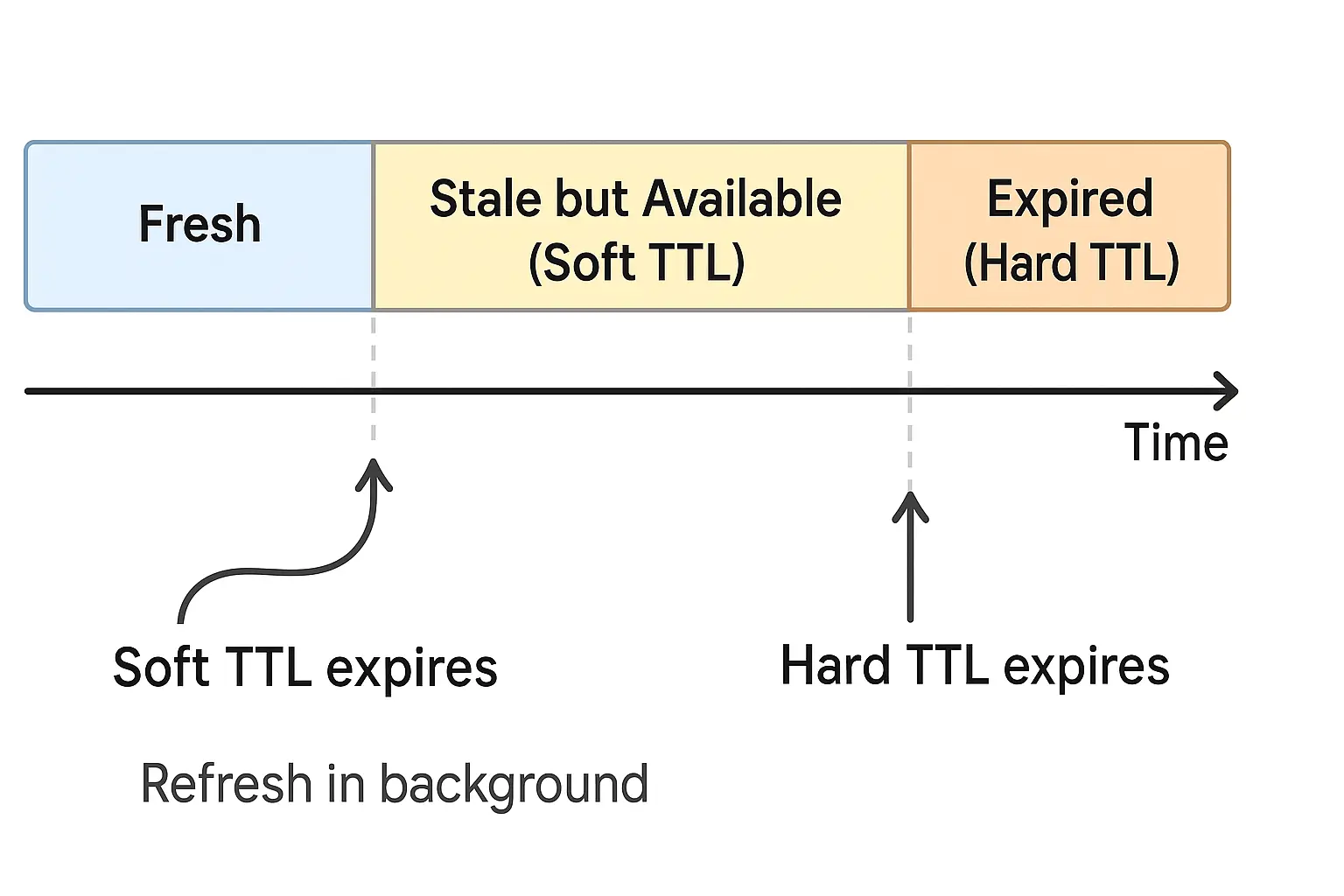
Soft TTL is the time after which a cached item is considered stale and triggers a refresh attempt without immediate eviction, whereas hard TTL is the absolute expiration time after which the cached item is invalidated and no longer served.
This means a cache uses a soft time-to-live as a grace period to update data in the background, and a hard time-to-live as a strict cutoff to ensure data freshness.
Understanding TTL (Time to Live) in Caching
Time to Live (TTL) in caching is the duration an object remains fresh in a cache before it expires. In other words, TTL is an object’s “freshness lifetime”; once that time passes, the object becomes stale and should be revalidated or refreshed.
For example, a cache entry might have a TTL of 60 seconds, meaning it’s considered up-to-date for one minute.
After the TTL expires, the cache will usually stop serving that item (or will revalidate it) to avoid serving outdated data.
TTL balances cache performance and data freshness.
Shorter TTLs update data more frequently (reducing staleness but increasing load and latency), while longer TTLs improve performance and reduce server load (but risk serving stale data longer).
The key challenge is choosing a TTL that’s long enough for efficiency but short enough to keep data accurate.
What Is a Soft TTL?
A soft TTL (soft expiration time) is a secondary, shorter TTL used as a grace period or early expiration threshold for cached data.
When the soft TTL is reached, the cached item is marked stale and triggers a refresh in the background, but the existing cached value is still served to users until new data is fetched or until the hard TTL is hit.
In practical terms, once the soft TTL expires:
-
The system will attempt to fetch fresh data from the origin or database (often asynchronously or on the next request).
-
If the refresh succeeds, the cache is updated with the new data and the TTLs are reset.
-
If the origin is unavailable or the refresh fails, the cache will continue serving the old (stale) data to users, rather than leaving the cache empty. The stale data can be served up until the hard TTL is reached.
Think of soft TTL as a “best before” date for cache content; when it passes, you should start getting a fresh version, but you can tolerate the old version for a bit longer if needed.
This mechanism improves latency and availability: users get a response from cache immediately (even if slightly stale), and the system fetches updates in the background.
For instance, some caching frameworks use soft TTL to serve stale content within a grace window while kicking off a background refresh.
This is similar to the “stale-while-revalidate” strategy in HTTP caching, where a cache can serve slightly stale content while it silently revalidates it for the next request.
What Is a Hard TTL?
A hard TTL (hard expiration time) is the final or absolute expiration for a cached item. When the hard TTL is reached, the cached data is considered expired and invalid. The cache must not serve it anymore unless it has been refreshed.
At hard TTL, if no fresh data is available, the cache entry is typically evicted or marked unusable (forcing the next request to fetch from the source).
In other words, hard TTL is a strict cut-off point for data freshness.
Using the earlier analogy, hard TTL is like the “expiration date” after which you throw the item out. It ensures correctness by preventing the cache from serving data that is too old or potentially incorrect.
Hard TTL is usually set longer than soft TTL. For example, you might have a soft TTL of 5 minutes and a hard TTL of 30 minutes for a given item.
This means the system tries to refresh the data after 5 minutes, but even if that fails, it will not use the cached data beyond 30 minutes.
Hard TTL guarantees eventual freshness: no matter what, the data will be refreshed by that hard deadline or not served at all.
Soft TTL vs Hard TTL: Key Differences
Both soft and hard TTL are measured in time (seconds, minutes, etc.), but they play different roles in a caching strategy.
Here are the key differences between soft TTL and hard TTL:
-
Expiration Behavior:
– Soft TTL triggers a background refresh of the cached item when it expires, without immediately evicting the item. The data is marked stale but can still be used if needed.
– Hard TTL triggers a full expiration of the item. Once hard TTL expires, the cached data is invalidated and removed (or not used) regardless of origin availability. -
Duration:
– Soft TTL is typically shorter than hard TTL. It’s an early threshold meant to keep data fairly fresh without abrupt removal.
– Hard TTL is longer, representing the maximum lifespan of the data in cache. The hard TTL must be equal to or greater than the soft TTL (often significantly greater) to allow a refresh window. -
Staleness vs Freshness:
– Soft TTL allows serving stale data (data older than soft TTL but newer than hard TTL) if fresh data cannot be fetched in time. This accepts a bit of staleness to maintain availability.
– Hard TTL prioritizes freshness. It ensures that no data older than the hard TTL is ever served, preventing indefinitely stale content. -
Purpose:
– Soft TTL is about latency and resilience. It avoids a cache miss by serving cached data quickly while updating in the background. It’s designed to reduce load on the backend and avoid downtime if the backend is slow or temporarily down.
– Hard TTL is about correctness and data integrity. It puts an upper bound on how out-of-date data can get. Even if the backend has issues, hard TTL makes sure the system doesn’t serve content that is too old, thereby forcing a update or failover after that point. -
Failure Handling:
– After soft TTL expiry, if the origin fails to respond (e.g. service outage), the cache can continue to use the last good value until hard TTL hits. This is a graceful degradation. Users might get slightly outdated info, but the system stays up.
– After hard TTL expiry, if the origin is still unavailable and no update was obtained, the cache will not serve the old data. At this point, the system may return an error or empty result rather than serve deeply stale data. Hard TTL thus draws a line to prevent serving content that could be dangerously outdated.
In summary, soft TTL is a soft expiration that trades off some data freshness for improved reliability and performance, whereas hard TTL is a hard expiration that guarantees data won’t become too stale.
By using them together, a cache can serve content quickly and reliably without “lying” to users about data that’s far out-of-date.
Why Do Soft TTL and Hard TTL Matter?
Using a combination of soft and hard TTL in caching is important for several reasons:
-
Improved Resilience and Availability: Soft TTL + hard TTL is a common pattern to keep systems running during backend outages or slowdowns. With a soft TTL, your service can withstand downstream service failures by serving cached data a bit longer instead of failing outright. For example, Amazon Web Services uses this pattern in some services (like AWS IAM) so that if a dependency is down, the service keeps working with cached data until the hard TTL is reached. This avoids cascading failures. Your app continues to function (with possibly stale data) rather than crashing or returning errors.
-
Reduced Load Spikes (Preventing Cache Stampede): Soft TTL helps avoid the “cache stampede” or thundering herd problem where many caches expire at once and all fetch from the database simultaneously. Instead of evicting data immediately at expiration, soft TTL staggers the refresh: one request triggers the refresh while others temporarily get the stale data. This means no sudden surge of requests to the database at a single expiration time, smoothing out load on the origin. It’s effectively a grace period that protects the backend from bursts of traffic.
-
Optimized Latency: Serving from cache (even stale) is faster than fetching from a remote source. Soft TTL ensures that users experience low latency because the cache can respond immediately with a cached item even after it’s technically stale, while asynchronously updating it. This provides a better user experience and the system remains fast and responsive, as there’s often no visible pause for refresh (especially if the refresh completes before the next user request). The hard TTL in turn ensures this doesn’t happen indefinitely.
-
Data Freshness Guarantees: The hard TTL is critical for guaranteeing that users don’t see extremely outdated information. It sets a limit on staleness. This matters for data correctness and user trust. For example, if you’re caching stock prices or time-sensitive information, you may allow a short grace period of stale data (soft TTL) to cover minor outages, but you need a hard TTL to ensure users never see data older than, say, 15 minutes. Without a hard TTL, a cache could keep serving old data forever if the refresh keeps failing, which could be harmful. Hard TTL enforces an update or an intentional failure (which might be better than showing wrong data).
-
Balanced Performance vs Consistency: By combining the two TTLs, you strike a balance between performance and consistency. Soft TTL leans toward performance (serving from cache to avoid delay), and hard TTL leans toward consistency (making sure data is eventually updated). This dual approach matters in systems where neither constant real-time fetch (too slow) nor long-term caching (too stale) alone is acceptable. Essentially, soft and hard TTL together provide a controlled trade-off between cache freshness and system reliability (soft TTL for speed, hard TTL for correctness).
Example Scenario
Imagine a web application caching product prices from a database.
The data isn’t updated very often (perhaps a few times a day), but it’s critical to always show reasonably up-to-date prices:
-
You set a soft TTL of 5 minutes and a hard TTL of 30 minutes for each product’s price in the cache.
-
Normal operation: Users repeatedly fetch product pages, and the prices come from the cache (fast response). After 5 minutes (soft TTL), the next user request for that product will trigger a background refresh from the database while still instantly returning the last cached price to the user. This way, the user isn’t kept waiting, and the cache begins updating for the next request.
-
If the database is temporarily slow or down: When the soft TTL is hit, the app tries to get fresh data but fails (downstream service is unavailable). Thanks to the soft TTL strategy, the app will continue serving the last known price from cache (which is now stale) rather than showing an error or empty data. Users can still see a price and continue shopping, and your site remains up. The system keeps doing this for up to 30 minutes.
-
Hard TTL expiry: If 30 minutes pass without a successful refresh (meaning the data in cache is now quite old), the hard TTL expires. At that point, the cached price is no longer served. The next request will either fetch a fresh price (if the database has recovered) or, if the database is still down, you might choose to show an error or a default message (since showing a 30+ minute old price might be misleading or against business rules). In practice, one would rarely want to hit the hard TTL; it’s a safety net to avoid very stale data.
In this scenario, the soft TTL ensured high availability and low latency. The site kept working and was fast.
The hard TTL ensured that users wouldn’t see prices older than 30 minutes, maintaining a level of correctness.
This illustrates why the difference between soft and hard TTL matters: together they let you serve “stale-but-safe” data for a while, but not forever.
Another real-world example is HTTP caching with “stale-if-error” or CDN caches.
Many CDNs allow serving stale content for a short time if the origin server is down (similar to a soft TTL grace period), and they have a maximum TTL after which the content must be refreshed from the origin.
The concept is maximizing uptime and performance without sacrificing eventual correctness.
Best Practices and Tips
When using soft and hard TTL in your caching strategy, keep in mind:
-
Set appropriate values: The soft TTL should reflect how long you’re comfortable serving stale data (e.g., a few seconds or minutes for rapidly changing data, or longer for mostly static data). The hard TTL should be set based on the maximum staleness you can tolerate. Always ensure the hard TTL is >= soft TTL (hard TTL typically is a multiple of soft TTL).
-
Monitor and adjust: Track cache hit rates and how often soft TTL refreshes happen. If you find the data is almost always fresh on refresh, you might extend the TTLs; if users are often getting stale data, you might shorten them or implement proactive invalidation. Also, watch for any errors at refresh. You want to know if data isn’t updating before hard TTLs expire.
-
Avoid too long grace periods: While serving stale data is better than failing, very long soft TTL periods could mask system problems or serve significantly outdated info. Use soft TTL as a temporary cushion, not a crutch for very long outages unless that’s acceptable in your context.
-
Combine with other strategies: Soft/hard TTL is often used alongside tactics like request coalescing (to prevent many simultaneous refreshes), randomized TTL jitter (to avoid all items expiring at once), and negative caching (caching error responses for a short time). These can further improve stability of the cache system.
🤖 Don't fully get this? Learn it with Claude
Stuck on What Is the Difference Between Soft TTL and Hard TTL, and Why Does It Matter? Open Claude, copy a block below, and it'll teach you this exact concept — visually and interactively.
Progressively stronger hints — you still solve it.
I'm working on the problem **What Is the Difference Between Soft TTL and Hard TTL, and Why Does It Matter** (System Design). Give me a HINT LADDER: start with the tiniest nudge, then wait. Only reveal the next, stronger hint when I ask. Do NOT show the full solution unless I type 'show solution'. Keep me doing the thinking. If you're unsure or a claim isn't standard, say so and reason from first principles instead of guessing.
See the technique, not just code.
Explain the optimal approach to **What Is the Difference Between Soft TTL and Hard TTL, and Why Does It Matter** with a VISUAL walkthrough: trace it on a small concrete example using ASCII art / a step-by-step diagram, narrate what changes each step, then give time & space complexity with a one-line derivation. If you're unsure or a claim isn't standard, say so and reason from first principles instead of guessing.
Catch bugs, edge cases, sub-optimality.
I'll paste my solution to **What Is the Difference Between Soft TTL and Hard TTL, and Why Does It Matter**. Review it for correctness, missed edge cases, and time/space complexity, then coach me toward the optimal — don't just rewrite it. Ask me to paste my code now. If you're unsure or a claim isn't standard, say so and reason from first principles instead of guessing.
Lock in recognition with look-alikes.
Give me 2 problems that use the SAME underlying pattern as **What Is the Difference Between Soft TTL and Hard TTL, and Why Does It Matter**. For each, let me attempt first, then review my answer and name the trigger signal that reveals the pattern. If you're unsure or a claim isn't standard, say so and reason from first principles instead of guessing.