What Is Graceful Degradation, and How Do Feature Flags Help Availability
Graceful degradation keeps a system available under partial failure or overload by deliberately dropping or downgrading non-essential work — shedding requests, deferring them, or serving cheaper results — so the scarce resource (CPU, a failing dependency, a saturated thread pool) is spent only on the critical path instead of being exhausted by every feature at once. A feature flag is the mechanical lever that makes this instant: it is a runtime branch, if flag(x) then new_path else fallback, evaluated per request, so flipping the flag in a dashboard reroutes live traffic to a safe fallback in seconds without a redeploy. That turns a flag into a manual — or monitoring-triggered — circuit breaker over any code path.
Degradation vs. fault tolerance — not the same lever
Fault tolerance hides a failure by having redundancy ready: a hot standby or active-active replica takes over with no visible quality loss. Graceful degradation instead accepts a loss of quality to survive. A fault-tolerant tier fails over to a duplicate server seamlessly; a gracefully degrading tier serves lower-resolution images, disables a recommendations widget, or rejects 5% of traffic during a surge. Redundancy is the answer to a machine died; degradation is the answer to everything is here but there is not enough capacity / a dependency is sick — the two failure classes redundancy cannot fix, because adding replicas of an overloaded or buggy path just multiplies the problem.
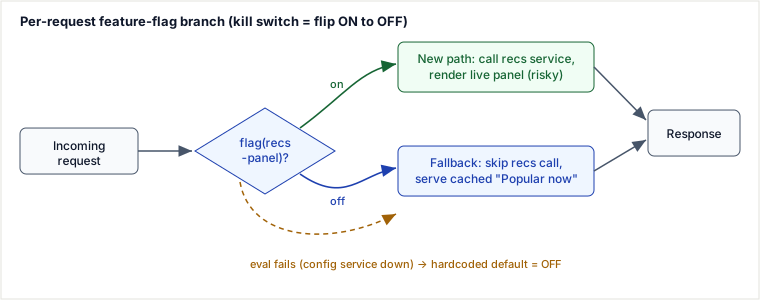
The load-bearing detail is the amber dashed arrow: what the code does when the flag evaluation itself fails. Naively reading a flag makes the remote config service a new single point of failure — if it is slow or down, every request throws, and the tool you added to protect availability now destroys it. The fix is to fail open to a hardcoded safe default (here, treat unknown as OFF = the proven fallback path):
// Correct: an unexpected error can never break the request path
boolean showRecs;
try {
    showRecs = flags.boolVariation("recs-panel", user, /* default */ false);
} catch (Exception e) {
    showRecs = false;              // config service down -> serve fallback
    log.warn("flag eval failed, using safe default", e);
}
return showRecs ? renderWithRecs(user) : renderCachedPopular();
Why the naive version is wrong. Writing boolean showRecs = flags.boolVariation("recs-panel", user); with no default and no try/catch means a flag-service outage propagates an exception up the request path and returns HTTP 500 to every user. You have coupled 100% of traffic to the availability of a config lookup that was supposed to be an optional convenience. Every SDK worth using (LaunchDarkly, Unleash, OpenFeature) takes a default argument for exactly this reason — the flag value is best-effort, the default is the contract.
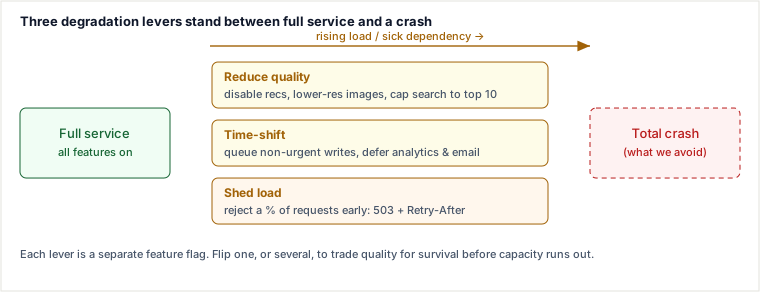
Worked example: recommendations panel on Black Friday
An e-commerce product page renders a Recommended for you panel by calling a recs microservice synchronously during page render. The call sits behind flag recs-panel (default OFF). Watch what the kill switch buys you as traffic goes 4x:
| Time | Signal | Action | Result |
|---|---|---|---|
| 20:00 | recs p99 = 120 ms · page p99 = 400 ms · error 0.2% · traffic 1x | steady state, flag ON | healthy |
| 20:42 | traffic 4x · recs p99 = 2,800 ms · page p99 = 3,900 ms (render blocks on recs) · error 6% · checkout conversion falling | — | page becoming unusable |
| 20:43 | alert: page p99 > 2 s sustained 60 s | on-call paged | — |
| 20:44 | — | flip recs-panel → OFF in dashboard | render skips recs call, serves cached "Popular now" |
| 20:45 | page p99 = 520 ms · error 0.4% · checkout healthy | watch, then investigate recs offline | store stays open through the peak |
Why the flag wins on MTTR. The alternative recovery paths are far slower for the same fix: a code rollback through CI/CD is typically 25–40 minutes (build, test, canary, promote); scaling the recs service adds nodes but the render path is still coupled to a sick dependency, so it may not help within the peak. The flag flip took the failing call out of the critical path in about a minute — degradation (no recs panel) instead of a store-wide outage. That gap between seconds and tens of minutes, multiplied across incidents, is the whole reason flags are treated as an availability tool, not just a release tool.
Pitfalls
- The flag service becomes a new single point of failure. No hardcoded default + no try/catch = a config-service blip 500s every request. Always fail open to a safe default and cache the last-known-good ruleset locally so a network partition can't take you down.
- Evaluating flags on the hot path adds latency and coupling. A synchronous network call to the flag provider per request is itself a dependency to degrade. Use an SDK that streams updates and evaluates in-process from a local cache; never block the request on a live fetch.
- The fallback path rots because it's never exercised. If the flag has been ON for a year, the OFF branch may no longer compile against the current schema — and it 500s the one time you flip it. Test both branches in CI and rehearse kill switches in game days.
- Naive shedding triggers a retry storm. Returning a bare 500 makes clients retry immediately, adding more load. Shed cheaply and early (at the edge, before expensive work), return
503withRetry-After, and require client backoff so shedding actually reduces the arrival rate. - Degrading a write silently loses data. Time-shifting reads is safe; "time-shifting" a write into an unbounded queue that later overflows, or dropping it as "non-essential," loses orders. Distinguish shed-reads (fine) from shed-writes (needs a durable buffer and a drain plan).
- Auto-flip flapping. A monitoring-triggered toggle that flips at exactly the threshold oscillates on/off near the boundary. Add hysteresis (trip at 5%, reset at 1%) and a cooldown before it can flip back.
- Flag debt. Stale kill switches accumulate; someone deletes the wrong one, or two flags interact unexpectedly. Govern lifecycles, tag long-lived operational flags distinctly from release flags, and document what each kill switch degrades.
When to use it — and when not
Reach for graceful degradation + a kill-switch flag when failures are expected and load- or dependency-driven (traffic spikes, a flaky downstream, a costly feature you can shed), and you can define an acceptable reduced experience the user will tolerate. The concrete signals: a feature is on the critical render/response path but is not itself critical; you have a cheaper fallback you can pre-build; and you need recovery measured in seconds by a human on-call.
Trade-offs vs. named alternatives:
- vs. an automated circuit breaker (resilience4j / Hystrix). A breaker trips automatically on a downstream call's error rate — no human, per-dependency, self-resetting. It reacts faster than a person and needs no dashboard, but it can only respond to a measurable failure of a specific call; it can't express product judgment like "shed recs to save CPU even though recs is technically up," and it flaps without tuning. Choose the flag when you want a manual/ops lever or a product-level toggle; choose the breaker for automatic protection of one sick downstream. In practice you use both — the flag is the coarse manual master switch over the breaker's fine automatic one.
- vs. redeploy/rollback. Rollback needs no runtime flag infra and leaves no flag debt, but MTTR is minutes-to-hours and it's all-or-nothing. Choose it only when the change wasn't put behind a flag, or flag infra is unavailable.
- vs. full redundancy / fault tolerance (active-active, hot standby). Redundancy hides failure with zero quality loss but costs 2x+ and — crucially — does nothing for overload (every replica saturates together) or a bad deploy (shipped to all replicas). Choose redundancy for hardware/AZ loss of a stateless-ish tier; choose degradation for overload, sick dependencies, and cost control.
Choose graceful degradation + flags when failures are expected/load-driven and a reduced experience is acceptable and cheap to build. Prefer full redundancy when even brief quality loss is unacceptable and budget allows. Prefer an automated circuit breaker when the trigger is a clear, measurable downstream-call failure and you want the reaction to be automatic rather than a human flipping a switch.
Takeaways
- Graceful degradation spends a scarce resource only on the critical path by choosing what to drop — reduce quality, time-shift, or shed load — instead of letting everything fail together; it answers overload and sick dependencies, which redundancy cannot.
- A feature flag is a per-request branch, so flipping it is a seconds-scale manual circuit breaker over any code path — that MTTR (seconds vs. a 25–40 min rollback) is why flags are an availability tool, not just a release tool.
- The one rule that makes flags safe: always fail open to a hardcoded default, or the flag service becomes the very outage it was meant to prevent.
- Pre-build and regularly exercise the fallback path, shed with
503/backoff not bare errors, and govern flag lifecycles — an untested degraded mode is a latent outage.
Sources: Michael Nygard, Release It! (2nd ed.) — stability patterns: Circuit Breaker, Fail Fast, Bulkhead, and graceful degradation under load; Google, Site Reliability Engineering — "Handling Overload" and "Addressing Cascading Failures" (load shedding, graceful degradation, retry amplification); Martin Fowler, "Feature Toggles (aka Feature Flags)" — release vs. ops toggles and long-lived kill switches; LaunchDarkly and Unleash documentation on operational flags, kill switches, and safe-default evaluation; OpenFeature spec on default values. Re-authored/Deepened for this guide.
🤖 Don't fully get this? Learn it with Claude
Stuck on What Is Graceful Degradation, and How Do Feature Flags Help Availability? Open Claude, copy a block below, and it'll teach you this exact concept — visually and interactively.
Build the mental picture, not memorization.
I just read a lesson on **What Is Graceful Degradation, and How Do Feature Flags Help Availability** (System Design) and want to truly understand it. Explain What Is Graceful Degradation, and How Do Feature Flags Help Availability from first principles using ONE vivid real-world analogy and a visual mental model — draw it as ASCII art or a clear step-by-step diagram — with a concrete example using real numbers. Then ask me one question to check I got the mental picture, and wait for my reply. If you're unsure or a claim isn't standard, say so and reason from first principles instead of guessing.
Socratic — adapts to where you're stuck.
Teach me **What Is Graceful Degradation, and How Do Feature Flags Help Availability** interactively. Ask me ONE guiding question at a time, wait for my answer, and adapt to my confusion — build the idea with me step by step instead of explaining it all at once. If you're unsure or a claim isn't standard, say so and reason from first principles instead of guessing.
Active recall exposes what you missed.
Quiz me on **What Is Graceful Degradation, and How Do Feature Flags Help Availability** with 5 questions, easy to tricky, ONE at a time. Tell me if each answer is right; at the end, explain clearly what I got wrong and why. If you're unsure or a claim isn't standard, say so and reason from first principles instead of guessing.
Intuition + hook + flashcards for long-term memory.
Help me remember **What Is Graceful Degradation, and How Do Feature Flags Help Availability** for the long term: give the one-sentence intuition, a memorable hook/mnemonic, a tiny worked example, and 3 active-recall flashcards (Q -> A). If you're unsure or a claim isn't standard, say so and reason from first principles instead of guessing.