Scalable Systems Advanced — Workload Identity, QUIC Under Loss, Late-Data Handling & Burn-Rate Alerting (Deep Dive)
Four scale-and-failure drills a senior engineer is expected to reason about live
Each of the four topics on this page is a place where a system that works fine at low scale or under happy-path conditions develops a distinct, well-understood failure mode once traffic, loss, or lateness cross a threshold. They are unrelated on the surface — identity bootstrapping, transport-layer loss recovery, event-time correctness, and alerting math — but they share the same interview shape: state the mechanism, trace what breaks, then show the fix. This page consolidates four such drills and cross-references three existing deep pages on this guide rather than re-deriving them: the TLS/mTLS handshake page and the encryption deep-dive already cover certificate mechanics and cert-lifecycle failure modes in full; the networking-at-scale page already covers QUIC's complete limits list; the burn-rate-alerting page already derives the multi-window multi-burn-rate arithmetic end to end. What follows is new material this guide didn't yet have — the secret-zero attestation bootstrap, the late-data handling toolkit for stream processing, and the "why two windows" intuition layer — plus the minimum restatement needed to connect them.
1. Workload identity and the secret-zero problem
mTLS (covered step by step on this guide's TLS & mTLS handshake page) assumes every service already holds a certificate and a private key. That assumption hides a bootstrapping puzzle: the very first time a brand-new service instance starts, it has no credential at all. Someone has to give it one. The naive answer — bake an API key or a pre-shared secret into the container image, a config file, or an environment variable — creates what practitioners call secret zero: a credential that must itself be protected, distributed, and rotated, but which exists before any identity or access-control system is in place to do any of that. It is baked in at build time, checked into some pipeline, and now every copy of that image is an equally valid holder of it forever, with no cryptographic way to tell which copy is the legitimate one. The problem is circular by construction: you need a secret-management system to protect secret zero, but a secret-management system needs its own secret zero to authenticate callers.
How SPIFFE/SPIRE-style attestation dissolves the circularity
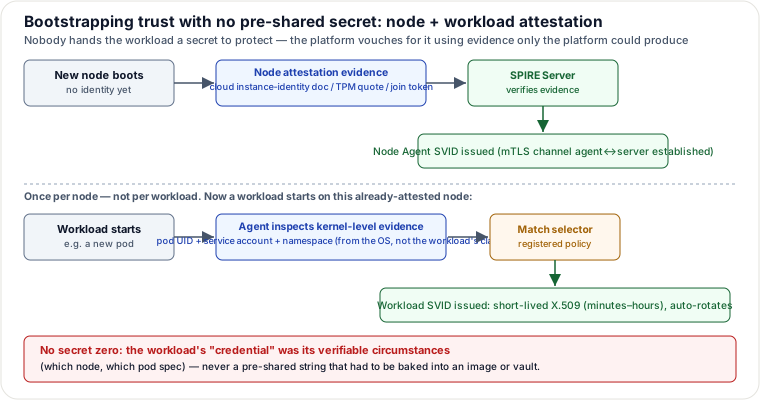
The fix is to stop trying to give the workload a secret to keep, and instead have the platform — something already trusted, because it controls the hardware or the orchestrator — vouch for the workload's identity using evidence the platform can observe directly, that the workload itself cannot fake. This is called attestation, and it happens in two stages:
- Node attestation (once per node). When a new node joins the fleet, its local agent presents evidence that only a legitimate node in this environment could produce — a cloud provider's signed instance-identity document, a hardware TPM quote, or a one-time join token handed out by the platform team. A central attestation authority (SPIRE Server, in the SPIFFE/SPIRE reference implementation) verifies that evidence and, if it checks out, issues the node's agent a credential and establishes a secure channel to it.
- Workload attestation (once per workload, on that already-attested node). When a process starts on the node, the local agent does not ask the workload to prove who it is by presenting something the workload holds — instead the agent reads unforgeable facts about the workload directly from the kernel and the orchestrator: which pod UID, which Kubernetes service account, which namespace, which container image digest launched this specific process. Those facts are matched against a registration policy (a selector) that says, in effect, "anything running as service account
ledger-sain namespaceprodisledger-svc." If the match succeeds, the agent requests — and the server issues — a short-lived identity document for that workload: an SVID (SPIFFE Verifiable Identity Document), typically a short-lived X.509 certificate (minutes to hours) bound to a URI likespiffe://prod.internal/ns/prod/sa/ledger-sa.
No pre-shared secret was ever created, distributed, or baked into anything. The workload's "credential" is the fact that it is genuinely running on this node, launched by this orchestrator, under this service account — evidence the platform is positioned to observe directly and the workload cannot forge, because it comes from the kernel/orchestrator layer beneath the workload's own control, not from a claim the workload makes about itself.
Traced example: a payment-svc instance getting its first identity, end to end
| Step | What happens |
|---|---|
| 1 | A cluster autoscaler boots a fresh node with zero pre-installed application secrets. A SPIRE Agent starts on it. |
| 2 | The agent fetches the cloud provider's signed instance-identity document for this exact VM/instance and presents it to the SPIRE Server as node attestation evidence. |
| 3 | The server checks the document's signature against the cloud provider's public key and confirms the instance is real and currently running — the node is now attested, once, and an mTLS channel between this agent and the server is established using a node-scoped SVID. |
| 4 | The scheduler places a new payment-svc pod on this node, running under Kubernetes service account payment-sa in namespace prod. |
| 5 | The local agent observes this directly from the kubelet/container runtime — pod UID, service account, namespace, container image digest — none of it supplied by the pod itself. |
| 6 | The agent matches those facts against a registered selector: "service account payment-sa in namespace prod → identity spiffe://prod.internal/ns/prod/sa/payment-sa." |
| 7 | The SPIRE Server issues a short-lived X.509 SVID for that identity over the already-secured agent↔server channel. payment-svc now holds a real certificate and private key, generated on the node, never transmitted from anywhere else. |
| 8 | payment-svc uses that SVID to run the ordinary mTLS handshake (CertificateVerify + chain validation, as traced on this guide's mTLS handshake page) with ledger-svc. Total secrets shipped in a config file, image, or vault entry to make this happen: zero. |
What the certificate proves, and the operational reality of running this at scale
Once issued, the SVID is an ordinary X.509 certificate and the rest is exactly what this guide's mTLS handshake page already derives: presenting a certificate proves nothing by itself (a certificate is public data), and the actual proof of identity is the CertificateVerify signature over the handshake transcript, made with the private key that never left the workload's node — that, plus the CA's signature binding the public key to the SPIFFE ID, is what a valid mutual handshake establishes. This page does not re-derive that mechanism; see the mTLS handshake page for the full step-by-step trace.
What attestation changes operationally is worth naming directly, because it is the part interviewers probe next: short-lived SVIDs (minutes to hours) make revocation nearly moot, since a compromised credential simply expires soon regardless of whether anyone notices the compromise — which is exactly why, in practice, the overwhelming share of production mTLS incidents trace back to certificate expiry, a missed or failed rotation, or a revocation gap, not a cryptographic break of TLS itself. Attestation does not remove that risk category, it relocates it: instead of "did we remember to rotate this cert," the operational question becomes "is the SPIRE Server/attestation control plane itself healthy," because if it has an outage, no new or renewed SVIDs can be issued, and every workload's existing (short-lived) SVID quietly expires on schedule regardless — turning a control-plane outage into a mesh-wide authentication outage on a delay equal to the SVID TTL. Attestation infrastructure is now a tier-0 dependency and needs to be operated, monitored, and capacity-planned like one.
2. QUIC under loss and congestion — the scale/failure drill
QUIC's pitch rests on two mechanisms working together at connection setup and during transmission:
- 0-RTT/1-RTT connection setup. QUIC folds the transport and TLS 1.3 handshakes into a single round trip (1-RTT for a new connection; 0-RTT for a returning client resuming a previous session, sending application data in its very first flight), versus TCP+TLS 1.3's own separate handshakes stacking sequentially.
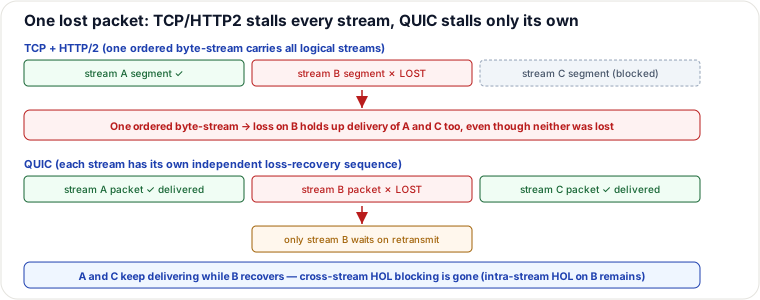
- No cross-stream head-of-line blocking. Each QUIC stream gets its own independent loss-recovery sequence, so a lost packet blocks delivery of only its own stream, not every other stream multiplexed onto the same connection.
The failure contrast is what makes this concrete. Over TCP, HTTP/2 multiplexes many logical streams onto one ordered byte-stream at the transport layer: TCP must deliver bytes to the application in the exact order they were sent, so if the segment carrying stream B's data is lost, every byte sent after it — including bytes belonging to streams A and C that arrived intact — sits in the kernel's receive buffer, undelivered, until the lost segment is retransmitted and the stream is back in order. One lost packet stalls the entire connection, not just the stream it belonged to. QUIC's per-stream sequencing means A and C keep flowing to the application the instant they arrive; only B itself waits on retransmission.
Where the win shows up, and where it costs you
Under real, sustained loss, two costs surface that the "no HOL blocking" pitch doesn't advertise. First, per-stream loss recovery has per-stream bookkeeping cost: QUIC tracks acknowledgment and retransmission state independently for every open stream, so a connection multiplexing hundreds of streams under heavy loss is doing proportionally more loss-recovery accounting than one TCP connection doing it once for the whole byte-stream — the isolation that stops cross-stream stalls is not free. Second, QUIC runs in userspace over UDP, so all of that packet parsing, congestion control, and ack processing costs application-level CPU cycles that kernel-offloaded TCP gets for free (often further accelerated by NIC hardware offload); at high packet rates and, especially, at high loss rates where recovery logic runs constantly, this userspace tax is measurable and becomes the actual bottleneck before the network does. This guide's networking-at-scale page covers the complete limits list — intra-stream HOL blocking still existing, QPACK's dynamic-table cross-stream dependency, and 0-RTT's replay exposure — in full; the headline to carry into an interview is: QUIC wins decisively on lossy/variable networks with many independent streams, and loses on low-loss, CPU-constrained, high-throughput paths where kernel TCP is cheaper per byte.
3. Late-data handling in stream processing — what you do besides dropping
A streaming system has two different notions of time for every event: event time (when the event actually happened — a sensor reading's timestamp, a click's timestamp) and processing time (when the system happens to observe and process that event). These diverge constantly in practice — a mobile client buffers events offline and uploads a batch hours later; a network partition delays a partition's events by minutes; a retry re-delivers an event after its window has already been computed. Any windowed aggregation (e.g. "count clicks per 1-minute window") that groups by event time faces an unavoidable question: how long do you wait for more data belonging to a window before you compute and emit its answer?
Watermarks: a heuristic bound on lateness
A watermark is the stream processor's running estimate, expressed as an event-time value, that says "I believe no more data with an event time earlier than this will arrive." When the watermark passes the end of a window, the engine considers that window complete and triggers its result. Watermarks are explicitly a heuristic, not a guarantee — they are usually derived from how far behind the slowest known source appears to be, plus a configured slack — so they can be wrong in either direction: too aggressive, and genuinely late data arrives after the window already fired; too conservative, and results are delayed longer than necessary waiting for stragglers that were never coming.
Allowed lateness, and the three things you can actually do with late data
Because the watermark is a heuristic, production systems (Apache Beam, Flink) add an explicit allowed-lateness grace period: after the watermark passes a window's end and the window fires its first result, the window state is kept around for an additional configured duration, during which further late-arriving data is still accepted and can update the result, rather than being silently discarded the instant the watermark ticks past. Only after allowed lateness itself expires is the window state finally dropped. What happens to data that arrives within that grace window — or after it — is a real design decision with three concrete options, not just "drop it":
- Trigger a late update (retraction/refinement). The engine re-fires the window with a corrected result, and downstream consumers must be able to accept a revision to a value they already received — either by overwriting (if the sink supports upsert/idempotent writes keyed by window) or by emitting an explicit retraction of the old value paired with the new one, so aggregates built on top stay correct.
- Side-output to a dead-letter path. Data that arrives after allowed lateness has fully expired (the window state is already gone, so it truly cannot be incorporated) is routed to a separate output — a dead-letter topic or a "late data" table — rather than being silently discarded, so it remains inspectable, replayable into a batch correction job, or usable for after-the-fact reconciliation and auditing.
- Drop. Genuinely discarding data past the lateness bound is a legitimate choice, but it must be a deliberate one made after weighing correctness needs against unbounded state growth — not the default that happens because nobody configured allowed lateness or a side output at all.
Traced example: a 1-minute window's watermark and late-data timeline
| Wall-clock time | Event arrives, event time | Watermark | What happens to window [10:00, 10:01) |
|---|---|---|---|
| 10:01:02 | event @10:00:45 | 10:00:40 | Window still open, accumulating; event included normally. |
| 10:01:10 | — | 10:01:00 | Watermark passes the window's end (10:01:00) → window fires its first result. |
| 10:01:40 | late event @10:00:58 (delayed by a mobile client) | 10:01:25 | Inside allowed-lateness grace (e.g. 2 minutes past window end) → window state still held → triggers a late update: result is recomputed and a retraction/refinement is emitted downstream. |
| 10:03:30 | very late event @10:00:20 (a retried, delayed batch upload) | 10:03:05 | Past allowed lateness (window state already discarded at 10:03:00) → routed to the dead-letter side-output rather than silently dropped; available for a later reconciliation job. |
Notice the shape: the same lateness (tens of seconds to a couple of minutes, in event time) is handled completely differently depending on when, in wall-clock time, it happens to arrive relative to the watermark and the allowed-lateness deadline — which is exactly why allowed lateness has to be sized deliberately against the real straggler distribution of your sources, not left at a framework default.
4. Multi-window multi-burn-rate alerting — why two windows, and why alert on budget
This guide's burn-rate-alerting page already derives the full arithmetic — error budgets, the burn-rate formula, and the exact multi-window multi-burn-rate (MWMBR) tiers Google's SRE Workbook recommends (14.4× over 1 hour paired with a 5-minute short window to page on acute outages; 6× over 6 hours paired with a 30-minute short window as a slower page-worthy tier; 1× over 3 days paired with a 6-hour short window to file a ticket for a quiet leak). What's worth stating directly is the intuition for why a single threshold can never do this job.
A single fixed alert is forced into one of two failure modes, and there is no setting that avoids both. Set the threshold to catch a genuine outage fast (a short window, a low bar) and you page on every brief, harmless blip that never threatens the monthly budget. Set it to be quiet and only fire on something serious (a long window, a high bar) and a real outage burns most of the budget before the long window has accumulated enough signal to cross the threshold — you catch it, just too late to matter. The reason two tiers running simultaneously resolves this rather than splitting the difference: a fast-burn tier (short window, high multiplier) is sized to catch an acute event — the kind that would exhaust the budget in hours if unaddressed — and pages within minutes of it starting, precisely because it doesn't need to wait for a long window to accumulate. A slow-burn tier (long window, low multiplier) is sized to catch a leak too gradual to ever trip the fast tier's bar, and it is allowed to take longer to fire because a slow leak, by definition, isn't racing toward zero budget in the next hour. Running both is not a compromise between fast and quiet — it is two independently-tuned detectors, each doing the job the other cannot.
The deeper point for an interview: the entire scheme alerts on the rate at which the error budget is being consumed, not on the raw error rate or the raw SLO breach itself. "99.9% breached" is a lagging signal — by the time it's true, the damage inside the current window is already done. Burn rate is a leading signal: it tells you, right now, whether you are on a trajectory to breach the budget before the window closes, which is the only version of this alert that gives on-call enough lead time to act.
Pitfalls
- Treating a hand-rolled shared secret as "good enough for now." Every static credential baked into an image or config is a secret-zero liability from day one — it doesn't become one later when a security review notices it. Attestation-based issuance is the fix at the point of first design, not a retrofit.
- Trusting a workload's self-reported attributes instead of platform-observed evidence. If workload attestation ever accepts something the workload itself asserts (an env var claiming "I am ledger-svc") rather than something the kernel/orchestrator observes independently, the whole scheme degrades back to a forgeable credential.
- Not monitoring the attestation control plane as a tier-0 dependency. Short-lived SVIDs make revocation moot but make control-plane availability critical — an outage there doesn't fail loudly at first, it fails on a delay equal to the SVID TTL, when every workload's cert quietly expires at once.
- Assuming QUIC eliminates head-of-line blocking everywhere. It removes only the cross-stream case; intra-stream blocking on the lost stream itself, and QPACK's shared dynamic-table dependency, both still exist.
- Defaulting to "just drop late data" with no allowed-lateness policy. Silently dropping late-arriving events is a legitimate choice only when made deliberately; left unconfigured, it usually means unbounded state growth was avoided by accident, at the cost of silently wrong aggregates nobody decided to accept.
- Sizing allowed lateness off a framework default instead of the real straggler distribution. A default that's too short discards data a slightly slower upstream would have delivered in time; one that's too long holds window state (memory) far longer than any realistic straggler needs.
- Running only one burn-rate window. A lone long window keeps paging for a stretch after an incident ends, because the trailing window still contains the elevated error period; the short "AND" window is what makes the alert clear promptly once the incident is actually over.
Judgment layer: named-alternative disambiguation
Workload credentials: attestation-issued SVIDs vs static API keys vs cloud IAM instance roles
| Choose… | When | You give up |
|---|---|---|
| SPIFFE/SPIRE-issued SVID | Service-to-service identity across a heterogeneous or multi-cluster fleet; zero-trust posture where "which node/pod launched this" should be the source of truth | Simplicity — you now run and must operate an attestation control plane as a tier-0 dependency |
| Cloud-native IAM instance/pod role (e.g. an instance profile) | Single-cloud, single-orchestrator environments where the cloud provider's own attestation (already built into the platform) is sufficient and a separate identity control plane would be redundant | Portability — identity is tied to that one cloud's attestation and IAM model, not to an open, cross-platform standard |
| Static API key / pre-shared secret | Rarely justified for service identity today; at most, a stopgap for a single low-value internal integration with no better option available yet | Everything: no rotation without a redeploy, a leak is valid until manually revoked, and the credential is secret zero by definition |
Late-data handling: drop vs side-output vs late-update/retraction
| Choose… | When | You give up |
|---|---|---|
| Late update / retraction | Downstream consumers can accept a revised value for a window they already saw (upsert-capable sinks, dashboards that tolerate a corrected number) | Simplicity of "fire once" semantics; every downstream consumer must handle revisions correctly |
| Side-output / dead-letter | Data arrives after window state is already gone, or correctness requires an auditable record of what was excluded, without corrupting already-emitted results | Automatic incorporation — late data needs a separate reconciliation path to actually get used |
| Drop | The lateness is rare and inconsequential to the metric's purpose (e.g. a real-time dashboard where a few-second-stale count is fine) | Completeness — only acceptable when made as a deliberate, sized decision, not a default |
Alerting: burn-rate MWMBR vs a single static threshold
Reuse this guide's burn-rate-alerting page verdict directly: prefer MWMBR whenever a real SLO and a trustworthy SLI exist, because a static threshold is either noisy (pages on blips that don't threaten the budget) or blind to slow leaks — never both safe at once. Keep static thresholds for signals that have no SLO/budget concept at all (disk 90% full, a queue depth, a certificate nearing its own expiry) where "how fast is a budget draining" doesn't apply.
Takeaways
- Secret zero is solved by attestation, not by a better secret: the platform vouches for a workload using evidence it observes directly (node identity documents, kernel-level pod/service-account facts), so no pre-shared credential is ever created — but this makes the attestation control plane itself a tier-0 dependency whose outage fails silently on a delay equal to the SVID TTL.
- QUIC's real win is eliminating cross-stream head-of-line blocking under loss, not head-of-line blocking in general — intra-stream blocking, QPACK's shared-table dependency, and userspace per-packet CPU cost are all real costs that show up specifically under sustained loss and high packet rates.
- Late data in stream processing has three legitimate outcomes — a late update/retraction, a side-output to a dead-letter path, or a deliberate drop — and watermarks plus an explicitly-sized allowed-lateness window are what decide which one applies to any given late event.
- Multi-window multi-burn-rate alerting works because a fast-burn and a slow-burn detector solve different problems simultaneously (catch acute outages in minutes vs. catch quiet leaks over days); the entire mechanism alerts on the rate the error budget is being consumed, a leading signal, rather than on the SLO breach itself, which is always a lagging one.
Related pages
- SLIs, SLOs, SLAs & Error Budgets — the base vocabulary the burn-rate math in this page is built on.
- What Are The Differences Between TCP, UDP, And QUIC, And When Should I Use Each — quick companion to the QUIC-under-loss drill.
- Stateful Stream Processing: Checkpoints, Restart & TTL — companion piece on the stream-processing state this page's late-data handling operates on.
- What Is The Difference Between TLS And MTLS, And When Is MTLS Appropriate For Service‑to‑service Auth — quick companion to the workload-identity/mTLS section.
- Observability & SRE II — SLO Composition, Pipeline Failure Under Load, Latency Burn Rate & SRE Practice (Deep Dive) — deeper SRE practice companion to the burn-rate alerting section.
🤖 Don't fully get this? Learn it with Claude
Stuck on Scalable Systems Advanced — Workload Identity, QUIC Under Loss, Late-Data Handling & Burn-Rate Alerting (Deep Dive)? Open Claude, copy a block below, and it'll teach you this exact concept — visually and interactively.
Build the mental picture, not memorization.
I just read a lesson on **Scalable Systems Advanced — Workload Identity, QUIC Under Loss, Late-Data Handling & Burn-Rate Alerting (Deep Dive)** (System Design) and want to truly understand it. Explain Scalable Systems Advanced — Workload Identity, QUIC Under Loss, Late-Data Handling & Burn-Rate Alerting (Deep Dive) from first principles using ONE vivid real-world analogy and a visual mental model — draw it as ASCII art or a clear step-by-step diagram — with a concrete example using real numbers. Then ask me one question to check I got the mental picture, and wait for my reply. If you're unsure or a claim isn't standard, say so and reason from first principles instead of guessing.
Socratic — adapts to where you're stuck.
Teach me **Scalable Systems Advanced — Workload Identity, QUIC Under Loss, Late-Data Handling & Burn-Rate Alerting (Deep Dive)** interactively. Ask me ONE guiding question at a time, wait for my answer, and adapt to my confusion — build the idea with me step by step instead of explaining it all at once. If you're unsure or a claim isn't standard, say so and reason from first principles instead of guessing.
Active recall exposes what you missed.
Quiz me on **Scalable Systems Advanced — Workload Identity, QUIC Under Loss, Late-Data Handling & Burn-Rate Alerting (Deep Dive)** with 5 questions, easy to tricky, ONE at a time. Tell me if each answer is right; at the end, explain clearly what I got wrong and why. If you're unsure or a claim isn't standard, say so and reason from first principles instead of guessing.
Intuition + hook + flashcards for long-term memory.
Help me remember **Scalable Systems Advanced — Workload Identity, QUIC Under Loss, Late-Data Handling & Burn-Rate Alerting (Deep Dive)** for the long term: give the one-sentence intuition, a memorable hook/mnemonic, a tiny worked example, and 3 active-recall flashcards (Q -> A). If you're unsure or a claim isn't standard, say so and reason from first principles instead of guessing.