hard Shard Keys: many-key skew vs a single hot key
Hashing spreads keys evenly — but a single key still lands on one shard
Sharding splits data across N nodes by a shard key. Hashing that key,
shard = hash(key) mod N, scatters the whole key space uniformly, so many keys land in
roughly equal piles — that is what kills distributional skew and range hotspots. But the
hash of a single key is a single number, so it maps to exactly one shard. Hashing
therefore fixes the many-keys problem and does nothing for a single hot key: the key is the atomic
unit of placement, and no hash function can put one key on two shards. These are two different problems that look
alike, and only one of them is a hashing problem.
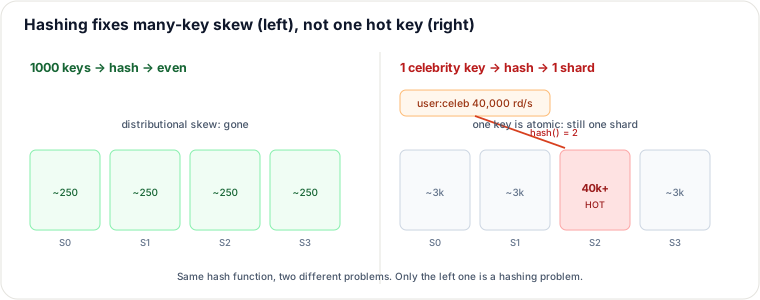
Trace it: 1000 even keys vs one celebrity
Four shards S0–S3, keys placed by hash(key) mod 4.
Case 1 — many keys, distributional skew
1000 keys, each read ~40 times/sec (40,000 reads/sec total, evenly across keys). A good hash spreads them
~250 keys per shard, so each shard serves ~10,000 reads/sec. Balanced — hashing did its job.
(Had we used the raw key prefix as the shard, all user:1… keys could pile on one shard;
hashing is precisely the fix for that.)
Case 2 — one hot key
Now a hot-skew workload where one celebrity key user:celeb takes 40,000/s on
its own while the other 999 keys add ~3k/s per shard on top. hash("user:celeb") mod 4 = 2. Shard 2
now eats 40,000 reads/sec; S0, S1, S3 sit near-idle. Rehashing, a bigger hash, more shards —
none help, because every one of them still sends this one key to exactly one shard. This is the identical mechanism
behind a rate-limiter hot key (one celebrity tenant’s INCRs hammering one Redis
slot): sharding distributes many keys, never one hot key.
The only things that fix a single hot key
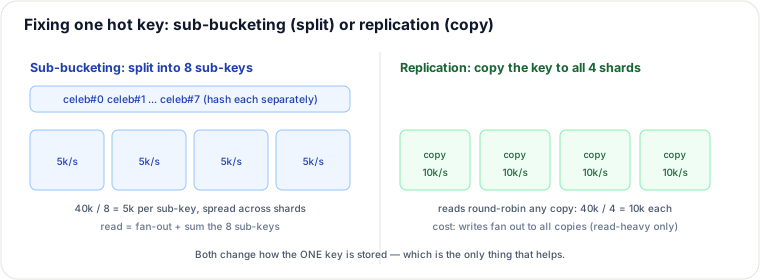
Sub-bucketing — split the key into N sub-keys
Replace user:celeb with user:celeb#0 … user:celeb#7. Each sub-key hashes
independently, so the 40,000/s spreads to ~5,000/s across (up to) 8 shards. A read fans out to all 8 sub-keys and
combines them (sum a counter, or pick any replica for a value). Cost: every read is now an
N-way fan-out and N× the storage; an exact single-key atomic operation is lost (you aggregate). This is the
same sub-counter trick used to defuse rate-limiter hot keys.
Replication — copy the hot key to several shards
Keep one logical key but store R copies, one per shard, and route reads round-robin: 40,000/s ÷ 4 = 10,000/s each. Cost: every write must fan out to all R copies and they can be briefly inconsistent — so replication of a hot key suits read-heavy keys (a trending post, a config blob), not write-hot ones.
Resharding cost — why the hash scheme matters when N changes
Adding a shard exposes the second big difference between hashing schemes. With plain modulo
hashing, changing mod 4 to mod 5 remaps almost every key: a key stays put only when
hash mod 4 == hash mod 5, which (over one period of 20) happens for just 4 of 20 residues — so
~80% of all keys move, a data-migration storm that can saturate the cluster.
Consistent hashing (with virtual nodes) instead places shards and keys on a ring; adding the 5th
shard only steals the arc that now falls to it, moving about 1/5 ≈ 20% of keys. Same
resharding, 4× less movement — and vnodes keep that movement even instead of dumping it all on one
neighbor.
| Scheme | 4→5 shards: keys moved | Why |
|---|---|---|
hash mod N | ~80% | changing the modulus reshuffles nearly every assignment |
| consistent hashing + vnodes | ~20% (≈ 1/(N+1)) | only the arc reassigned to the new node moves |
Pitfalls
- Believing a bigger cluster fixes a hot key. Adding shards redistributes different keys; the hot one is still on one shard. The counting/storage scheme for that key must change.
- Hash sharding then expecting cheap range scans. Hashing destroys key order, so
WHERE ts BETWEEN a AND bmust scatter-gather across all shards. - Low-cardinality or correlated shard key. Sharding on
countryor a monotoniccreated_atrecreates skew/hotspots even with hashing on a bad key — choose a high-cardinality key. - Modulo hashing in a system that will grow. You will pay an 80%-migration bill the first time you add a node. Reach for consistent hashing up front if N will change.
Judgment — two decisions, kept separate
Hash sharding vs range sharding
Hash sharding gives even load and kills hotspots for many keys, but scatters ordered data, so range queries fan out to every shard. Range sharding keeps contiguous key ranges on a shard, so range scans and “latest N” are cheap and local — but a hot range (today’s date, an auto-increment tail) concentrates on one shard, and you must actively split/rebalance ranges as they grow. Choose hash when access is point-lookup and even load matters; choose range when workloads are range-scan heavy (time series, analytics) and you can manage the rebalancing and tail hotspot.
Many-key skew (hashing fixes) vs single hot key (bucketing/replication fixes)
Diagnose which problem you have before reaching for a tool. Uneven load across many keys is a hashing / shard-key-choice problem — fix the shard key. Load concentrated on one key is not a hashing problem — hashing cannot split one key — so fix it with sub-bucketing (near-exact, costs a read fan-out) or replication (cheap even reads, costs write fan-out and works only for read-hot keys). Using the wrong lever — resharding to fix a hot key — is the classic wasted migration.
Takeaways
- Hashing the shard key fixes many-key skew and range hotspots; it cannot touch a single hot key, which always hashes to one shard.
- A single hot key is fixed only by changing how that key is stored: sub-bucketing (split into N sub-keys, aggregate on read) or replication (copy across shards, read-heavy only).
- Resharding cost depends on the scheme:
mod Nmoves ~80% of keys on a resize; consistent hashing + vnodes move only ~1/(N+1). - Hash vs range sharding trades even load (no range scans) against cheap range scans (but hot-range/rebalance risk).
Sources: DDIA (Kleppmann) ch.6 on partitioning, skew and hot spots; the Dynamo paper and Karger et al. on consistent hashing with virtual nodes; production write-ups on hot-key mitigation. See also: Rate-Limit Hot Keys (sub-counter sharding & local pre-aggregation), Consistent Hashing, and Cache Stampede. Re-authored/Deepened for this guide.
🤖 Don't fully get this? Learn it with Claude
Stuck on Shard Keys: many-key skew vs a single hot key? Open Claude, copy a block below, and it'll teach you this exact concept — visually and interactively.
Build the mental picture, not memorization.
I just read a lesson on **Shard Keys: many-key skew vs a single hot key** (System Design) and want to truly understand it. Explain Shard Keys: many-key skew vs a single hot key from first principles using ONE vivid real-world analogy and a visual mental model — draw it as ASCII art or a clear step-by-step diagram — with a concrete example using real numbers. Then ask me one question to check I got the mental picture, and wait for my reply. If you're unsure or a claim isn't standard, say so and reason from first principles instead of guessing.
Socratic — adapts to where you're stuck.
Teach me **Shard Keys: many-key skew vs a single hot key** interactively. Ask me ONE guiding question at a time, wait for my answer, and adapt to my confusion — build the idea with me step by step instead of explaining it all at once. If you're unsure or a claim isn't standard, say so and reason from first principles instead of guessing.
Active recall exposes what you missed.
Quiz me on **Shard Keys: many-key skew vs a single hot key** with 5 questions, easy to tricky, ONE at a time. Tell me if each answer is right; at the end, explain clearly what I got wrong and why. If you're unsure or a claim isn't standard, say so and reason from first principles instead of guessing.
Intuition + hook + flashcards for long-term memory.
Help me remember **Shard Keys: many-key skew vs a single hot key** for the long term: give the one-sentence intuition, a memorable hook/mnemonic, a tiny worked example, and 3 active-recall flashcards (Q -> A). If you're unsure or a claim isn't standard, say so and reason from first principles instead of guessing.