hard Message Ordering: In-Order Retries & Reconstructing Global Order
The order you think you get is not the order you're guaranteed
A distributed queue or stream (Kafka, SQS FIFO, Kinesis) only guarantees order within a single partition — never globally across the whole topic. The moment a producer retries a send, or related events land on different partitions, the order a consumer observes can differ from the order events actually happened in, even though each partition, taken alone, still looks perfectly ordered by offset.
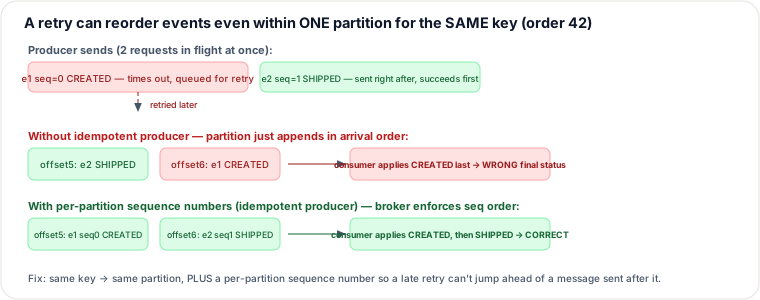
Traced: how the reorder happens
Order 42 emits two events for the same key: e1 = CREATED (sequence 0), then shortly
after, e2 = SHIPPED (sequence 1). The producer has more than one request in flight at once (a common
default for throughput):
e1is sent first, but its acknowledgment is lost to a transient network blip; the producer's client library queues it for retry.e2is sent right after, on a separate in-flight request, and succeeds immediately — it lands at offset 5 of the partition.- The producer retries
e1; it now lands at offset 6 — aftere2. - The consumer reads offset 5 then offset 6, i.e. SHIPPED, then CREATED — the reverse of what actually happened. A consumer that blindly overwrites a status field ends up with the order stuck at "CREATED" when it was really shipped.
Note this happens within a single partition — partitioning by key alone (see Kafka Internals) is not enough to prevent it, because the retry itself is what reorders the log.
Fix (a): partition by key + a per-partition sequence number
Two things have to be true together. First, route by key (e.g. orderId) so every event for one
entity lands on one partition — this is the baseline that gives you any ordering guarantee at all. Second,
attach a monotonically increasing per-key/per-partition sequence number to every send, and have the
broker (or a de-dup layer) reject or re-slot an out-of-order sequence instead of just appending whatever arrives.
Kafka's idempotent producer (enable.idempotence=true) does exactly this: it assigns
each producer a producer ID and a per-partition sequence number, and the broker refuses to accept sequence N+1 until
it has seen sequence N — so a delayed retry can no longer jump ahead of a message sent after it. This is the fix
traced in the diagram above.
Fix (b): reconstructing a trustworthy global order
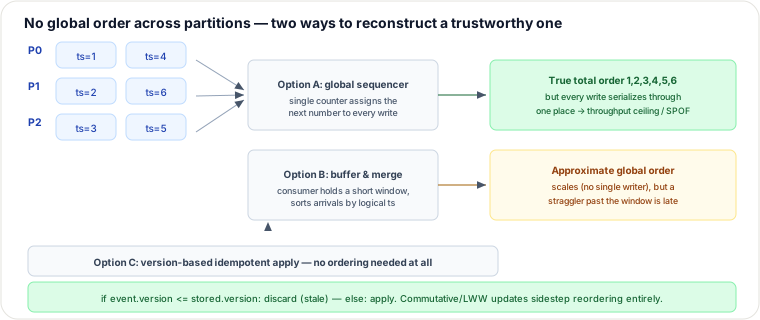
Partitioning solves ordering within a key, but many systems also need to know the order of events across keys/partitions — e.g. merging per-user event streams into one global audit log. There is no free global order in a partitioned system; you have to build one, and there are three honest ways to do it:
- A monotonic global sequencer: a single service (or a single DB counter/Raft-backed log) hands out the next number to every write before it is partitioned out. Gives a true total order, at the cost of every write funnelling through one place.
- A logical timestamp the consumer merges by: tag each event with a Lamport-style logical clock or a source version at produce time (see Time, Clocks & Ordering for the mechanism); the consumer reads all partitions, holds a short buffer window, and emits events sorted by that timestamp — a k-way merge across partitions. This scales (no single writer) but a straggler that arrives after the buffer window closes is simply late.
- Version-based idempotent apply: skip reconstructing order at all. Each update carries a
version (or is naturally commutative/last-writer-wins), and the consumer applies it directly: if
event.version <= stored.version, discard it as stale; otherwise apply. Correctness no longer depends on delivery order.
Pitfalls
- Assuming "the queue guarantees order" means global order. It guarantees order per partition only — the moment you fan out across partitions or keys, that guarantee stops applying.
- Multiple in-flight requests without idempotence silently reorder retries — even within one partition, as the traced example shows. This is a real, easy-to-miss Kafka producer misconfiguration.
- Reordering by wall-clock timestamp. Clock skew across producers can make an event that truly
happened first look later — use a logical clock or source version, not
System.currentTimeMillis()(see Time, Clocks & Ordering). - Reorder buffers aren't free. A buffer-and-sort consumer adds latency equal to its window, and a straggler arriving after the window closes must still be handled explicitly — discarded, dead-lettered, or the window extended (with a further latency cost).
Judgment layer: which fix for which problem
- Partition by key — use it when per-entity order is all you actually need, which is the overwhelmingly common case (one order's lifecycle, one user's event stream, one device's telemetry). Trade-off vs a global sequencer: no cross-key ordering guarantee at all, and a skewed key distribution creates a hot partition — but it scales with the number of partitions and needs no coordination.
- Global sequencer — use it only when you need a true total order across every entity (a single ledger, a global leaderboard tie-break) and can accept — or invest in making highly available (e.g. a Raft-backed counter) — a single serialization point. Trade-off vs partitioning: correctness of order is absolute, but throughput is capped by that one sequencer and it is a single point of failure unless replicated.
- Version-based idempotent apply — use it when your updates can be made commutative or last-writer-wins safe (most CRUD-style state updates can). Trade-off vs the other two: it sidesteps the ordering problem entirely and scales the best, but it only works when the operation allows it — a pure "append" or "increment" isn't naturally last-writer-wins-safe and still needs real ordering or a CRDT-style merge.
Takeaways
- Partitioned queues/streams guarantee order per partition, never globally — retries and multi-partition fan-out both reorder events a consumer sees.
- Fix per-entity order with partition-by-key plus a per-partition/per-key sequence number (e.g. Kafka's idempotent producer) so a delayed retry can't jump ahead of a later message.
- Reconstruct cross-partition order with a monotonic global sequencer (simple, but a bottleneck/SPOF), a logical timestamp the consumer buffers-and-merges by (approximate, scales), or version-based idempotent apply (no ordering needed at all, if updates are commutative).
- Pick based on what you actually need: per-key order (cheap, common) vs true global order (rare, costly) vs no ordering requirement at all (cheapest, when the data model allows it).
Re-authored for this guide; diagrams hand-authored as SVG. Follows Kafka's idempotent-producer design (KIP-98), Lamport (1978) logical clocks, and standard last-writer-wins/CRDT practice. See also: Kafka Internals — Partitions, Offsets & Consumer Groups; Time, Clocks & Ordering; Idempotency & "Exactly-Once Is a Myth"; Event Delivery Semantics & Dead Letter Queues.
🤖 Don't fully get this? Learn it with Claude
Stuck on Message Ordering: In-Order Retries & Reconstructing Global Order? Open Claude, copy a block below, and it'll teach you this exact concept — visually and interactively.
Build the mental picture, not memorization.
I just read a lesson on **Message Ordering: In-Order Retries & Reconstructing Global Order** (System Design) and want to truly understand it. Explain Message Ordering: In-Order Retries & Reconstructing Global Order from first principles using ONE vivid real-world analogy and a visual mental model — draw it as ASCII art or a clear step-by-step diagram — with a concrete example using real numbers. Then ask me one question to check I got the mental picture, and wait for my reply. If you're unsure or a claim isn't standard, say so and reason from first principles instead of guessing.
Socratic — adapts to where you're stuck.
Teach me **Message Ordering: In-Order Retries & Reconstructing Global Order** interactively. Ask me ONE guiding question at a time, wait for my answer, and adapt to my confusion — build the idea with me step by step instead of explaining it all at once. If you're unsure or a claim isn't standard, say so and reason from first principles instead of guessing.
Active recall exposes what you missed.
Quiz me on **Message Ordering: In-Order Retries & Reconstructing Global Order** with 5 questions, easy to tricky, ONE at a time. Tell me if each answer is right; at the end, explain clearly what I got wrong and why. If you're unsure or a claim isn't standard, say so and reason from first principles instead of guessing.
Intuition + hook + flashcards for long-term memory.
Help me remember **Message Ordering: In-Order Retries & Reconstructing Global Order** for the long term: give the one-sentence intuition, a memorable hook/mnemonic, a tiny worked example, and 3 active-recall flashcards (Q -> A). If you're unsure or a claim isn't standard, say so and reason from first principles instead of guessing.